GS Paper III — Q8
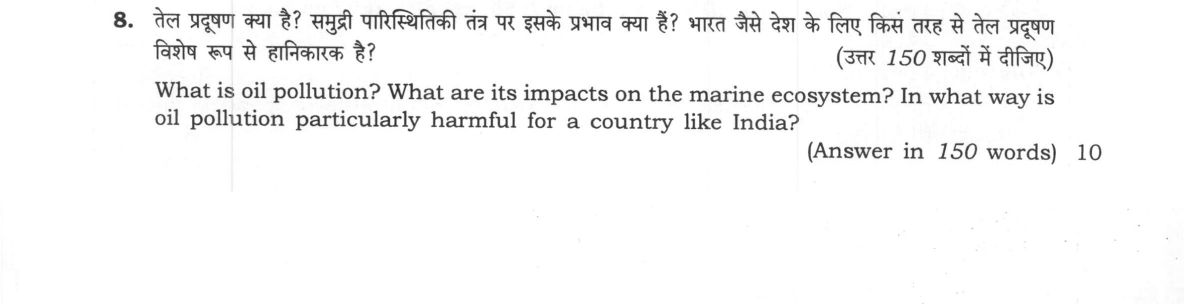
What is oil pollution? What are its impacts on the marine ecosystem? In what way is oil pollution particularly harmful for a…
What is oil pollution? What are its impacts on the marine ecosystem? In what way is oil pollution particularly harmful for a country like India? (Answer in 150 words) 10 marks
हिंदी में प्रश्न पढ़ें
तेल प्रदूषण क्या है? समुद्री पारिस्थितिकी तंत्र पर इसके प्रभाव क्या हैं? भारत जैसे देश के लिए किस तरह से तेल प्रदूषण विशेष रूप से हानिकारक है? (उत्तर 150 शब्दों में दीजिए)
Model answer
Written by UPSC Answer Check against this question's marking rubric, to the 150-word length. UPSC does not publish answers for Mains — this is one way to score well, not an official key.
Oil pollution is the contamination of marine environments by petroleum hydrocarbons, arising from accidental tanker spills, operational ship discharges, runoff, and natural seabed seeps.
Impacts on Marine Ecosystems: Floating oil slicks block sunlight and atmospheric gas exchange, inducing marine hypoxia and halting phytoplankton photosynthesis. Toxic chemical fractions bioaccumulate across trophic levels, causing long-term habitat degradation. Physiologically, oil coats seabird feathers and marine mammal fur, destroying thermal insulation and buoyancy. Ingestion of toxic compounds causes severe internal organ damage and reproductive failure across marine fauna.
Vulnerability for India: With a 7,516 km coastline, 13 major ports, and proximity to high-density Indian Ocean tanker sea lanes, India is acutely vulnerable. Oil spills severely threaten fragile mangrove ecosystems like the Sundarbans and Gulf of Kutch, disrupt ONGC offshore operations, and harm coastal tourism. Crucially, marine pollution imperils the food security and livelihoods of over 4 million coastal fishers.
Strengthening the National Oil Spill Disaster Contingency Plan (NOS-DCP) through the Indian Coast Guard and enforcing MARPOL conventions are essential to secure India's marine ecology.
What "Explain" is asking you to do
Make the working of something clear — what sets it off, what follows from what, and what it produces. Explain is the Commission's mechanism word: it dominates the technical papers and the “explain why” stems, where the marks sit in the causal chain and not in the label.
Structure that answers it
State what it is → the initiating condition → the chain of cause, step by step → an instance where it plays out → what the chain produces
Where marks are lost
Describing what something looks like instead of why it works that way. Naming the stages without linking them reads as description too.
How this answer will be evaluated
Approach
Framework: Environment: threat, causes, impact, mitigation. explain: definition/context > points in order > small example > short close Full marks: Precise definition, specific marine impacts, and detailed India-specific analysis with examples.
Key points expected
- Define oil pollution (hydrocarbon contamination)
- Marine impacts: oxygen depletion, food web disruption
- India-specific harm: coastal livelihoods, fisheries
- Mention specific Indian context (e.g., Mumbai, Chennai)
Evaluation rubric
Each sub-part is marked on its own, against the marks and word limit printed on the paper.
- The answer Define oil pollution, detail marine ecosystem impacts, and analyze specific harm to India. 10 marks · 150 words
explain— definition/context → points in order → small example → short close
Must cover
- Define oil pollution (hydrocarbon contamination)
- Marine impacts: oxygen depletion, food web disruption
- India-specific harm: coastal livelihoods, fisheries
- Mention specific Indian context (e.g., Mumbai, Chennai)
Loses marks
- Generic environmental writing without India focus
- Ignoring the 'marine ecosystem' specific impacts
- Aspirational solutions without implementation details
Earns more
- Mention specific species (e.g., Olive Ridley)
- Reference to specific spill (e.g., 2020 Mumbai)
- Mention economic loss in crores
- Reference to National Disaster Management Authority
Extra mark
- Mention specific cleanup technology (e.g., bioremediation)
- Reference to specific legal act (e.g., Environment Protection Act)
Practice this exact question
Write your answer and it is marked point by point against the model answer above — what you covered, what you missed, what you got wrong.
Evaluate my answer →More from General Studies 2023 GS Paper III
- Q5 Introduce the concept of Artificial Intelligence (AI). How does AI help clinical diagnosi…
- Q6 Discuss several ways in which microorganisms can help in meeting the current fuel shortag…
- Q7 Dam failures are always catastrophic, especially on the downstream side, resulting in a c…
- Q8 What is oil pollution? What are its impacts on the marine ecosystem? In what way is oil p…
- Q9 Winning of 'Hearts and Minds' in terrorism-affected areas is an essential step in restori…
- Q10 The use of unmanned aerial vehicles (UAVs) by our adversaries across the borders to ferry…
- Q11 Most of the unemployment in India is structural in nature. Examine the methodology adopte…