GS Paper I — Q20
Critically analyse the proposition that there is a high correlation between India's cultural diversities and socio-economic…
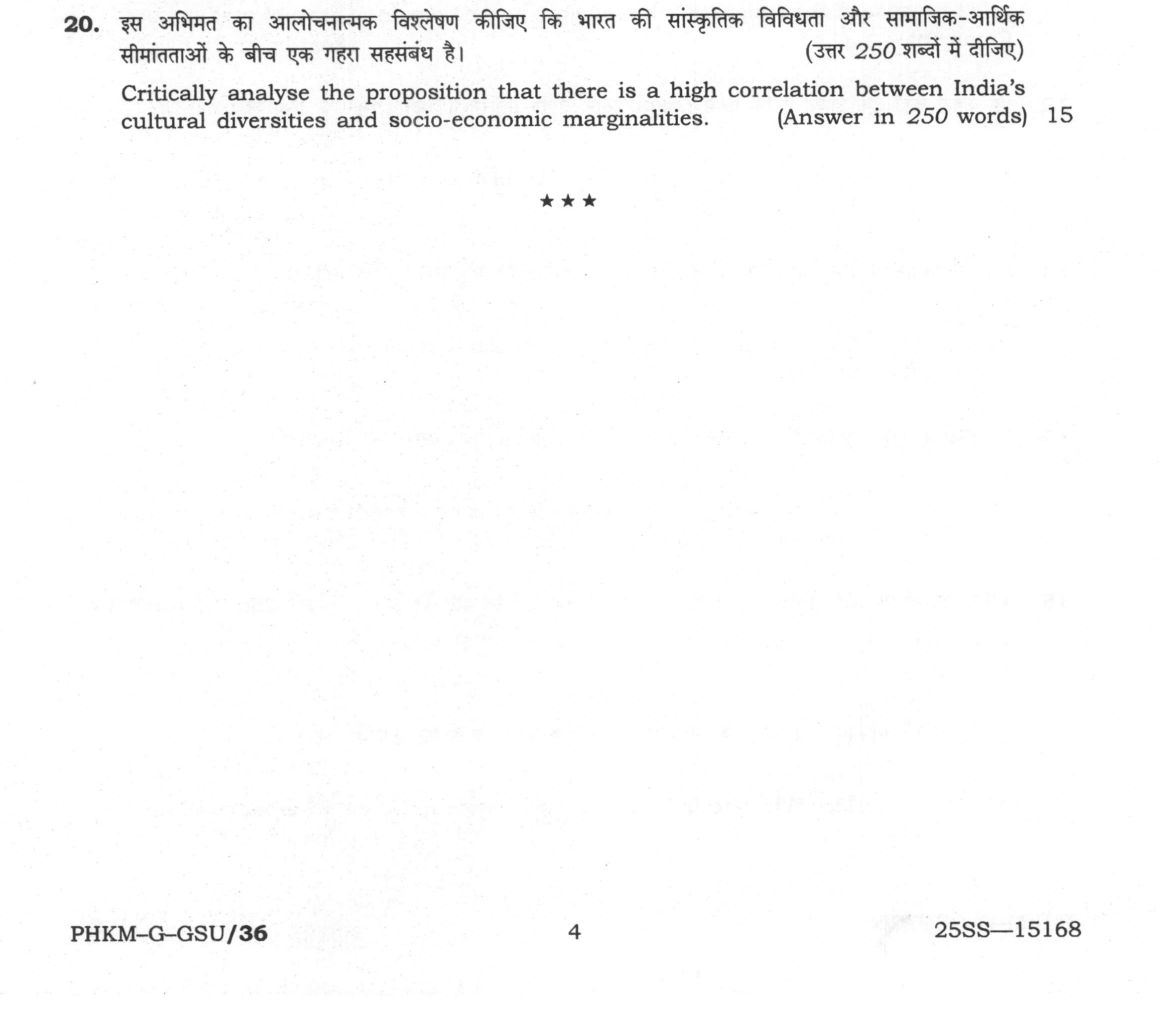
Critically analyse the proposition that there is a high correlation between India's cultural diversities and socio-economic marginalities. (Answer in 250 words) 15 marks
हिंदी में प्रश्न पढ़ें
इस अभिमत का आलोचनात्मक विश्लेषण कीजिए कि भारत की सांस्कृतिक विविधता और सामाजिक-आर्थिक सीमांतताओं के बीच एक गहरा सहसंबंध है। (उत्तर 250 शब्दों में दीजिए)
Model answer
Written by UPSC Answer Check against this question's marking rubric, to the 250-word length. UPSC does not publish answers for Mains — this is one way to score well, not an official key.
Cultural diversity encompasses linguistic, religious, caste, tribal, and regional pluralities, while socio-economic marginality manifests as structural deficits in income, education, healthcare, and political representation. The proposition of a correlation between the two holds empirical validity in India, though this link is contingent rather than deterministic.
Evidence and Mechanisms of Correlation Cultural distinctiveness often overlaps with socio-economic vulnerability. Scheduled Tribes (Adivasis) in Central India and the Northeast face disproportionate multidimensional poverty, dispossession, and physical isolation. Similarly, caste hierarchies historically institutionalized occupational segregation, leaving Scheduled Castes with persistent deficits in land ownership and social capital.
The primary mechanisms linking diversity to marginality include:
- Structural discrimination and historical exclusion from formal institutions.
- Geographic peripherality limiting access to markets, infrastructure, and administrative delivery.
- Linguistic barriers impeding formal education, legal access, and high-productivity employment.
- A deficit of dominant cultural capital required to compete in modern, urbanized economic systems.
The Counter-Perspective: Decoupling Diversity from Deprivation However, cultural diversity does not intrinsically produce marginality. States like Kerala (with deep religious and caste pluralism) and Punjab demonstrate high human development and economic prosperity, driven by public investments, land reforms, and agrarian growth rather than cultural uniformity. Furthermore, cultural diversity serves as an economic asset through heritage tourism, traditional knowledge systems, and handicraft economies. Socio-economic backwardness is frequently caused by structural governance failures and regional neglect, independent of cultural identity.
Verdict The correlation between cultural diversity and marginality is mediated by state policy and institutional inclusion. Constitutional safeguards like the Fifth and Sixth Schedules, the PESA Act, 1996, and targeted interventions like PM-JANMAN illustrate that marginality declines when institutional mechanisms accommodate distinct identities. India’s policy imperative is to pursue culturally sensitive, decentralized development that prevents diversity from translating into disadvantage.
What "Critically analyse" is asking you to do
Break the subject into its working parts and show how they act on each other. The marks are in the interconnections — which factor drives which, and what the resulting structure explains — not in the inventory of factors. “Critically” is not a section added at the end: name the yardstick you are judging by — the evidence, the stated objective, a constitutional principle, a rival explanation — and let a verdict close each part of the body. Where the question quotes a claim, that verdict must land on the claim itself, accepted, qualified or rejected, and not on the theme in general.
Structure that answers it
Define the whole → separate it into its parts → show which part drives which → what that interaction produces → what the structure implies
Where marks are lost
Merits in one paragraph, demerits in the next, and a conclusion calling for a balanced and holistic approach. That is a survey with the judgement left out and it holds the answer in the middle band. The opposite error is reading “critically” as permission to attack — and with the odd pairings, critically describe or critically explain, the exposition still carries most of the marks, the judgement being a layer on it rather than a substitute for it.
How this answer will be evaluated
Approach
Framework: GS1 Society: Continuity, Data, Intersectionality, Solution. critique: the claim > its strengths > its weaknesses > your judgment Full marks: Rigorous analysis of the correlation mechanism with strong data and critical judgment.
Key points expected
- Define the specific nature of the correlation (positive/negative)
- Explain the mechanism linking cultural identity to economic exclusion
- Provide evidence of intersectionality (caste, religion, region)
- Offer a critical judgment on the proposition's validity
Evaluation rubric
Each sub-part is marked on its own, against the marks and word limit printed on the paper.
- The answer Assess the validity of the correlation between cultural diversity and socio-economic marginality in India. 15 marks · 250 words
critique— the claim → its strengths → its weaknesses → your judgment
Must cover
- Define the specific nature of the correlation (positive/negative)
- Explain the mechanism linking cultural identity to economic exclusion
- Provide evidence of intersectionality (caste, religion, region)
- Offer a critical judgment on the proposition's validity
Loses marks
- Narrating cultural diversity without linking to economic status
- Using emotive language instead of analytical reasoning
- Ignoring the 'critical' aspect by only listing facts
Earns more
- Cite specific data on regional or caste-based disparities
- Discuss the role of historical stratification in current status
- Mention specific marginalized cultural groups (e.g., Adivasis, SCs)
- Reference constitutional safeguards or policy interventions
Extra mark
- Cite specific Census or NSSO data on regional inequality
- Reference a specific Supreme Court judgment on cultural rights
Practice this exact question
Write your answer and it is marked point by point against the model answer above — what you covered, what you missed, what you got wrong.
Evaluate my answer →More from General Studies 2024 GS Paper I
- Q17 What is regional disparity? How does it differ from diversity? How serious is the issue o…
- Q18 Despite comprehensive policies for equity and social justice, underprivileged sections ar…
- Q19 Globalization has increased urban migration by skilled, young, unmarried women from vario…
- Q20 Critically analyse the proposition that there is a high correlation between India's cultu…