GS Paper I — Q8
Distinguish between gender equality, gender equity and women's empowerment. Why is it important to take gender concerns into…
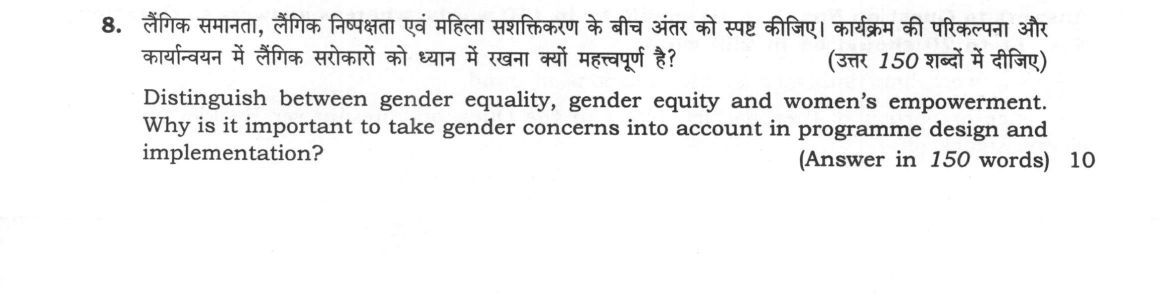
Distinguish between gender equality, gender equity and women's empowerment. Why is it important to take gender concerns into account in programme design and implementation? (Answer in 150 words) 10 marks
हिंदी में प्रश्न पढ़ें
लैंगिक समानता, लैंगिक निष्पक्षता एवं महिला सशक्तिकरण के बीच अंतर को स्पष्ट कीजिए। कार्यक्रम की परिकल्पना और कार्यान्वयन में लैंगिक सरोकारों को ध्यान में रखना क्यों महत्वपूर्ण है? (उत्तर 150 शब्दों में दीजिए)
Model answer
Written by UPSC Answer Check against this question's marking rubric, to the 150-word length. UPSC does not publish answers for Mains — this is one way to score well, not an official key.
Conceptual Distinctions
Gender equality is the state of equal rights, responsibilities, and opportunities for all genders (the ultimate outcome). Gender equity is fairness of treatment through differential measures to compensate for historical disadvantages (the means/substantive equality). Women’s empowerment is the transformative process of expanding agency, decision-making power, and control over resources, distinguishing it as active self-determination rather than passive entitlement. Relational link: equity is the pathway, empowerment is the catalytic process, and equality is the end.
Importance in Programme Design and Implementation
Gender-blind policies risk efficiency losses, perpetuate structural barriers, and cause suboptimal development outcomes. Mainstreaming gender ensures:
- Differential Needs Assessment: Utilising gender-disaggregated data prevents exclusion and enables targeted beneficiary selection.
- Overcoming Practical Constraints: Interventions like MGNREGA mandate equal wages and on-site crèches, ensuring high female participation, while Beti Bachao Beti Padhao applies equity-based targeting to correct skewed sex ratios.
Integrating gender concerns is indispensable for transformative governance and achieving SDG-5 (Gender Equality).
What "Distinguish" is asking you to do
Name the property that separates the items and say which side holds it. Distinguish is marked exactly as differentiate is, with no difference in expectation, but its stems more often line up three terms rather than two — gender equality, gender equity and empowerment — and every pair in the set has to be separated.
Structure that answers it
The category they all sit in → the property dividing the first pair → the second pair → the third → why the boundary matters in practice
Where marks are lost
Separating the two obviously different items and leaving the middle term unplaced. A description of each side from which the line must be inferred is marked as description, not as a distinction.
How this answer will be evaluated
Approach
Framework: GS1 Society: Continuity, data, intersectionality, then solution. compare: paired headings or table > key differences > significance > conclusion Full marks: Clear distinction of all three terms with specific examples and strong justification for mainstreaming.
Key points expected
- Define gender equality as equal rights/status
- Define gender equity as fair distribution of resources
- Define women's empowerment as agency and decision-making
- Explain why gender concerns are needed in programme design
Evaluation rubric
Each sub-part is marked on its own, against the marks and word limit printed on the paper.
- The answer Distinguish three concepts and justify gender mainstreaming in programme design. 10 marks · 150 words
compare— paired headings or table → key differences → significance → conclusion
Must cover
- Define gender equality as equal rights/status
- Define gender equity as fair distribution of resources
- Define women's empowerment as agency and decision-making
- Explain why gender concerns are needed in programme design
Loses marks
- Treating equality and equity as identical
- Vague generalities without specific programme examples
- Ignoring the 'implementation' aspect of the second part
Earns more
- Mention intersectionality (class, caste, region)
- Cite a specific scheme (e.g., MGNREGA, Beti Bachao)
- Distinguish 'sameness' (equality) from 'fairness' (equity)
- Link to Sustainable Development Goals (SDG 5)
Extra mark
- Reference CEDAW or National Commission for Women
- Cite a specific statistic on gender gap
Practice this exact question
Write your answer and it is marked point by point against the model answer above — what you covered, what you missed, what you got wrong.
Evaluate my answer →More from General Studies 2024 GS Paper I
- Q5 Why do large cities tend to attract more migrants than smaller towns? Discuss in the ligh…
- Q6 What is the phenomenon of 'cloudbursts'? Explain. (Answer in 150 words) 10
- Q7 What is the concept of a 'demographic winter'? Is the world moving towards such a situati…
- Q8 Distinguish between gender equality, gender equity and women's empowerment. Why is it imp…
- Q9 Intercaste marriages between castes which have socio-economic parity have increased, to s…
- Q10 In dealing with socio-economic issues of development, what kind of collaboration between…
- Q11 "Though the great Cholas are no more yet their name is still remembered with great pride…