GS Paper III — Q15
The world is facing an acute shortage of clean and safe freshwater. What are the alternative technologies which can solve this…
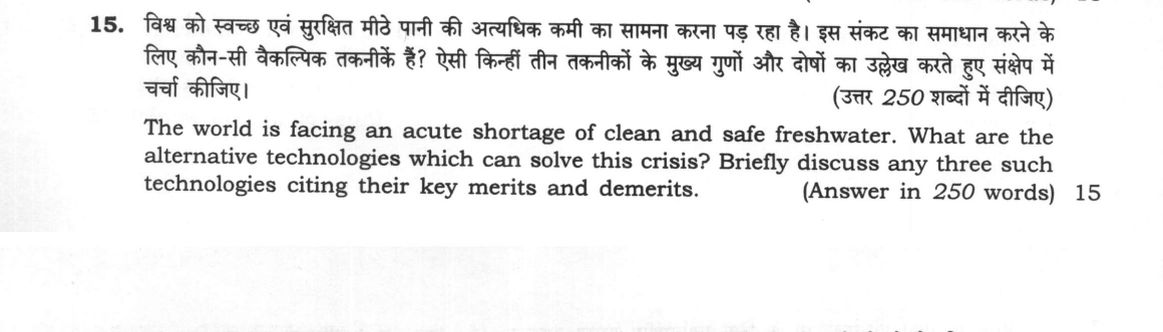
The world is facing an acute shortage of clean and safe freshwater. What are the alternative technologies which can solve this crisis? Briefly discuss any three such technologies citing their key merits and demerits. (Answer in 250 words) 15 marks
हिंदी में प्रश्न पढ़ें
विश्व को स्वच्छ एवं सुरक्षित मीठे पानी की अत्यधिक कमी का सामना करना पड़ रहा है। इस संकट का समाधान करने के लिए कौन-सी वैकल्पिक तकनीकें हैं? ऐसी किन्हीं तीन तकनीकों के मुख्य गुणों और दोषों का उल्लेख करते हुए संक्षेप में चर्चा कीजिए। (उत्तर 250 शब्दों में दीजिए)
Model answer
Written by UPSC Answer Check against this question's marking rubric, to the 250-word length. UPSC does not publish answers for Mains — this is one way to score well, not an official key.
According to NITI Aayog’s Composite Water Management Index, nearly 600 million Indians face high to extreme water stress, reflecting a global freshwater crisis aggravated by climate change and over-extraction. With Central Pollution Control Board (CPCB) data showing severe pollution in major river stretches, alternative water technologies are imperative.
Seawater Reverse Osmosis (SWRO) Desalination Desalination utilizes semi-permeable membranes to convert abundant seawater into potable water. Merits: It provides a climate-resilient, perennial water supply independent of monsoons, as demonstrated by Chennai’s Minjur and Nemmeli desalination plants. Demerits: It is highly energy-intensive, involves steep capital costs, and generates concentrated toxic brine that threatens marine ecosystems upon discharge.
Advanced Wastewater Recycling and Reuse Tertiary treatment through Membrane Bioreactors (MBR) and advanced oxidation purifies municipal and industrial sewage into reusable water. Merits: It fosters a circular economy, lowers freshwater abstraction, and yields dependable supply, successfully illustrated by Surat’s reuse of treated sewage for industrial clusters. Demerits: High installation and operational expenditures, risks of micro-pollutant contamination, and socio-cultural resistance ("toilet-to-tap" taboo) constrain wide adoption.
Modernized Rainwater Harvesting (RWH) and Aquifer Recharge This technology utilizes modular filters, recharge shafts, and injection wells to capture surface runoff and replenish depleted aquifers. Merits: It is decentralized, cost-effective, improves local water tables, and mitigates urban flooding, as mandated across Bengaluru's municipal framework. Demerits: It is inherently dependent on seasonal rainfall patterns and requires rigorous maintenance to prevent groundwater contamination.
A singular technology cannot resolve the water crisis. Sustainable water security demands an Integrated Water Resources Management (IWRM) framework that merges advanced engineering with decentralized conservation, demand-side efficiency, and strict watershed protection.
What "Discuss" is asking you to do
Lay the issue out from more than one side — how it arose, what is claimed for it, what is held against it, and where it now stands. UPSC attaches discuss to broad topics with several live dimensions, so coverage of the dimensions earns more than the strength of your opinion.
Structure that answers it
Set the issue up → the case as it is made → the case against → the dimension both sides leave out → where the balance now lies
Where marks are lost
Listing facts with no thread between them, or arguing one side throughout and calling it a discussion.
How this answer will be evaluated
Approach
Framework: GS3 Environment/Technology: Threat, Causes, Impact, Mitigation. discuss: intro > 3-4 dimensions > example > balanced close Full marks: Three technologies clearly identified with balanced, specific merits and demerits.
Key points expected
- Identify three distinct alternative technologies
- Cite key merits for each technology
- Cite key demerits for each technology
- Briefly discuss the crisis context
Evaluation rubric
Each sub-part is marked on its own, against the marks and word limit printed on the paper.
- The answer Identify and evaluate three alternative freshwater technologies with merits and demerits. 15 marks · 250 words
discuss— intro → 3-4 dimensions → example → balanced close
Must cover
- Identify three distinct alternative technologies
- Cite key merits for each technology
- Cite key demerits for each technology
- Briefly discuss the crisis context
Loses marks
- Listing technologies without merits/demerits
- Aspirational solutions without implementation details
- Ignoring the 'clean and safe' aspect
Earns more
- Mention specific technologies like desalination
- Mention rainwater harvesting or fog harvesting
- Mention wastewater recycling or greywater reuse
- Balanced assessment of cost vs benefit
Extra mark
- Cite a specific current scheme or data point
- Simple flowchart of a water cycle solution
Practice this exact question
Write your answer and it is marked point by point against the model answer above — what you covered, what you missed, what you got wrong.
Evaluate my answer →More from General Studies 2024 GS Paper III
- Q12 What is the need for expanding the regional air connectivity in India? In this context, d…
- Q13 What are the major challenges faced by Indian irrigation system in recent times? State th…
- Q14 Elucidate the importance of buffer stocks for stabilizing agricultural prices in India. W…
- Q15 The world is facing an acute shortage of clean and safe freshwater. What are the alternat…
- Q16 What are asteroids? How real is the threat of them causing extinction of life? What strat…
- Q17 What is disaster resilience? How is it determined? Describe various elements of a resilie…
- Q18 Flooding in urban areas is an emerging climate-induced disaster. Discuss the causes of th…