GS Paper III — Q7
Industrial pollution of river water is a significant environmental issue in India. Discuss the various mitigation measures to…
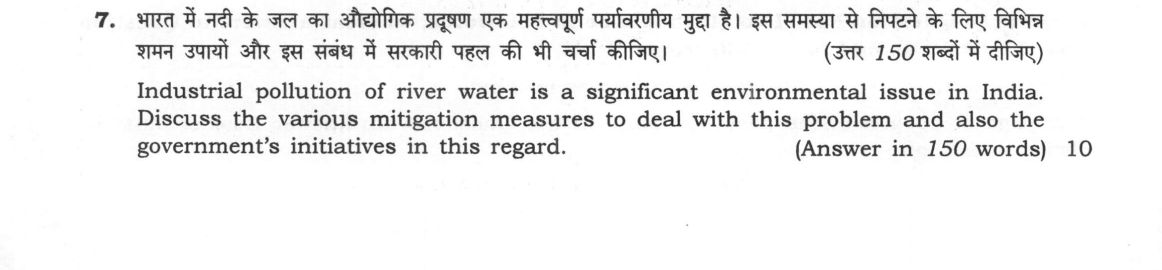
Industrial pollution of river water is a significant environmental issue in India. Discuss the various mitigation measures to deal with this problem and also the government's initiatives in this regard. (Answer in 150 words) 10 marks
हिंदी में प्रश्न पढ़ें
भारत में नदी के जल का औद्योगिक प्रदूषण एक महत्त्वपूर्ण पर्यावरणीय मुद्दा है। इस समस्या से निपटने के लिए विभिन्न शमन उपायों और इस संबंध में सरकारी पहल की भी चर्चा कीजिए। (उत्तर 150 शब्दों में दीजिए)
Model answer
Written by UPSC Answer Check against this question's marking rubric, to the 150-word length. UPSC does not publish answers for Mains — this is one way to score well, not an official key.
Industrial effluents laden with heavy metals and toxic chemicals severely degrade river ecosystems and public health across India.
Mitigation Measures Technological mitigation involves establishing Common Effluent Treatment Plants (CETPs), mandating Zero Liquid Discharge (ZLD), upgrading to tertiary treatment, and installing Online Continuous Effluent Monitoring Systems (OCEMS). Regulators utilize industrial categorization (Red, Orange, Green), enforcement by State Pollution Control Boards (SPCBs), the Polluter Pays Principle, and punitive environmental compensations.
Government Initiatives Key interventions include the Namami Gange Programme steered by the National Mission for Clean Ganga (NMCG), legacy Ganga Action Plans, and the Industrial Pollution Abatement Project (IPAP) to expand dedicated STP-ETP infrastructure. Compliance is reinforced through revised effluent standards (2015) alongside statutory penalties under the Water Act 1974 and Environment (Protection) Act 1986.
Challenges and Way Forward However, implementation deficits, financial unviability of CETPs, unmonitored informal clusters, and poor inter-state coordination persist. Sustained abatement requires adopting circular economy principles, green financing, public-private partnerships, and robust community-led river monitoring.
What "Discuss" is asking you to do
Lay the issue out from more than one side — how it arose, what is claimed for it, what is held against it, and where it now stands. UPSC attaches discuss to broad topics with several live dimensions, so coverage of the dimensions earns more than the strength of your opinion.
Structure that answers it
Set the issue up → the case as it is made → the case against → the dimension both sides leave out → where the balance now lies
Where marks are lost
Listing facts with no thread between them, or arguing one side throughout and calling it a discussion.
How this answer will be evaluated
Approach
Framework: GS3 Environment: threat, causes, impact, mitigation. discuss: intro > 3-4 dimensions > example > balanced close Full marks: Specific legal/institutional measures + named schemes (Namami Gange) + technical solutions
Key points expected
- Legal framework (Water Act, CPCB)
- Institutional measures (CPCB, State Boards)
- Specific government initiatives (Namami Gange, etc.)
- Technical mitigation (Effluent treatment, Zero Liquid Discharge)
Evaluation rubric
Each sub-part is marked on its own, against the marks and word limit printed on the paper.
- The answer Mitigation measures and government initiatives for industrial river pollution 10 marks · 150 words
discuss— intro → 3-4 dimensions → example → balanced close
Must cover
- Legal framework (Water Act, CPCB)
- Institutional measures (CPCB, State Boards)
- Specific government initiatives (Namami Gange, etc.)
- Technical mitigation (Effluent treatment, Zero Liquid Discharge)
Loses marks
- Vague generalities without naming specific laws or schemes
- Ignoring the 'government initiatives' part of the prompt
- Focusing only on causes without mitigation
Earns more
- Mention of specific industrial sectors (tanneries, textiles)
- Reference to judicial interventions (Supreme Court orders)
- Linkage to public health impacts
- Mention of industrial clusters (e.g., Kanpur)
Extra mark
- Specific data on BOD levels or pollution load
- Reference to a specific recent court order or scheme
Practice this exact question
Write your answer and it is marked point by point against the model answer above — what you covered, what you missed, what you got wrong.
Evaluate my answer →More from General Studies 2024 GS Paper III
- Q4 Explain the role of millets for ensuring health and nutritional security in India. (Answe…
- Q5 What is the present world scenario of intellectual property rights with respect to life m…
- Q6 What is the technology being employed for electronic toll collection on highways? What ar…
- Q7 Industrial pollution of river water is a significant environmental issue in India. Discus…
- Q8 What role do environmental NGOs and activists play in influencing Environmental Impact As…
- Q9 Explain how narco-terrorism has emerged as a serious threat across the country. Suggest s…
- Q10 Describe the context and salient features of the Digital Personal Data Protection Act, 20…