GS Paper III — Q19
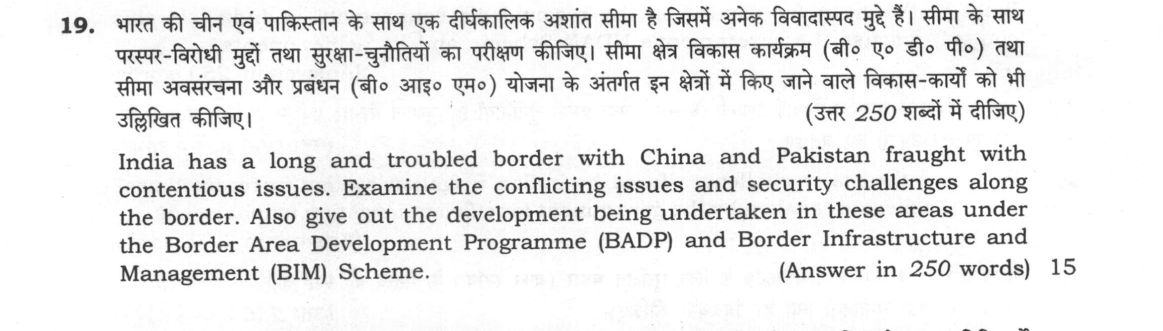
India has a long and troubled border with China and Pakistan fraught with contentious issues. Examine the conflicting issues and…
India has a long and troubled border with China and Pakistan fraught with contentious issues. Examine the conflicting issues and security challenges along the border. Also give out the development being undertaken in these areas under the Border Area Development Programme (BADP) and Border Infrastructure and Management (BIM) Scheme. (Answer in 250 words) 15 marks
हिंदी में प्रश्न पढ़ें
भारत की चीन एवं पाकिस्तान के साथ एक दीर्घकालिक अशांत सीमा है जिसमें अनेक विवादास्पद मुद्दे हैं। सीमा के साथ परस्पर-विरोधी मुद्दों तथा सुरक्षा-चुनौतियों का परीक्षण कीजिए। सीमा क्षेत्र विकास कार्यक्रम (बी० ए० डी० पी०) तथा सीमा अवसंरचना और प्रबंधन (बी० आई० ए०) योजना के अंतर्गत इन क्षेत्रों में किए जाने वाले विकास-कार्यों को भी उल्लिखित कीजिए। (उत्तर 250 शब्दों में दीजिए)
Model answer
Written by UPSC Answer Check against this question's marking rubric, to the 250-word length. UPSC does not publish answers for Mains — this is one way to score well, not an official key.
India’s contested borders with China (3,488 km) and Pakistan (3,323 km) present multifaceted sovereignty and security challenges requiring continuous strategic calibration.
Conflicting Issues and Security Challenges Along the Line of Actual Control (LAC) with China, friction stems from an undelineated boundary, notably regarding Aksai Chin and the McMahon Line. Flashpoints such as Galwan, Pangong Tso, and Depsang illustrate recurrent transgressions. China’s infrastructure asymmetry—marked by dual-use civil-military Xiaokang border villages, high-speed rail, and airbases—threatens India’s operational readiness.
Across the western front, Pakistan sustains cross-border proxy warfare. Challenges include Line of Control (LoC) ceasefire violations, state-sponsored terrorism (seen in Pathankot, Uri, and Pulwama), subterranean infiltration tunnels, fencing gaps in riverine terrain, and an emerging drone-driven narco-terrorism nexus.
Developmental and Infrastructure Interventions To counter these vulnerabilities, India has aligned socio-economic consolidation with hardened physical infrastructure:
Border Area Development Programme (BADP): Implemented across 111 border districts, BADP delivers socio-economic infrastructure including education, healthcare, local roads, mobile connectivity, and skill development. It incorporates a 10% fund flexibility for immediate security-linked village needs, aiming to stem outward migration from strategic frontiers.
Border Infrastructure and Management (BIM) Scheme: With a central allocation of ₹4,800 crore (2021–26), BIM focuses on operational capability. It funds all-weather strategic roads, bridges, helipads, and Border Outposts (BOPs) in high-altitude zones like Ladakh and Arunachal Pradesh. It also deploys technological enablers, including the Comprehensive Integrated Border Management System (CIBMS) and Long-Range Reconnaissance and Observation Systems (LORROS).
Socio-economic development acts as a critical force multiplier. By transforming local populations into the primary "eyes and ears" of security forces and closing tactical mobility gaps, BADP and BIM reinforce India's comprehensive border deterrence posture.
What "Examine" is asking you to do
Test the proposition the question puts to you and return a finding on how far it holds. Examine stems carry a claim, or ask whether something has happened, and expect evidence weighed both ways before the extent is stated — often with remedial measures attached.
Structure that answers it
Restate the claim as the question frames it → evidence that supports it → evidence that undercuts it → the conditions under which it holds → verdict on how far it stands
Where marks are lost
Stopping at description. An examination has to reach a finding, and “examine with justification” means the extent must be stated, not implied.
How this answer will be evaluated
Approach
Framework: Security: classify threat, vulnerability, response; stay calm. examine: intro > how/why with reasoning > evidence > conclusion Full marks: Precise analysis of China/Pak issues with specific BADP/BIM details.
Key points expected
- China border issues (LAC, Aksai Chin, Galwan)
- Pakistan border issues (Line of Control, terrorism)
- BADP scheme objectives and scope
- BIM scheme infrastructure focus
Evaluation rubric
Each sub-part is marked on its own, against the marks and word limit printed on the paper.
- The answer Analyze border conflicts/challenges and detail BADP/BIM development measures. 15 marks · 250 words
examine— intro → how/why with reasoning → evidence → conclusion
Must cover
- China border issues (LAC, Aksai Chin, Galwan)
- Pakistan border issues (Line of Control, terrorism)
- BADP scheme objectives and scope
- BIM scheme infrastructure focus
Loses marks
- Dramatic or emotional security writing
- Vague generalities without naming specific schemes
- Ignoring the developmental aspect of the question
Earns more
- Specific security challenges (infiltration, smuggling)
- Linkage between development and security
- Mention of specific border states
- Balanced view of diplomatic vs military response
Extra mark
- Specific budget allocation for BADP/BIM
- Reference to specific infrastructure projects (e.g., border roads)
Practice this exact question
Write your answer and it is marked point by point against the model answer above — what you covered, what you missed, what you got wrong.
Evaluate my answer →More from General Studies 2024 GS Paper III
- Q16 What are asteroids? How real is the threat of them causing extinction of life? What strat…
- Q17 What is disaster resilience? How is it determined? Describe various elements of a resilie…
- Q18 Flooding in urban areas is an emerging climate-induced disaster. Discuss the causes of th…
- Q19 India has a long and troubled border with China and Pakistan fraught with contentious iss…
- Q20 Social media and encrypting messaging services pose a serious security challenge. What me…