GS Paper III — Q18
Flooding in urban areas is an emerging climate-induced disaster. Discuss the causes of this disaster. Mention the features of two…
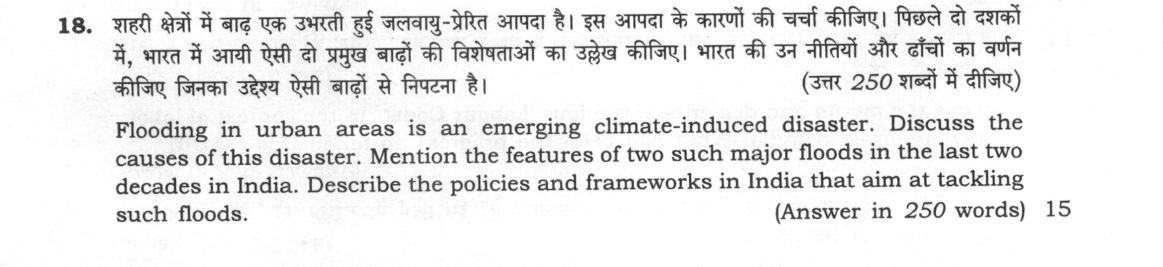
Flooding in urban areas is an emerging climate-induced disaster. Discuss the causes of this disaster. Mention the features of two such major floods in the last two decades in India. Describe the policies and frameworks in India that aim at tackling such floods. (Answer in 250 words) 15 marks
हिंदी में प्रश्न पढ़ें
शहरी क्षेत्रों में बाढ़ एक उभरती हुई जलवायु-प्रेरित आपदा है। इस आपदा के कारणों की चर्चा कीजिए। पिछले दो दशकों में, भारत में आयी ऐसी दो प्रमुख बाढ़ों की विशेषताओं का उल्लेख कीजिए। भारत की उन नीतियों और ढाँचों का वर्णन कीजिए जिनका उद्देश्य ऐसी बाढ़ों से निपटना है। (उत्तर 250 शब्दों में दीजिए)
Model answer
Written by UPSC Answer Check against this question's marking rubric, to the 250-word length. UPSC does not publish answers for Mains — this is one way to score well, not an official key.
Urban flooding has emerged as a severe climate-induced disaster where extreme meteorological events collide with dense, impermeable built environments.
Causes of Urban Flooding Natural drivers include high-intensity precipitation, cyclonic depressions, storm surges, and river overflow due to climate change. Anthropogenic drivers exacerbate these events through rapid concretization reducing soil infiltration, rampant encroachment on natural wetlands and floodplains, obsolete and inadequate stormwater drainage networks, unplanned urban sprawl, and solid waste choking drainage channels.
Features of Two Major Floods
- Mumbai Floods (2005): Triggered by an unprecedented 944 mm rainfall in 24 hours coinciding with high tide. Key features included the overflow of the heavily encroached Mithi River, systemic failure of British-era stormwater drains under the Municipal Corporation of Greater Mumbai (MCGM), and the total paralysis of suburban railway networks and arterial roads.
- Chennai Floods (2015): Triggered by 345 mm rainfall in 24 hours driven by cyclonic systems. It was characterized by the sudden, mismanaged water release from the Chembarambakkam reservoir into the encroached Adyar River, the destruction of the Pallikaranai marshland, and the severe inundation of the IT corridor built over natural flood basins.
Policies and Frameworks in India Institutional governance is anchored by the Disaster Management Act, 2005, through a three-tier NDMA, SDMA, and DDMA structure aligned with the Sendai Framework. The NDMA Guidelines on Management of Urban Flooding (2010) mandate treating urban flooding as a distinct disaster, requiring dedicated urban drainage cells and early warning systems. Upgrades to stormwater infrastructure are integrated under the Smart Cities Mission and AMRUT, complemented by the National Water Policy’s focus on water-sensitive planning. States have also evolved localized frameworks, such as the Rebuild Kerala Initiative post-2018.
Way Forward Crucial gaps remain, including weak enforcement of wetland conservation laws, fragmented municipal governance, and an overarching climate adaptation deficit. Bridging these requires mainstreaming "Sponge City" designs, mandating blue-green infrastructure in master plans, and enforcing strict floodplain zoning across Indian cities.
What "Discuss" is asking you to do
Lay the issue out from more than one side — how it arose, what is claimed for it, what is held against it, and where it now stands. UPSC attaches discuss to broad topics with several live dimensions, so coverage of the dimensions earns more than the strength of your opinion.
Structure that answers it
Set the issue up → the case as it is made → the case against → the dimension both sides leave out → where the balance now lies
Where marks are lost
Listing facts with no thread between them, or arguing one side throughout and calling it a discussion.
How this answer will be evaluated
Approach
Framework: GS3 Environment/Disaster Management: Situation > Analysis > Measures > Assessment. discuss: intro > 3-4 dimensions > example > balanced close Full marks: Precise causes, specific flood examples with dates, and detailed policy analysis.
Key points expected
- Causes: Urbanization, drainage failure, climate change
- Features of two specific floods (e.g., Chennai 2015, Mumbai 2005)
- Policies: National Disaster Management Act, NDRF, State Action Plans
- Balanced close on implementation gaps
Evaluation rubric
Each sub-part is marked on its own, against the marks and word limit printed on the paper.
- The answer Analyze causes, features of two floods, and policy frameworks for urban flooding. · 250 words
discuss— intro → 3-4 dimensions → example → balanced close
Must cover
- Causes: Urbanization, drainage failure, climate change
- Features of two specific floods (e.g., Chennai 2015, Mumbai 2005)
- Policies: National Disaster Management Act, NDRF, State Action Plans
- Balanced close on implementation gaps
Loses marks
- Generic 'climate change' without urban-specific context
- Listing policies without explaining their function
- Ignoring the 'urban' aspect of the question
Earns more
- Mention of specific state-level frameworks (e.g., Kerala, Maharashtra)
- Reference to 'Smart Cities' or 'AMRUT' for drainage
- Mention of 'National Water Policy' or 'Flood Control' schemes
- Distinction between natural and man-made causes
Extra mark
- Specific statistic on urban flood damage or NDRF deployment
- Reference to a specific committee report (e.g., Yash Pal Committee)
Practice this exact question
Write your answer and it is marked point by point against the model answer above — what you covered, what you missed, what you got wrong.
Evaluate my answer →More from General Studies 2024 GS Paper III
- Q15 The world is facing an acute shortage of clean and safe freshwater. What are the alternat…
- Q16 What are asteroids? How real is the threat of them causing extinction of life? What strat…
- Q17 What is disaster resilience? How is it determined? Describe various elements of a resilie…
- Q18 Flooding in urban areas is an emerging climate-induced disaster. Discuss the causes of th…
- Q19 India has a long and troubled border with China and Pakistan fraught with contentious iss…
- Q20 Social media and encrypting messaging services pose a serious security challenge. What me…