GS Paper III — Q6
What is the technology being employed for electronic toll collection on highways? What are its advantages and limitations? What…
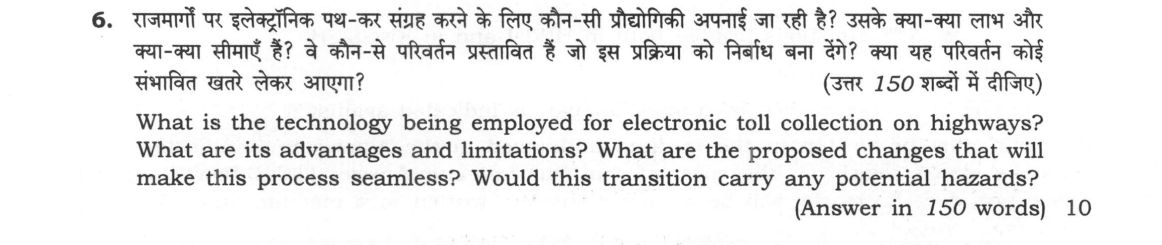
What is the technology being employed for electronic toll collection on highways? What are its advantages and limitations? What are the proposed changes that will make this process seamless? Would this transition carry any potential hazards? (Answer in 150 words) 10 marks
हिंदी में प्रश्न पढ़ें
राजमार्गों पर इलेक्ट्रॉनिक पथ-कर संग्रह करने के लिए कौन-सी प्रौद्योगिकी अपनाई जा रही है? उसके क्या-क्या लाभ और क्या-क्या सीमाएँ हैं? वे कौन-से परिवर्तन प्रस्तावित हैं जो इस प्रक्रिया को निर्बाध बना देंगे? क्या यह परिवर्तन कोई संभावित खतरे लेकर आएगा? (उत्तर 150 शब्दों में दीजिए)
Model answer
Written by UPSC Answer Check against this question's marking rubric, to the 150-word length. UPSC does not publish answers for Mains — this is one way to score well, not an official key.
Electronic Toll Collection (ETC) in India employs Radio Frequency Identification (RFID) technology through FASTags under NHAI’s National Electronic Toll Collection (NETC) program. Toll plaza readers use radio waves to read the vehicle’s passive tag and deduct tolls directly from a linked account.
Advantages and Limitations: RFID reduces plaza congestion, cuts vehicular fuel wastage, plugs revenue leakages, and fosters digital payments. However, it faces operational bottlenecks including tag reading malfunctions, double charging, interoperability gaps across state highways, high physical infrastructure costs, and friction for non-tag users.
Proposed Transition: To make transit seamless, the government is introducing GNSS/GPS-based satellite tolling. This calculates tolls dynamically based on exact distance traveled via On-Board Units (OBUs), eliminating physical toll plazas entirely.
Potential Hazards: This transition introduces severe privacy and mass surveillance concerns regarding continuous location tracking, cybersecurity vulnerabilities, high implementation costs for retrofitting OBUs, and digital exclusion. Safeguards under the DPDP Act, 2023 are vital for secure execution.
What "Explain" is asking you to do
Make the working of something clear — what sets it off, what follows from what, and what it produces. Explain is the Commission's mechanism word: it dominates the technical papers and the “explain why” stems, where the marks sit in the causal chain and not in the label.
Structure that answers it
State what it is → the initiating condition → the chain of cause, step by step → an instance where it plays out → what the chain produces
Where marks are lost
Describing what something looks like instead of why it works that way. Naming the stages without linking them reads as description too.
How this answer will be evaluated
Approach
Framework: GS3 Technology: why it matters, use, benefit, risk, policy. explain: definition/context > points in order > small example > short close Full marks: Precise tech ID, balanced pros/cons, specific hazards, and clear policy context.
Key points expected
- Identify RFID/FASTag as the core technology
- List at least two distinct advantages (e.g., speed, fuel)
- List at least two distinct limitations (e.g., hardware, privacy)
- Identify one specific potential hazard of the transition
Evaluation rubric
Each sub-part is marked on its own, against the marks and word limit printed on the paper.
- The answer Define the tech, list pros/cons, and assess the transition's risks. 10 marks · 150 words
explain— definition/context → points in order → small example → short close
Must cover
- Identify RFID/FASTag as the core technology
- List at least two distinct advantages (e.g., speed, fuel)
- List at least two distinct limitations (e.g., hardware, privacy)
- Identify one specific potential hazard of the transition
Loses marks
- Vague generalities without naming the specific tech
- Ignoring the 'hazards' or 'limitations' part of the question
- Aspirational solutions without implementation details
Earns more
- Mention specific proposed changes (e.g., interoperability, 2.4GHz)
- Mention specific hazards (e.g., data security, job loss)
- Mention specific schemes (e.g., FASTag, e-NHAI)
Extra mark
- Mention specific data/statistics on toll collection
- Mention specific legal/regulatory framework (e.g., IT Act)
Practice this exact question
Write your answer and it is marked point by point against the model answer above — what you covered, what you missed, what you got wrong.
Evaluate my answer →More from General Studies 2024 GS Paper III
- Q3 What were the factors responsible for the successful implementation of land reforms in so…
- Q4 Explain the role of millets for ensuring health and nutritional security in India. (Answe…
- Q5 What is the present world scenario of intellectual property rights with respect to life m…
- Q6 What is the technology being employed for electronic toll collection on highways? What ar…
- Q7 Industrial pollution of river water is a significant environmental issue in India. Discus…
- Q8 What role do environmental NGOs and activists play in influencing Environmental Impact As…
- Q9 Explain how narco-terrorism has emerged as a serious threat across the country. Suggest s…