GS Paper III — Q17
What is disaster resilience? How is it determined? Describe various elements of a resilience framework. Also mention the global…
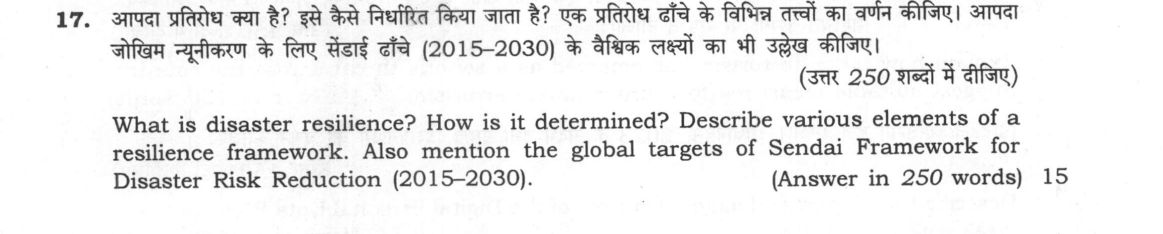
What is disaster resilience? How is it determined? Describe various elements of a resilience framework. Also mention the global targets of Sendai Framework for Disaster Risk Reduction (2015-2030). (Answer in 250 words) 15 marks
हिंदी में प्रश्न पढ़ें
आपदा प्रतिरोध क्या है? इसे कैसे निर्धारित किया जाता है? एक प्रतिरोध ढाँचे के विभिन्न तत्वों का वर्णन कीजिए। आपदा जोखिम न्यूनीकरण के लिए सेंडाई ढाँचे (2015-2030) के वैश्विक लक्ष्यों का भी उल्लेख कीजिए। (उत्तर 250 शब्दों में दीजिए)
Model answer
Written by UPSC Answer Check against this question's marking rubric, to the 250-word length. UPSC does not publish answers for Mains — this is one way to score well, not an official key.
Disaster resilience, as defined by UNISDR, is the capacity of social, economic and environmental systems to cope with, adapt to and recover from hazards, while maintaining essential functions and reducing future risk. It is determined by exposure to hazards, vulnerability of people and assets, coping capacity, adaptive capacity, and institutional preparedness. Poverty, unsafe land-use, environmental degradation and weak institutions increase vulnerability, while early warning, planning, response and recovery systems improve resilience.
A resilience framework comprises physical/infrastructure resilience—safe buildings, transport, energy and water systems, such as cyclone shelters and flood-proofing; social resilience—community networks, inclusion, health and education; economic resilience—livelihoods, insurance, credit and diversified income; and institutional/organizational resilience—governance, coordination, legal frameworks, funding and learning, including NDMA-SDMA-DDMA coordination.
The Sendai Framework (2015–2030) sets seven global targets, to be achieved by 2030: (A) substantially reduce disaster mortality; (B) reduce the number of people affected; (C) reduce direct economic losses to GDP; (D) reduce damage to critical infrastructure and disruption of basic services; (E) substantially increase the number of countries with national and local disaster risk reduction strategies; (F) substantially enhance international cooperation to developing countries; and (G) substantially increase availability and access to multi-hazard early warning systems and disaster risk information and early warning.
India’s National Disaster Management Plan 2016 aligns with Sendai priorities, while the Aspirational Districts Programme builds local resilience through infrastructure, health, education and disaster preparedness. Thus resilience is not mere recovery but sustained risk reduction, requiring integration of disaster risk reduction into development planning at national, state and district levels.
What "Describe" is asking you to do
Give a full, ordered account of the thing named — its parts, stages or mechanism — in the sequence in which it actually exists or occurs. Most describe questions come from the science optionals, where the marks sit in correct technical detail and, where the stem says so, a labelled diagram.
Structure that answers it
One-line identification of the subject → the parts or stages in their real order, each with its defining detail → labelled diagram where the subject is structural → closing line on function or significance
Where marks are lost
Loose general prose where the examiner is ticking named parts, correct terminology and their sequence; and in the General Studies papers, turning to evaluation before the description is finished.
How this answer will be evaluated
Approach
Framework: GS3 Method: Situation > Analysis > Measures > Assessment. describe: define > structure or process in order > labelled diagram > significance Full marks: Precise definitions, clear framework elements, accurate Sendai targets, logical flow.
Key points expected
- Define disaster resilience (capacity to cope/adapt)
- List determinants (social, economic, institutional, physical)
- Describe resilience framework elements (prevention, preparedness, response, recovery)
- Mention Sendai Framework global targets (2015-2030)
Evaluation rubric
Each sub-part is marked on its own, against the marks and word limit printed on the paper.
- The answer Define resilience, its determinants, framework elements, and Sendai targets. · 250 words
describe— define → structure or process in order → labelled diagram → significance
Must cover
- Define disaster resilience (capacity to cope/adapt)
- List determinants (social, economic, institutional, physical)
- Describe resilience framework elements (prevention, preparedness, response, recovery)
- Mention Sendai Framework global targets (2015-2030)
Loses marks
- Confusing resilience with general disaster management
- Listing Sendai targets without context or explanation
- Vague description of framework elements without specific examples
Earns more
- Mention specific Sendai targets (e.g., reduce mortality, economic loss)
- Link framework elements to specific disaster phases
- Distinguish between resilience and resistance
- Reference specific Sendai means of action
Extra mark
- Cite specific Sendai target percentages (e.g., 50% reduction in mortality)
- Reference specific Sendai means of action (e.g., M1, M2)
Practice this exact question
Write your answer and it is marked point by point against the model answer above — what you covered, what you missed, what you got wrong.
Evaluate my answer →More from General Studies 2024 GS Paper III
- Q14 Elucidate the importance of buffer stocks for stabilizing agricultural prices in India. W…
- Q15 The world is facing an acute shortage of clean and safe freshwater. What are the alternat…
- Q16 What are asteroids? How real is the threat of them causing extinction of life? What strat…
- Q17 What is disaster resilience? How is it determined? Describe various elements of a resilie…
- Q18 Flooding in urban areas is an emerging climate-induced disaster. Discuss the causes of th…
- Q19 India has a long and troubled border with China and Pakistan fraught with contentious iss…
- Q20 Social media and encrypting messaging services pose a serious security challenge. What me…