GS Paper III — Q5
What is the present world scenario of intellectual property rights with respect to life materials? Although, India is second in…
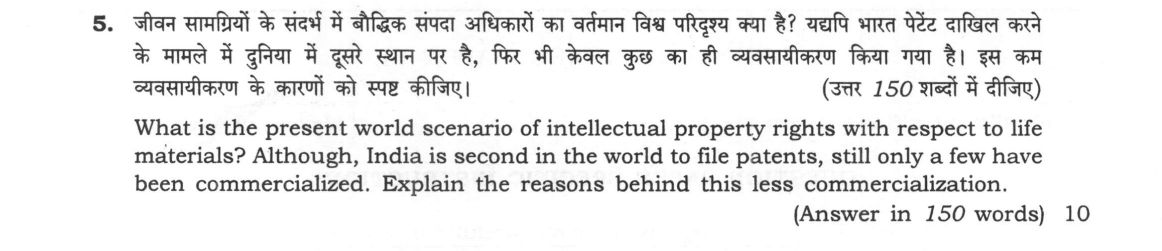
What is the present world scenario of intellectual property rights with respect to life materials? Although, India is second in the world to file patents, still only a few have been commercialized. Explain the reasons behind this less commercialization. (Answer in 150 words) 10 marks
हिंदी में प्रश्न पढ़ें
जीवन सामग्रियों के संदर्भ में बौद्धिक संपदा अधिकारों का वर्तमान विश्व परिदृश्य क्या है? यद्यपि भारत पेटेंट दाखिल करने के मामले में दुनिया में दूसरे स्थान पर है, फिर भी केवल कुछ का ही व्यवसायीकरण किया गया है। इस कम व्यवसायीकरण के कारणों को स्पष्ट कीजिए। (उत्तर 150 शब्दों में दीजिए)
Model answer
Written by UPSC Answer Check against this question's marking rubric, to the 150-word length. UPSC does not publish answers for Mains — this is one way to score well, not an official key.
The global IPR regime for life materials is defined by tension between the WTO-TRIPS framework—which enforces strict patentability for biotechnology and gene-editing tools like CRISPR—and the Convention on Biological Diversity (CBD) with the Nagoya Protocol, which mandates Access and Benefit-Sharing (ABS) to prevent biopiracy (e.g., historical Neem and Turmeric cases).
Despite India ranking among the top patent filers globally (WIPO), commercialization remains under 1% due to distinct systemic bottlenecks:
- Weak Industry-Academia Linkages: Research prioritizes academic publishing over market viability, compounded by an absence of effective Technology Transfer Offices (TTOs).
- Regulatory and Financial Hurdles: Lengthy, multi-tiered clearances from bodies like the GEAC and DCGI, along with expensive clinical trials and scarce deep-tech venture capital, stall commercial transition.
- Monetization and Skill Deficits: Researchers frequently lack IP valuation expertise, business acumen, and institutional support for patent enforcement and litigation.
Strengthening public-private platforms like BIRAC, building institutional TTOs, and streamlining regulatory pathways are essential to translate patent filings into commercial output.
What "Explain" is asking you to do
Make the working of something clear — what sets it off, what follows from what, and what it produces. Explain is the Commission's mechanism word: it dominates the technical papers and the “explain why” stems, where the marks sit in the causal chain and not in the label.
Structure that answers it
State what it is → the initiating condition → the chain of cause, step by step → an instance where it plays out → what the chain produces
Where marks are lost
Describing what something looks like instead of why it works that way. Naming the stages without linking them reads as description too.
How this answer will be evaluated
Approach
Framework: Situation > Analysis > Measures: legal, institutional, developmental > Assessment. explain: definition/context > points in order > small example > short close Full marks: Clear definition of global IP scenario, specific reasons for low commercialization, and relevant examples.
Key points expected
- Define global IP scenario for life materials
- Identify reasons for low commercialization of Indian patents
- Link patent filing to commercialization gap
- Provide specific examples of life materials
Evaluation rubric
Each sub-part is marked on its own, against the marks and word limit printed on the paper.
- The answer Define global IP scenario for life materials and analyze reasons for India's low commercialization of patents. 10 marks · 150 words
explain— definition/context → points in order → small example → short close
Must cover
- Define global IP scenario for life materials
- Identify reasons for low commercialization of Indian patents
- Link patent filing to commercialization gap
- Provide specific examples of life materials
Loses marks
- Vague generalities without specific examples
- Ignoring the 'life materials' aspect
- Failing to address the commercialization gap
Earns more
- Mention specific Indian patent examples
- Reference relevant IP laws or policies
- Discuss R&D to market pipeline issues
- Compare with other countries' commercialization
Extra mark
- Cite specific patent numbers or statistics
- Reference specific government schemes or initiatives
Practice this exact question
Write your answer and it is marked point by point against the model answer above — what you covered, what you missed, what you got wrong.
Evaluate my answer →More from General Studies 2024 GS Paper III
- Q2 What are the causes of persistent high food inflation in India? Comment on the effectiven…
- Q3 What were the factors responsible for the successful implementation of land reforms in so…
- Q4 Explain the role of millets for ensuring health and nutritional security in India. (Answe…
- Q5 What is the present world scenario of intellectual property rights with respect to life m…
- Q6 What is the technology being employed for electronic toll collection on highways? What ar…
- Q7 Industrial pollution of river water is a significant environmental issue in India. Discus…
- Q8 What role do environmental NGOs and activists play in influencing Environmental Impact As…