Paper I — Q1
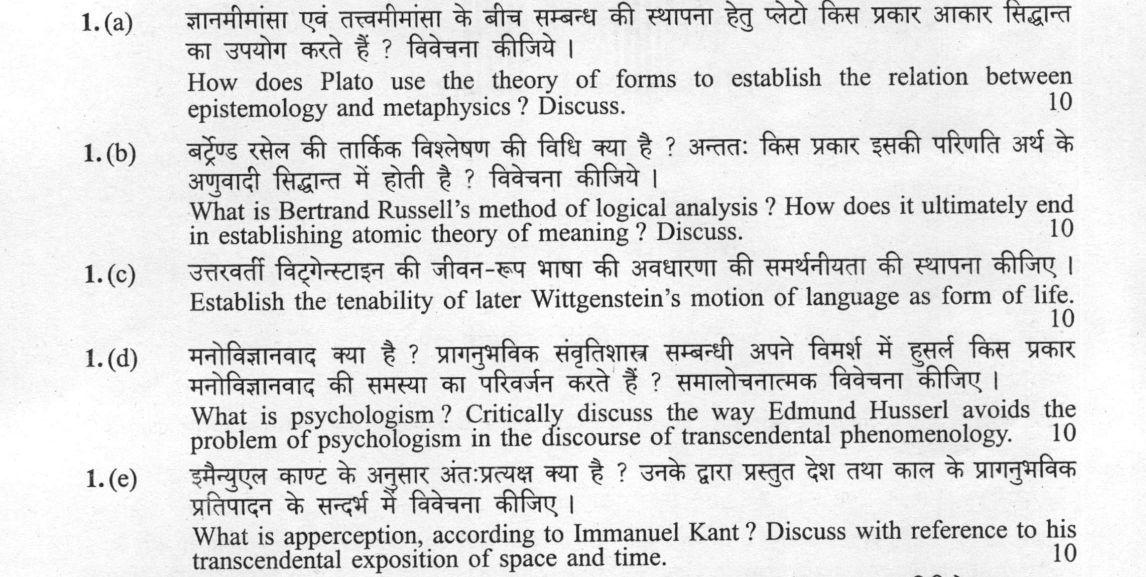
(a) How does Plato use the theory of forms to establish the relation between epistemology and metaphysics ? Discuss. (10…
How does Plato use the theory of forms to establish the relation between epistemology and metaphysics ? Discuss. 10 marks
What is Bertrand Russell's method of logical analysis ? How does it ultimately end in establishing atomic theory of meaning ? Discuss. 10 marks
Establish the tenability of later Wittgenstein's notion of language as form of life. 10 marks
What is psychologism ? Critically discuss the way Edmund Husserl avoids the problem of psychologism in the discourse of transcendental phenomenology. 10 marks
What is apperception, according to Immanuel Kant ? Discuss with reference to his transcendental exposition of space and time. 10 marks
हिंदी में प्रश्न पढ़ें
ज्ञानमीमांसा एवं तत्त्वमीमांसा के बीच सम्बन्ध की स्थापना हेतु प्लेटो किस प्रकार आकार सिद्धान्त का उपयोग करते हैं ? विवेचना कीजिये । (10 अंक)
बर्ट्रैण्ड रसेल की तार्किक विश्लेषण की विधि क्या है ? अन्ततः किस प्रकार इसकी परिणति अर्थ के अणुवादी सिद्धान्त में होती है ? विवेचना कीजिये । (10 अंक)
उत्तरवर्ती विट्टगेन्स्टाइन की जीवन-रूप भाषा की अवधारणा की समर्थनीयता की स्थापना कीजिए । (10 अंक)
मनोविज्ञानवाद क्या है ? प्रागनुभविक संप्रतिशास्त्र सम्बन्धी अपने विमर्श में हुसर्ल किस प्रकार मनोविज्ञानवाद की समस्या का परिवर्जन करते हैं ? समालोचनात्मक विवेचना कीजिये । (10 अंक)
इमैन्युएल काण्ट के अनुसार अन्तःप्रत्यक्ष क्या है ? उनके द्वारा प्रस्तुत देश तथा काल के प्रागनुभविक प्रतिपादन के सन्दर्भ में विवेचना कीजिये । (10 अंक)
Model answer
Written by UPSC Answer Check against this question's marking rubric, to the expected length. UPSC does not publish answers for Mains — this is one way to score well, not an official key.
(a) Plato: Theory of Forms, Epistemology, and Metaphysics
Plato establishes an indissoluble nexus between epistemology and metaphysics by asserting that the nature of reality dictates the nature of knowledge. In his metaphysical schema, reality is bifurcated into the sensible world of Becoming, characterized by flux and impermanence, and the intelligible realm of Being, composed of immutable, eternal, and non-spatial Forms (Eide). Epistemologically, Plato maintains that true knowledge (episteme) must be infallible and directed toward what truly is, whereas sensory observation yields only mutable opinion (doxa).
This alignment is systematically articulated in the Analogy of the Divided Line. Plato maps cognitive states directly onto ontological levels: illusion (eikasia) corresponds to shadows and reflections; belief (pistis) corresponds to physical particulars; hypothetical reasoning (dianoia) corresponds to mathematical entities; and pure dialectical intellection (noesis) grasps the unhypothetical first principles, the Forms.
Through the doctrine of anamnesis (recollection), Plato bridges this epistemic-metaphysical divide, demonstrating that learning is the soul’s recovery of its innate acquaintance with the Forms prior to embodiment. Sensible particulars participate in (methexis) and imperfectly copy these archetypes. At the apex stands the Form of the Good, which serves both as the metaphysical source of existence (ousia) for all Forms and the epistemological condition of their intelligibility, analogous to the sun illuminating the visible cosmos. Plato’s synthesis asserts that ontology is the ground of epistemology; genuine cognitive certainty is attainable only through metaphysical transcendence.
(b) Bertrand Russell: Logical Analysis and Atomic Theory of Meaning
Bertrand Russell’s method of logical analysis emerged as a dual critique of Hegelian absolute idealism—specifically F.H. Bradley’s monism and doctrine of internal relations—and naive empirical realism. Russell posited that the surface grammatical structure of natural language frequently obscures its underlying logical form, generating philosophical pseudo-problems. The task of philosophy is the decomposition of complex, molecular propositions into their primitive logical constituents.
The paradigm of this method is the 1905 Theory of Definite Descriptions. In analyzing the proposition "The present King of France is bald," Russell demonstrated that the grammatical subject is not a genuine referring term. Instead, the sentence resolves into a complex existential quantification: there exists an entity x, such that x is currently King of France, x is unique, and x is bald. This resolved the ontological puzzle of non-existent entities without positing a realm of subsistent entities, as Alexius Meinong had done.
This analytical method terminates in Logical Atomism. Russell postulated an isomorphic correspondence between the structure of language and the structure of reality. The world consists of atomic facts—simple particulars possessing qualities or standing in relations. Language, at its most fundamental level, consists of atomic propositions composed of logically proper names whose meaning is directly tied to simple particulars apprehended through direct acquaintance. Molecular propositions are truth-functional compounds of these atomic units. Meaning is thus structurally grounded in atomic propositions that mirror foundational ontological facts.
(c) Later Wittgenstein: Language as a Form of Life
In the Philosophical Investigations, Ludwig Wittgenstein repudiates the referential and atomistic semantics of his Tractatus, replacing the picture theory of meaning with the pragmatic principle that "the meaning of a word is its use in the language." Language is not a uniform, static calculus, but an open-ended multiplicity of rule-governed activities termed "language-games" (Sprachspiele), such as describing, commanding, thanking, or speculating.
The tenability of language-games is anchored in the concept of a "form of life" (Lebensform). A form of life represents the shared, pre-linguistic biological and cultural framework of human practices, agreements, and communal actions. Language does not mirror an independent metaphysical reality; rather, linguistic significance is sustained by its interweaving within human socio-behavioral patterns.
This contextualism is reinforced by the Private Language Argument. Wittgenstein demonstrates that rule-following cannot be a purely internal, subjective enterprise. To follow a rule correctly requires a standard of correctness, which is inherently communal; an individual in absolute isolation cannot distinguish between thinking they are following a rule and actually following it. Thus, a private language referring solely to unshareable sensations is impossible.
The tenability of this position rests on its anti-essentialism and therapeutic nature: it frees philosophy from foundationalist metaphysics by treating meaning as socially embodied. While critics argue this leads to linguistic relativism or fideism, it offers a robust account of how communication functions stably through lived, normative practices.
(d) Edmund Husserl: Psychologism and Transcendental Phenomenology
Psychologism is the epistemological stance that reduces ideal logical laws and normative principles of reasoning to empirical, contingent facts of human psychology (as advocated by John Stuart Mill, Christoph Sigwart, and Theodor Lipps). In the Prolegomena to Pure Logic, Edmund Husserl launched a devastating critique against psychologism, demonstrating that it commits a category mistake by conflating the psychological act of thinking (which is temporal, causal, and subjective) with the ideal content of thought (which is atemporal, necessary, and objectively valid). If logical laws were mere empirical generalizations of human mental biology, they would lack apodictic certainty and degenerate into skeptical relativism and self-refutation.
Husserl avoids psychologism without lapsing into uncritical metaphysical realism by establishing Transcendental Phenomenology. This is achieved through methodological reductions: First, the epoché (phenomenological reduction) brackets the "natural attitude"—suspending all ontological commitments regarding the existence of the external world. Second, the eidetic reduction shifts focus from empirical particulars to their universal, essential structures (eidos) through free imaginative variation.
Within this purified field, Husserl uncovers transcendental subjectivity as the ultimate, non-empirical ground of constitution. Experience is characterized by intentionality—consciousness is always consciousness of something. Husserl maps this through the correlation between noesis (the intentional act of meaning-bestowal) and noema (the objective meaning-correlate intended in the act). By demonstrating that ideal meanings are constituted by transcendental consciousness rather than caused by empirical psychological mechanisms, Husserl secures the objective foundation of logic and science.
(e) Immanuel Kant: Transcendental Apperception, Space, and Time
In the Critique of Pure Reason, Immanuel Kant defines transcendental apperception as the pure, original, and unchangeable consciousness that generates the representation "I think" (Ich denke). This "I think" must be capable of accompanying all other representations; otherwise, something would be represented in me that could not be thought, rendering the representation impossible or nothing to me. Transcendental apperception is not the empirical ego observed through inner sense, but the necessary, formal condition for the synthetic unity of all manifold representations into a coherent, single experience of an objective world.
This subjective condition of understanding operates in unison with the subjective conditions of sensibility. In the Transcendental Aesthetic, Kant's transcendental exposition of space (the outer form of intuition) and time (the inner form of intuition) establishes them as a priori intuitions rather than empirical concepts or mind-independent entities (contra Newton’s absolute space and Leibniz’s relational space). Space and time serve as the subjective, formal conditions under which alone objects can be given to human sensibility, providing the synthetic a priori foundation for geometry and pure mechanics.
However, receptive intuitions in space and time alone cannot yield cognition: "thoughts without content are empty, intuitions without concepts are blind." The spatial-temporal manifold of intuition must be synthesized. The transcendental synthesis of imagination, governed by the schematism, translates the categories of understanding into temporal-spatial determinations. This entire architecture is unified under the supreme principle of transcendental apperception, ensuring that the subjective conditions of thinking necessarily coincide with the objective conditions of possible experience.
Conclusion
From Plato's metaphysical anchoring of epistemology to Kant's critical synthesis and the modern analytical and phenomenological paradigms of Russell, Wittgenstein, and Husserl, philosophy continually navigates the relation between mind, language, and reality. The progression highlights a transformative trajectory: grounding objectivity shifted from transcendent metaphysical realms to the structural logic of language, the synthetic unity of transcendental consciousness, and ultimately the lived practices of human forms of life.
What "Discuss" is asking you to do
Lay the issue out from more than one side — how it arose, what is claimed for it, what is held against it, and where it now stands. UPSC attaches discuss to broad topics with several live dimensions, so coverage of the dimensions earns more than the strength of your opinion.
Structure that answers it
Set the issue up → the case as it is made → the case against → the dimension both sides leave out → where the balance now lies
Where marks are lost
Listing facts with no thread between them, or arguing one side throughout and calling it a discussion.
How this answer will be evaluated
Approach
Framework: State the position > Argument > Strongest objection > Evaluation. (a) discuss: intro > 3-4 dimensions > example > balanced close | (b) discuss: intro > 3-4 dimensions > example > balanced close | (c) justify: claim > 3-4 reasons > evidence > conclusion | (d) critique: the claim > its strengths > its weaknesses > your judgment | (e) discuss: intro > 3-4 dimensions > example > balanced close Full marks: Precise technical vocabulary, clear argument reconstruction, strong counter-arguments, exact terms.
Key points expected
- Define episteme vs doxa (knowledge vs opinion)
- Explain the ontological status of Forms (metaphysics)
- Link Forms to the source of true knowledge (epistemology)
- Mention the Allegory of the Cave or Divided Line
- Define logical analysis as a method
- Explain the reduction of complex propositions
- Define the 'atomic theory of meaning'
- Link analysis to the elimination of ambiguity
Evaluation rubric
Each sub-part is marked on its own, against the marks and word limit printed on the paper.
- (a) Reconstruct Plato's argument linking Forms to knowledge and being. 10 marks
discuss— intro → 3-4 dimensions → example → balanced close
Must cover
- Define episteme vs doxa (knowledge vs opinion)
- Explain the ontological status of Forms (metaphysics)
- Link Forms to the source of true knowledge (epistemology)
- Mention the Allegory of the Cave or Divided Line
Loses marks
- Biographical details of Plato
- Vague paraphrase without technical terms
- Confusing Forms with mere concepts
Earns more
- Use Greek terms: eidos, noesis, aisthesis
- Reference the 'Republic' or 'Phaedo'
- Contrast the sensible world with the intelligible world
Extra mark
- Mention the 'Theory of Recollection' (Anamnesis)
- (b) Explain Russell's logical analysis leading to atomic meaning. 10 marks
discuss— intro → 3-4 dimensions → example → balanced close
Must cover
- Define logical analysis as a method
- Explain the reduction of complex propositions
- Define the 'atomic theory of meaning'
- Link analysis to the elimination of ambiguity
Loses marks
- Confusing Russell with Frege
- Failing to define 'atomic' in this context
- Biographical details
Earns more
- Mention 'logical atomism'
- Reference 'The Problems of Philosophy'
- Contrast with Frege or Wittgenstein (early)
Extra mark
- Mention the 'Theory of Descriptions'
- (c) Argue for the validity of language as a form of life. 10 marks
justify— claim → 3-4 reasons → evidence → conclusion
Must cover
- Define 'form of life' (Lebensform)
- Explain 'language games' (Sprachspiele)
- Contrast with the 'Tractatus' picture theory
- Show how meaning is use, not reference
Loses marks
- Treating language as a code only
- Ignoring the social/practical aspect
- Biographical details
Earns more
- Use German terms: Lebensform, Sprachspiel
- Reference 'Philosophical Investigations'
- Mention the 'beetle in a box' example
Extra mark
- Mention 'agreement in judgments'
- (d) Define psychologism and Husserl's transcendental solution. 10 marks
critique— the claim → its strengths → its weaknesses → your judgment
Must cover
- Define psychologism (logic as psychology)
- Explain Husserl's critique of psychologism
- Define 'transcendental phenomenology'
- Explain the 'epoché' or 'bracketing'
Loses marks
- Confusing phenomenology with psychology
- Failing to define 'transcendental'
- Biographical details
Earns more
- Reference 'Logical Investigations'
- Mention the 'cogito' or 'transcendental ego'
- Contract with Brentano
Extra mark
- Mention 'intentionality'
- (e) Define apperception and link to space/time exposition. 10 marks
discuss— intro → 3-4 dimensions → example → balanced close
Must cover
- Define 'transcendental apperception' (unity of consciousness)
- Explain the 'transcendental exposition of space'
- Explain the 'transcendental exposition of time'
- Link space/time to the unity of apperception
Loses marks
- Confusing apperception with empirical consciousness
- Ignoring the link to space/time
- Biographical details
Earns more
- Use German: Transzendentale Apperzeption
- Reference 'Critique of Pure Reason' (A-edition)
- Mention 'synthesis' or 'imagination'
Extra mark
- Mention the 'schematism'
Practice this exact question
Write your answer and it is marked point by point against the model answer above — what you covered, what you missed, what you got wrong.
Evaluate my answer →More from Philosophy 2022 Paper I
- Q1 (a) How does Plato use the theory of forms to establish the relation between epistemology…
- Q2 (a) Provide a critical account of Heidegger's Being-in-the-world and discuss the problem…
- Q3 (a) How does Kant construct antinomies to illustrate the illusory tendencies of pure reas…
- Q4 (a) How does Soren Kierkegaard define the notion of 'subjectivity'? Explain it with refer…