Paper I — Q5
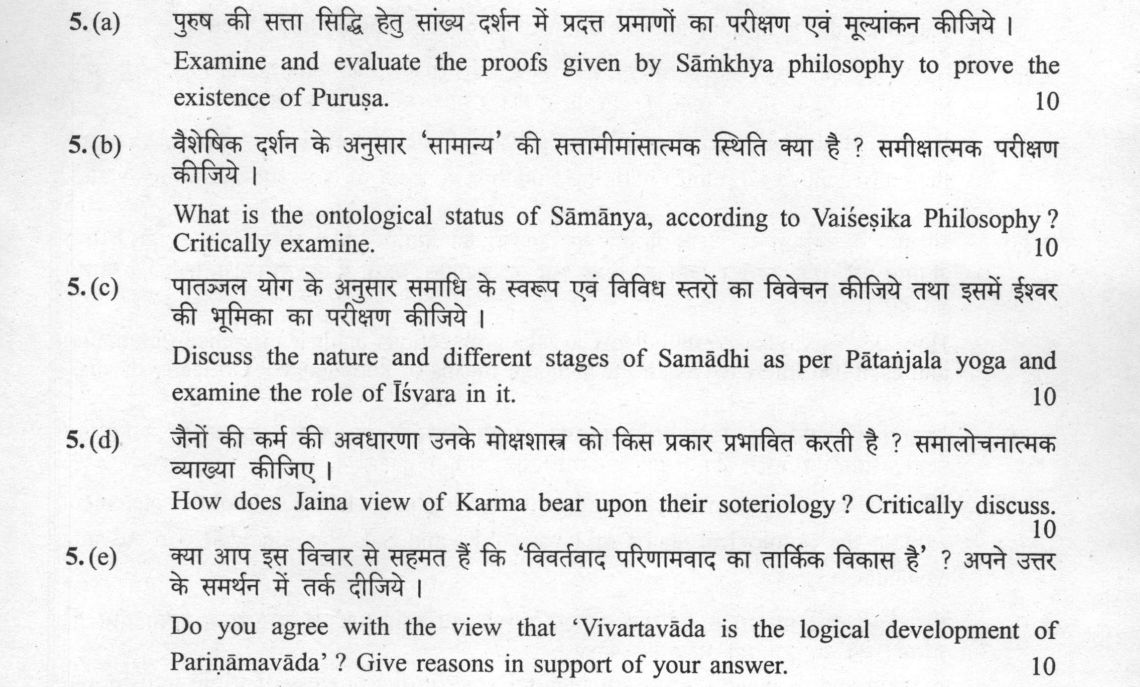
(a) Examine and evaluate the proofs given by Sāmkhya philosophy to prove the existence of Puruṣa. (10 marks) (b) What is the…
Examine and evaluate the proofs given by Sāmkhya philosophy to prove the existence of Puruṣa. 10 marks
What is the ontological status of Sāmānya, according to Vaiśeṣika Philosophy? Critically examine. 10 marks
Discuss the nature and different stages of Samādhi as per Pātañjala yoga and examine the role of Īśvara in it. 10 marks
How does Jaina view of Karma bear upon their soteriology? Critically discuss. 10 marks
Do you agree with the view that 'Vivartavāda is the logical development of Parināṇamavāda'? Give reasons in support of your answer. 10 marks
हिंदी में प्रश्न पढ़ें
पुरुष की सत्ता सिद्ध हेतु सांख्य दर्शन में प्रदत्त प्रमाणों का परीक्षण एवं मूल्यांकन कीजिये । (10 अंक)
वैशेषिक दर्शन के अनुसार 'सामान्य' की सत्तामीमांसात्मक स्थिति क्या है ? समीक्षात्मक परीक्षण कीजिये । (10 अंक)
पातञ्जल योग के अनुसार समाधि के स्वरूप एवं विविध स्तरों का विवेचन कीजिये तथा इसमें ईश्वर की भूमिका का परीक्षण कीजिये । (10 अंक)
जैनों की कर्म की अवधारणा उनके मोक्षशास्त्र को किस प्रकार प्रभावित करती है ? समालोचनात्मक व्याख्या कीजिए । (10 अंक)
क्या आप इस विचार से सहमत हैं कि 'विवर्तवाद परिणामवाद का तार्किक विकास है' ? अपने उत्तर के समर्थन में तर्क दीजिये । (10 अंक)
Model answer
Written by UPSC Answer Check against this question's marking rubric, to the expected length. UPSC does not publish answers for Mains — this is one way to score well, not an official key.
Sāmkhya proofs of Puruṣa. Sāmkhya argues that insentient Prakṛti cannot account for the world or experience. Its five proofs are inferential. First, saṅghāta-parārthatvāt: the aggregation of instruments and causes implies a purpose, and purpose requires a conscious witness. Second, triguṇyādiviṣayavat: the world contains objects suited to the three guṇas, suggesting an enjoyer. Third, adhiṣṭhātṛ: the subtle body (tanmātras, mind, etc.) requires a controller. Fourth, bhoktṛbhāvāt: experience itself requires an experiencer. Fifth, kaivalyārtha-pravṛtteḥ: the fact that sādhanā aims at liberation implies a liberated subject. Critically, these proofs are mutually reinforcing but not strictly independent. The aggregation and teleology proofs risk circularity if Prakṛti’s evolution is explained as for Puruṣa’s sake. The controller proof is awkward because Puruṣa is passive witness, not an active agent. The experiencer and liberation proofs are the strongest, since they appeal to the givenness of consciousness and the intelligibility of mokṣa. Thus the proofs are better read as a cumulative case than as formal demonstrations; they establish Puruṣa as the necessary condition of experience and liberation, though some formulations are redundant or teleologically loaded.
Vaiśeṣika sāmānya. For Vaiśeṣika, sāmānya is a real universal, eternal, one, and distinct from the particulars in which it inheres. It is not mental but an ontological ground of similarity. It inheres in many particulars through samavāya, an inseparable relation that is neither identity nor contact. Prashastapāda classifies sāmānya into para, Sattā, and apara; apara is further divided into parāpara, such as dravyatva, and apara, such as gotva. This hierarchy explains how higher universals subsume lower ones without collapsing into particulars. Against Buddhist apoha, which treats universals as mere negative exclusions, Vaiśeṣika argues that cognition of commonality, memory, inference and language require a positive real universal. The critical difficulty is samavāya: if the universal is one and in many, how is it undivided? If it is distinct from particulars, how does it make them what they are? The relation is primitive and hard to analyse. Nevertheless, sāmānya’s ontological realism is epistemologically indispensable: it makes general knowledge, scientific classification and valid inference possible. The doctrine is therefore defensible, though its metaphysical account of inherence remains opaque.
Pātañjala samādhi and Īśvara. In Pātañjala Yoga, samādhi is citta-vṛtti-nirodha, the stilling of mental modifications. Samprajñāta samādhi retains an object and passes through savitarka, where thought is accompanied by word and concept; nirvitarka, where it transcends them; savicāra, where attention turns to subtle objects; nirvicāra, where even subtle object is transcended; and then sānanda and sāsmitā, where bliss and refined ego-light remain. Asamprajñāta samādhi has no object, but it is not final, because residual saṃskāras, saṃskāra-śeṣa, remain. Only nirbīja samādhi, described in YS 1.51, removes all seeds and leads to kaivalya. Īśvara is a viśeṣa-puruṣa, a special self untouched by afflictions, habits and merit. He is not the creator of the world but an object of īśvara-praṇidhāna, a limb of aṣṭāṅga yoga. Meditation on him produces prasāda-bhāvana, a receptive grace that steadies the mind and hastens samādhi. Critically, the stages are phenomenological and not always strictly linear; a practitioner may move back and forth. The role of Īśvara is theistic but optional, suited to those with faith, and does not make Pātañjala a creator-theism. Its strength is practical psychology; its weakness is that the transition to seedless samādhi is described as attainment rather than analysis.
Jaina karma and soteriology. Jaina philosophy treats karma not as a moral record but as subtle matter, karma-vargaṇā, that enters and binds the jīva. It binds through yoga, activity, and kaṣāya, passion. Karma is broadly divided into ghātiyā, which obstructs the soul’s nature, and aghātiyā, which does not; specifically, it is analysed into eight types: jñānāvaraṇīya, darśanāvaraṇīya, mohanīya, antarāya, vedanīya, nāma, gotra and āyuṣya. These determine the soul’s perception, knowledge, delusion, obstruction, pleasure and pain, name, birth and life-span. Soteriology follows directly: mokṣa is the complete release of jīva from karmic matter through saṃvara, the stoppage of new influx, and nirjarā, the exhaustion of old karma. Ahiṃsā is central because violence generates passion and karmic influx; the triratna of right faith, knowledge and conduct provides the disciplined path. Critically, the doctrine risks determinism, since karma seems to fix birth, experience and capacity. Yet Jaina thought preserves agency: yoga and kaṣāya are conditions, not absolute causes, and the soul can choose non-violence, renunciation and austerities. The material account of karma is unusual and vulnerable to the objection that matter cannot bind consciousness, but it gives a concrete, non-theistic explanation of moral causation. On balance, Jaina soteriology is coherent: karma is the problem, ethical discipline is the method, and liberation is the removal of matter from the self.
Vivartavāda and pariṇāmavāda. The claim that vivartavāda is the logical development of pariṇāmavāda is partly true. Pariṇāmavāda holds that Brahman, as material cause, undergoes real transformation into the world. This explains experience but creates severe problems: if Brahman changes, it becomes subject to time, plurality, impermanence and limitation. Śaṅkara argues that pariṇāma implies avidyā in Brahman, because real change requires ignorance, potency and affectability, all incompatible with nirguṇa, nirvikāra Brahman. Vivartavāda therefore develops as a corrective: the world is not a real modification but an apparent modification, māyā or avidyā, superimposed on Brahman. This preserves Brahman’s nirvikāratva while accounting for empirical appearance. However, it is not a strict logical consequence of pariṇāma; it changes the ontological thesis from real change to apparent change. Bhāskara objects that the world is Brahman’s real body, not illusion, and Yādavaprakāśa defends a more robust reality of change, arguing that Shankara’s view makes experience unreal. These counter-arguments show that vivarta is a dialectical response to pariṇāma’s aporias, not its inevitable outcome. I therefore agree only in a qualified sense: vivartavāda is the logical development of the critical problems raised by pariṇāmavāda, but not the logical continuation of pariṇāma itself. It is a different solution to the same problem: how to reconcile the one Brahman with the many. Across these systems, ontological claims are tested by their explanatory power for experience, knowledge and liberation.
What "Critically examine" is asking you to do
Test the proposition the question puts to you and return a finding on how far it holds. Examine stems carry a claim, or ask whether something has happened, and expect evidence weighed both ways before the extent is stated — often with remedial measures attached. “Critically” is not a section added at the end: name the yardstick you are judging by — the evidence, the stated objective, a constitutional principle, a rival explanation — and let a verdict close each part of the body. Where the question quotes a claim, that verdict must land on the claim itself, accepted, qualified or rejected, and not on the theme in general.
Structure that answers it
Restate the claim as the question frames it → evidence that supports it → evidence that undercuts it → the conditions under which it holds → verdict on how far it stands
Where marks are lost
Merits in one paragraph, demerits in the next, and a conclusion calling for a balanced and holistic approach. That is a survey with the judgement left out and it holds the answer in the middle band. The opposite error is reading “critically” as permission to attack — and with the odd pairings, critically describe or critically explain, the exposition still carries most of the marks, the judgement being a layer on it rather than a substitute for it.
How this answer will be evaluated
Approach
Framework: UPSC Philosophy Paper 1. (a) evaluate: criteria > evidence > balanced judgment | (b) examine: intro > how/why with reasoning > evidence > conclusion | (c) discuss: intro > 3-4 dimensions > example > balanced close | (d) discuss: intro > 3-4 dimensions > example > balanced close | (e) comment: context > arguments both sides > judgment > close Full marks: Precise technical vocabulary, strong counter-arguments, exact Sanskrit terms, logical reconstruction.
Key points expected
- Reconstruct the 'Pratibhā' (reflection) argument
- Reconstruct the 'Sakṣi' (witness) argument
- Reconstruct the 'Svabhāva' (intrinsic nature) argument
- Evaluate the logical validity of the proofs
- Define Sāmānya (universals) in Vaiśeṣika
- Explain the 'Sāmānya-viśeṣa' (universal-particular) relation
- Critically examine the 'Sāmānya' as a distinct entity
- Address the 'Sāmānya' in 'Sāmānya-sāmānya' (universal of universals)
Evaluation rubric
Each sub-part is marked on its own, against the marks and word limit printed on the paper.
- (a) Reconstruct Sāṃkhya arguments for Puruṣa and assess their logical validity. 10 marks
evaluate— criteria → evidence → balanced judgment
Must cover
- Reconstruct the 'Pratibhā' (reflection) argument
- Reconstruct the 'Sakṣi' (witness) argument
- Reconstruct the 'Svabhāva' (intrinsic nature) argument
- Evaluate the logical validity of the proofs
Loses marks
- Biographical details of Kapila
- Vague paraphrase of 'consciousness'
- Confusing Puruṣa with Īśvara
Earns more
- Mention the 'Sādhana' (instrument) argument
- Reference the 'Sāṃkhya Kārikā' verses
- Distinguish Puruṣa from Prakṛti clearly
- Mention the 'Svataḥ-siddhi' (self-evident) nature
Extra mark
- Cite specific Sāṃkhya Kārikā verse numbers
- Reference a specific modern commentator
- (b) Analyze the ontological status of Sāmānya in Vaiśeṣika and critique its reality. 10 marks
examine— intro → how/why with reasoning → evidence → conclusion
Must cover
- Define Sāmānya (universals) in Vaiśeṣika
- Explain the 'Sāmānya-viśeṣa' (universal-particular) relation
- Critically examine the 'Sāmānya' as a distinct entity
- Address the 'Sāmānya' in 'Sāmānya-sāmānya' (universal of universals)
Loses marks
- Confusing Sāmānya with 'Sāmānya-sāmānya'
- Vague paraphrase of 'universals'
- Confusing with Nyāya view
Earns more
- Mention the 'Sāmānya' in 'Sāmānya-sāmānya'
- Reference the 'Sāmānya' in 'Sāmānya-sāmānya'
- Distinguish from Nyāya view of Sāmānya
- Mention the 'Sāmānya' in 'Sāmānya-sāmānya'
Extra mark
- Cite specific Vaiśeṣika Sūtra
- Reference a specific modern commentator
- (c) Discuss the nature and stages of Samādhi in Pātañjala Yoga and the role of Īśvara. 10 marks
discuss— intro → 3-4 dimensions → example → balanced close
Must cover
- Define Samādhi in Pātañjala Yoga
- Explain the 'Sāmbhava' (with seed) and 'Nirbīja' (seedless) stages
- Examine the role of Īśvara in Samādhi
- Discuss the 'Sāmbhava' and 'Nirbīja' stages
Loses marks
- Confusing Samādhi with 'Dhyāna'
- Vague paraphrase of 'meditation'
- Confusing Īśvara with 'Puruṣa'
Earns more
- Mention the 'Sāmbhava' and 'Nirbīja' stages
- Reference the 'Sāmbhava' and 'Nirbīja' stages
- Distinguish 'Sāmbhava' from 'Nirbīja'
- Mention the 'Sāmbhava' and 'Nirbīja' stages
Extra mark
- Cite specific Yoga Sūtra verse
- Reference a specific modern commentator
- (d) Critically discuss how the Jaina view of Karma impacts their soteriology. 10 marks
discuss— intro → 3-4 dimensions → example → balanced close
Must cover
- Define Karma in Jaina philosophy
- Explain the 'Karma' as 'substance' (dravya)
- Examine the 'Karma' in 'Soteriology' (liberation)
- Critically discuss the 'Karma' in 'Soteriology'
Loses marks
- Confusing Karma with 'Karma' in other schools
- Vague paraphrase of 'action'
- Confusing 'Karma' with 'Karma' in other schools
Earns more
- Mention the 'Karma' as 'substance'
- Reference the 'Karma' in 'Soteriology'
- Distinguish 'Karma' from 'Karma' in other schools
- Mention the 'Karma' in 'Soteriology'
Extra mark
- Cite specific Jaina text
- Reference a specific modern commentator
- (e) Comment on whether Vivartavāda is the logical development of Parināṃamavāda. 10 marks
comment— context → arguments both sides → judgment → close
Must cover
- Define Vivartavāda (apparent transformation)
- Define Parināṃamavāda (real transformation)
- Compare the two views logically
- Provide reasons for or against the claim
Loses marks
- Confusing Vivartavāda with Parināṃamavāda
- Vague paraphrase of 'transformation'
- Confusing 'Vivartavāda' with 'Parināṃamavāda'
Earns more
- Mention the 'Vivartavāda' in 'Advaita Vedānta'
- Reference the 'Parināṃamavāda' in 'Viśiṣṭādvaita'
- Distinguish 'Vivartavāda' from 'Parināṃamavāda'
- Mention the 'Vivartavāda' in 'Advaita Vedānta'
Extra mark
- Cite specific Vedānta text
- Reference a specific modern commentator
Practice this exact question
Write your answer and it is marked point by point against the model answer above — what you covered, what you missed, what you got wrong.
Evaluate my answer →More from Philosophy 2022 Paper I
- Q2 (a) Provide a critical account of Heidegger's Being-in-the-world and discuss the problem…
- Q3 (a) How does Kant construct antinomies to illustrate the illusory tendencies of pure reas…
- Q4 (a) How does Soren Kierkegaard define the notion of 'subjectivity'? Explain it with refer…
- Q5 (a) Examine and evaluate the proofs given by Sāmkhya philosophy to prove the existence of…
- Q6 (a) How compatible is Buddhist theory of momentariness with their theory of Karma? In thi…
- Q7 (a) Inspite of accepting the intrinsic validity of knowledge, why and how Prabhākara and…
- Q8 (a) 'Brahma satyam jaganmithyā, jivo Brahmaiva nāparaḥ'. In the light of this statement e…