Paper I — Q8
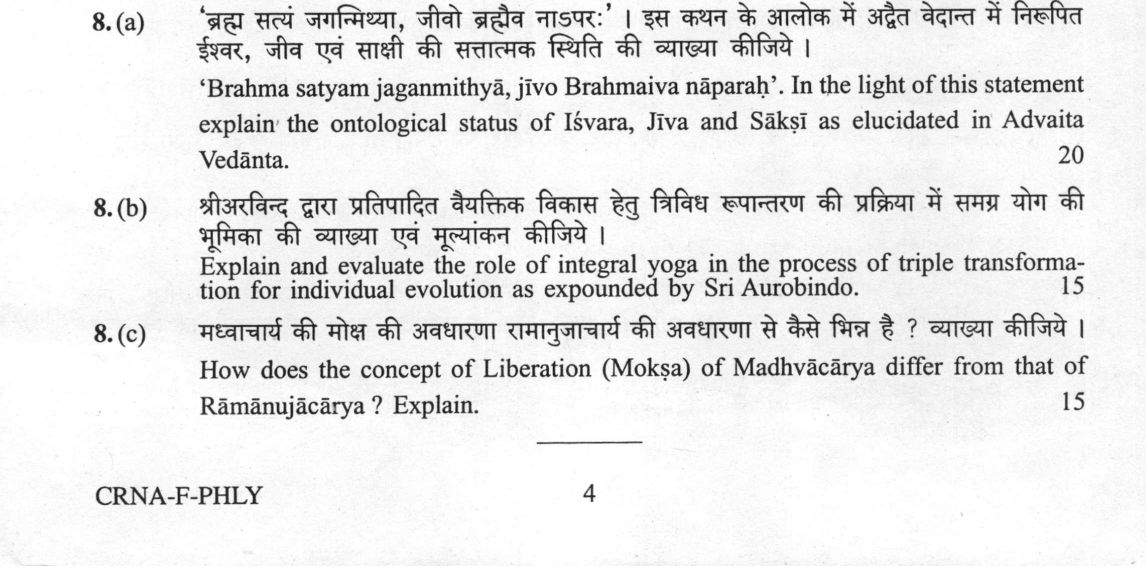
(a) 'Brahma satyam jaganmithyā, jivo Brahmaiva nāparaḥ'. In the light of this statement explain the ontological status of Īśvara…
'Brahma satyam jaganmithyā, jivo Brahmaiva nāparaḥ'. In the light of this statement explain the ontological status of Īśvara, Jīva and Sākṣī as elucidated in Advaita Vedānta. 20 marks
Explain and evaluate the role of integral yoga in the process of triple transformation for individual evolution as expounded by Sri Aurobindo. 15 marks
How does the concept of Liberation (Mokṣa) of Madhvācārya differ from that of Rāmānujācārya ? Explain. 15 marks
हिंदी में प्रश्न पढ़ें
'ब्रह्म सत्यं जगन्मिथ्या, जीवो ब्रह्मैव नापरः ।' इस कथन के आलोक में अद्वैत वेदान्त में निरूपित ईश्वर, जीव एवं साक्षी की सत्तात्मक स्थिति की व्याख्या कीजिये । (20 अंक)
श्रीअरविन्द द्वारा प्रतिपादित वैयक्तिक विकास हेतु त्रिविध रूपान्तरण की प्रक्रिया में समग्र योग की भूमिका की व्याख्या एवं मूल्यांकन कीजिये । (15 अंक)
मध्वाचार्य की मोक्ष की अवधारणा रामानुजाचार्य की अवधारणा से कैसे भिन्न है ? व्याख्या कीजिये । (15 अंक)
Model answer
Written by UPSC Answer Check against this question's marking rubric, to the expected length. UPSC does not publish answers for Mains — this is one way to score well, not an official key.
The three traditions move from non-duality to integral evolution to dualism.
Part (a) The mahāvākya states that Brahman alone is real, the world is mithyā, and the jīva is none other than Brahman. In Śaṅkara’s adhyāsa-bhāṣya thesis, this explains empirical experience without denying it. Brahman is pāramārthika sat, self-luminous and without second. The world is vyāvahārika mithyā: neither absolutely real like Brahman nor unreal like a horn, because it is experienced, causally efficacious, and sublated in knowledge of Brahman. Hence mithyātva is anirvacyanīya, beyond sat and asat. Its appearance is explained through sṛṣṭi-dr̥ṣṭi-vāda: the world is not independent creation but an appearance of Brahman, a superimposition (adhyāsa) of name and form. The three grades of reality—prātibhāsika, vyāvahārika and pāramārthika—show that the world has transactional reality while Brahman alone is ultimate. Īśvara is not a second reality but saguṇa Brahman, Brahman associated with māyā and names/forms; he is the efficient cause and object of worship, yet distinct from nirguṇa Brahman transactionally. The jīva is Brahman reflected or limited by upādhis such as body, mind and ignorance; as avaccheda it appears individual, but its essence is svarūpa-caitanya, the sākṣī witnessing consciousness. This sākṣī witnesses adhyāsa unchanged; when ignorance is removed, the jīva’s apparent difference disappears and only Brahman remains. Thus Brahman is ultimate, Īśvara is the real-as-appearing saguṇa aspect, and the jīva is ultimately identical with Brahman, while the world is dependently real and sublatable.
Part (b) Sri Aurobindo’s integral yoga is pūrṇa-yoga because it unites karma, jñāna, bhakti and prāṇa, but aims not at escape from nature but its transformation. The mechanism is that the aspirant turns body, vital and mind towards the higher principle, so action becomes selfless, knowledge intuitive, devotion universal, and prāṇa a transformative force. This prepares the psychic being, the soul-centred centre, to govern the personality. The triple transformation then proceeds: first psychic transformation, where the soul replaces ego as centre; second spiritual transformation, where higher, illumined and intuitive mind replace ordinary mind; third supramental transformation, where truth-consciousness descends into matter, vital and body, making life a vehicle of divine consciousness. Its strength is overcoming ascetic dualism and making evolution active, collective and material. Its limitation is a teleological assumption that consciousness must become supramental, and the feasibility of stable supramental descent in ordinary life remains difficult to verify.
Part (c) Madhva’s mokṣa differs from Rāmānuja’s because Dvaita preserves absolute eternal difference. For Madhva, the fivefold bheda—between Brahman and jīva, Brahman and matter, jīva and matter, jīva and jīva, matter and matter—remains even in liberation. Jīvas are divided into nitya-mukta, nitya-baddha and mukti-yogya; only the last attain liberation through Viṣṇu’s grace, aided by bhakti and prapatti. Mokṣa is sāyujya with Viṣṇu in his abode, not identity or absorption into undifferentiated Brahman; the liberated jīva enjoys blissful communion while retaining distinctness. Rāmānuja, by contrast, holds viśiṣṭādvaita: the jīva is a real part of Brahman, like a body to the soul, and is śeṣa of Brahman/Śrī. Mokṣa is union with Brahman while individuality is retained, not Advaitic kaivalya as isolation. It is experienced in four modes—sālokya, sāmīpya, sārūpya and sāyujya—according to the jīva’s capacity, with bhakti as the primary means. Thus Madhva’s liberation is eternal distinction under grace, whereas Rāmānuja’s is organic unity-in-difference through devotion.
Thus, while Advaita resolves ontology into identity, Aurobindo’s integral yoga is a powerful but speculative evolutionary synthesis, and the Vedāntic difference between Madhva and Rāmānuja turns on whether difference is eternal or qualified.
What "Explain" is asking you to do
Make the working of something clear — what sets it off, what follows from what, and what it produces. Explain is the Commission's mechanism word: it dominates the technical papers and the “explain why” stems, where the marks sit in the causal chain and not in the label.
Structure that answers it
State what it is → the initiating condition → the chain of cause, step by step → an instance where it plays out → what the chain produces
Where marks are lost
Describing what something looks like instead of why it works that way. Naming the stages without linking them reads as description too.
How this answer will be evaluated
Approach
(a) explain: definition/context > points in order > small example > short close | (b) evaluate: criteria > evidence > balanced judgment | (c) compare: paired headings or table > key differences > significance > conclusion Full marks: Precise Sanskrit terminology, clear distinction of ontological/philosophical concepts, strong evaluation/critique.
Key points expected
- Define 'Brahma satyam jaganmithyā' (Mayavada) and 'jīvo Brahmaiva nāparaḥ' (identity).
- Explain Īśvara as Māyā-śakti (qualified Brahman) and its ontological status.
- Explain Jīva as Brahman with Avidyā (empirical) vs. Tattva (real).
- Explain Sākṣī as the pure, unchanging witness consciousness.
- Define the 'Triple Transformation': Psychic, Spiritual, and Supramental.
- Explain the role of Integral Yoga in effecting these changes.
- Evaluate the process: from lower nature to higher nature.
- Discuss the goal: Divine Life on Earth (Supramentalisation).
Evaluation rubric
Each sub-part is marked on its own, against the marks and word limit printed on the paper.
- (a) Ontological status of Īśvara, Jīva, and Sākṣī in Advaita Vedānta based on the provided maxim. 20 marks
explain— definition/context → points in order → small example → short close
Must cover
- Define 'Brahma satyam jaganmithyā' (Mayavada) and 'jīvo Brahmaiva nāparaḥ' (identity).
- Explain Īśvara as Māyā-śakti (qualified Brahman) and its ontological status.
- Explain Jīva as Brahman with Avidyā (empirical) vs. Tattva (real).
- Explain Sākṣī as the pure, unchanging witness consciousness.
Loses marks
- Confusing Advaita with Viśiṣṭādvaita or Dvaita ontologies.
- Treating Īśvara as a separate, independent creator (Dvaita view).
- Vague paraphrase without technical Sanskrit terminology.
Earns more
- Distinguish between Vyāvahārika (empirical) and Pāramārthika (absolute) reality.
- Use precise Sanskrit terms: Avidyā, Māyā, Tattva, Ātman.
- Discuss the role of Avidyā in creating the illusion of difference.
Extra mark
- Reference to specific Upaniṣadic quotes (e.g., Tat Tvam Asi).
- Mention of specific Advaitin commentators (e.g., Śaṅkara's Bhaṣya).
- (b) Role of Integral Yoga in Sri Aurobindo's triple transformation for individual evolution. 15 marks
evaluate— criteria → evidence → balanced judgment
Must cover
- Define the 'Triple Transformation': Psychic, Spiritual, and Supramental.
- Explain the role of Integral Yoga in effecting these changes.
- Evaluate the process: from lower nature to higher nature.
- Discuss the goal: Divine Life on Earth (Supramentalisation).
Loses marks
- Confusing Integral Yoga with standard Hatha or Raja Yoga.
- Failing to distinguish the three specific transformations.
- Biographical details of Sri Aurobindo instead of philosophical analysis.
Earns more
- Distinguish between Psychic Being and the Soul.
- Explain the concept of 'Descent of the Supermind'.
- Critique the feasibility or the specific stages of the transformation.
Extra mark
- Reference to specific works (e.g., The Life Divine, Savitri).
- Mention of the 'Harmonisation' of the parts of the nature.
- (c) Differences in the concept of Liberation (Mokṣa) between Madhvācārya and Rāmānujācārya. 15 marks
compare— paired headings or table → key differences → significance → conclusion
Must cover
- Rāmānuja's Mokṣa: Sādharmyā (likeness to God) and eternal service (Sevā).
- Madhva's Mokṣa: Eternal service (Sevā) in Vaikuṇṭha.
- Key difference: Rāmānuja's 'likeness' vs. Madhva's 'eternal difference' (Bheda).
- Explain the role of God's grace (Prasāda) in both.
Loses marks
- Confusing the two systems (e.g., attributing identity to Madhva).
- Failing to mention the concept of 'Service' (Sevā) in both.
- Vague generalities without specific technical terms.
Earns more
- Mention of 'Sādharmyā' specifically for Rāmānuja.
- Mention of 'Bheda' (difference) as the core of Madhva's view.
- Comparison of the nature of the soul (Jīva) in both systems.
Extra mark
- Reference to specific texts (e.g., Śrī Bhāṣya vs. Gītā Bhaṣya).
- Mention of the 'Fivefold Bhakti' in Madhva's system.
Practice this exact question
Write your answer and it is marked point by point against the model answer above — what you covered, what you missed, what you got wrong.
Evaluate my answer →More from Philosophy 2022 Paper I
- Q5 (a) Examine and evaluate the proofs given by Sāmkhya philosophy to prove the existence of…
- Q6 (a) How compatible is Buddhist theory of momentariness with their theory of Karma? In thi…
- Q7 (a) Inspite of accepting the intrinsic validity of knowledge, why and how Prabhākara and…
- Q8 (a) 'Brahma satyam jaganmithyā, jivo Brahmaiva nāparaḥ'. In the light of this statement e…