Paper I — Q2
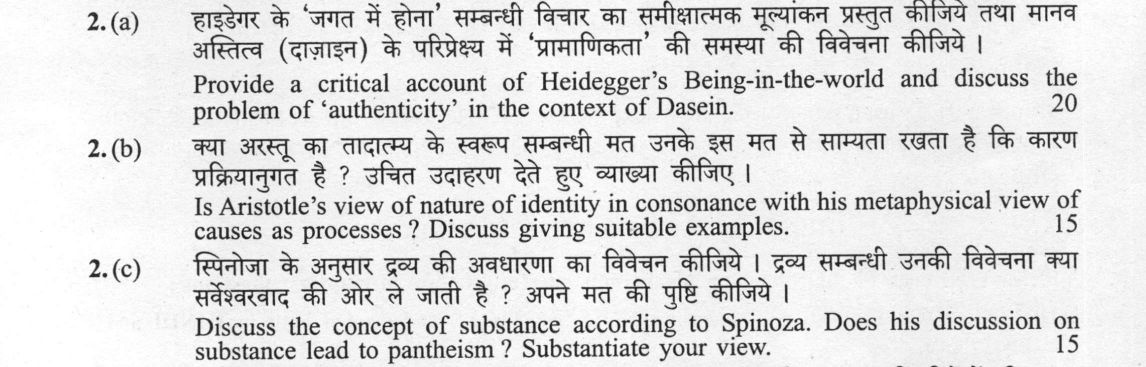
(a) Provide a critical account of Heidegger's Being-in-the-world and discuss the problem of 'authenticity' in the context of…
Provide a critical account of Heidegger's Being-in-the-world and discuss the problem of 'authenticity' in the context of Dasein. 20 marks
Is Aristotle's view of nature of identity in consonance with his metaphysical view of causes as processes ? Discuss giving suitable examples. 15 marks
Discuss the concept of substance according to Spinoza. Does his discussion on substance lead to pantheism ? Substantiate your view. 15 marks
हिंदी में प्रश्न पढ़ें
हाइडेगर के 'जगत में होना' सम्बन्धी विचार का समीक्षात्मक मूल्यांकन प्रस्तुत कीजिये तथा मानव अस्तित्व (दाजाइन) के परिप्रेक्ष्य में 'प्रामाणिकता' की समस्या की विवेचना कीजिये । (20 अंक)
क्या अरस्तू का तादात्म्य के स्वरूप सम्बन्धी मत उनके इस मत से साम्यता रखता है कि कारण प्रक्रियानुगत है ? उचित उदाहरण देते हुए व्याख्या कीजिए । (15 अंक)
स्पिनोजा के अनुसार द्रव्य की अवधारणा का विवेचन कीजिये । द्रव्य सम्बन्धी उनकी विवेचना क्या सर्वेश्वरवाद की ओर ले जाती है ? अपने मत की पुष्टि कीजिये । (15 अंक)
Model answer
Written by UPSC Answer Check against this question's marking rubric, to the expected length. UPSC does not publish answers for Mains — this is one way to score well, not an official key.
The question spans the continental-analytical divide: Heidegger’s continental existential ontology, Aristotle’s processual hylomorphism, and Spinoza’s rationalist monism all reconfigure identity.
Heidegger For Heidegger, Dasein is not a subject facing an object but Being-in-the-world (In-der-Welt-sein): a primordial involvement in which world is disclosed through use, reference and concern. In the equipmental totality, a hammer is encountered as Zuhanden (ready-to-hand) within a referential whole, not as present-at-hand (Vorhandenheit) for theoretical inspection. Dasein’s existence is care (Sorge), whose practical concern with equipment is Besorgen, and which is structured by thrownness (Geworfenheit) and projection: we are already in a world we did not choose, yet we understand ourselves by taking up possibilities. Anxiety (Angst) strips away the distractions of the They (das Man) and discloses being-toward-death, making authenticity (Eigentlichkeit) possible through resoluteness (Entschlossenheit): owning one’s finite situation rather than fleeing into idle talk. Critically, this account is powerful but narrow. Authenticity is framed ontologically, not ethically or politically; resoluteness can become a private stance without norms for justice or responsibility. Irigaray’s feminist critique shows Dasein’s “neutral” subject is still coded by masculine norms of self-presence and separation. Sartre’s existentialism stresses concrete freedom, which exposes the risk that Heidegger’s authenticity remains abstract; the sharper charge of political abstraction—detachment from social institutions, labour and domination—is better associated with Adorno, Marcuse and Habermas.
Aristotle Aristotle’s identity is not a Platonic fixed form but the actualization of a substance’s form. In the Categories and Metaphysics, the ti estin (what-it-is) is tied to formal cause (eidos) as a relatively static essence; yet in Physics, causes are principles of change (kinêsis), not static explanations. The tension is resolved through potentiality (dynamis) and actuality (entelecheia): identity is the stable form that is continuously realized in material process. The acorn-oak example shows this: the oak’s identity is not a finished shape but the form guiding growth, while the embryo illustrates how biological identity is maintained through developmental change. Thus identity is consonant with processual causation if substantial form is understood as telic activity, not a frozen essence. A Platonist reading would make form static and separate; Aristotle’s immanent form avoids that, though the risk remains if formal cause is treated as a final blueprint rather than an ongoing entelechy.
Spinoza Spinoza defines substance, in Ethics I, as in se, per se, causa sui, infinite and unique. Attributes—thought and extension, as known to us—are the infinite ways in which the intellect perceives substance’s essence; modes are its finite affections. God is not a transcendent creator but deus sive natura: an immanent cause whose nature is the order of nature. This seems pantheistic, but the charge needs qualification. God is not strictly coextensive with the physical and mental universe, because substance has infinite attributes of which humans perceive only thought and extension. Against mystical pantheism, such as Plotinian emanation, Spinoza’s God does not overflow into lesser beings; against scientific naturalism, his God is not merely matter in motion but rational necessity. The Advaita parallel is suggestive: Brahman-Atman is the ground of all, while the world is not simply identical with the Absolute in the same crude sense. Spinoza’s “God-intoxicated” view preserves immanence but not transcendence; it is pantheism in a rationalist, non-mystical sense.
Conclusion Each thinker reconfigures traditional metaphysics: Heidegger makes identity existential and finite, Aristotle makes it processual and teleological, Spinoza makes it monistic and immanent. The critical verdict is that Heidegger’s authenticity is illuminating but politically underdetermined; Aristotle’s identity is consonant with process only when form is entelechy, not static essence; and Spinoza’s substance leads to a qualified pantheism that is immanent, not transcendent, and richer than the known universe.
What "Critically analyse" is asking you to do
Break the subject into its working parts and show how they act on each other. The marks are in the interconnections — which factor drives which, and what the resulting structure explains — not in the inventory of factors. “Critically” is not a section added at the end: name the yardstick you are judging by — the evidence, the stated objective, a constitutional principle, a rival explanation — and let a verdict close each part of the body. Where the question quotes a claim, that verdict must land on the claim itself, accepted, qualified or rejected, and not on the theme in general.
Structure that answers it
Define the whole → separate it into its parts → show which part drives which → what that interaction produces → what the structure implies
Where marks are lost
Merits in one paragraph, demerits in the next, and a conclusion calling for a balanced and holistic approach. That is a survey with the judgement left out and it holds the answer in the middle band. The opposite error is reading “critically” as permission to attack — and with the odd pairings, critically describe or critically explain, the exposition still carries most of the marks, the judgement being a layer on it rather than a substitute for it.
How this answer will be evaluated
Approach
Framework: UPSC Philosophy Paper 1. (a) critique: the claim > its strengths > its weaknesses > your judgment | (b) discuss: intro > 3-4 dimensions > example > balanced close | (c) discuss: intro > 3-4 dimensions > example > balanced close Full marks: Precise technical vocabulary, strong critical analysis, clear examples, and balanced judgment.
Key points expected
- Define Dasein and Being-in-the-world (In-der-Welt-sein)
- Distinguish authentic (Eigentlichkeit) from inauthentic (Uneigentlichkeit) existence
- Explain the role of 'the They' (das Man) in inauthenticity
- Critique the concept of authenticity or its limitations
- Define Aristotle's view of identity (substance/form)
- Explain the four causes (material, formal, efficient, final)
- Discuss how causes operate as processes (becoming)
- Provide suitable examples (e.g., acorn to oak, bronze statue)
Evaluation rubric
Each sub-part is marked on its own, against the marks and word limit printed on the paper.
- (a) Critical reconstruction of Being-in-the-world and the problem of authenticity in Dasein. 20 marks
critique— the claim → its strengths → its weaknesses → your judgment
Must cover
- Define Dasein and Being-in-the-world (In-der-Welt-sein)
- Distinguish authentic (Eigentlichkeit) from inauthentic (Uneigentlichkeit) existence
- Explain the role of 'the They' (das Man) in inauthenticity
- Critique the concept of authenticity or its limitations
Loses marks
- Biographical details of Heidegger
- Vague paraphrase without technical terms
- Confusing Dasein with 'human being' in general
Earns more
- Use of Greek/German terms (Dasein, Eigentlichkeit, das Man)
- Reference to 'Being-towards-death' (Sein-zum-Tode)
- Mention of 'Care' (Sorge) as the structure of Dasein
Extra mark
- Reference to specific sections of Being and Time (Sein und Zeit)
- (b) Examine the relationship between Aristotle's view of identity and his view of causes as processes. 15 marks
discuss— intro → 3-4 dimensions → example → balanced close
Must cover
- Define Aristotle's view of identity (substance/form)
- Explain the four causes (material, formal, efficient, final)
- Discuss how causes operate as processes (becoming)
- Provide suitable examples (e.g., acorn to oak, bronze statue)
Loses marks
- Treating causes as static rather than processual
- Lack of concrete examples
- Confusing identity with mere sameness
Earns more
- Use of Greek terms (ousia, eidos, aitia)
- Distinction between potentiality (dynamis) and actuality (energeia)
- Reference to hylomorphism
Extra mark
- Reference to specific books of Metaphysics or Physics
- (c) Discuss Spinoza's concept of substance and whether it leads to pantheism. 15 marks
discuss— intro → 3-4 dimensions → example → balanced close
Must cover
- Define Spinoza's concept of substance (Deus sive Natura)
- Explain the attributes of substance (thought and extension)
- Analyze the argument for the uniqueness of substance
- Evaluate whether this leads to pantheism (God = Nature)
Loses marks
- Confusing Spinoza's God with a personal deity
- Failing to substantiate the view on pantheism
- Vague description of substance without attributes
Earns more
- Use of Latin terms (Deus sive Natura, substantia, attributa)
- Reference to the Ethics (Ethica)
- Distinction between pantheism and panentheism
Extra mark
- Reference to specific propositions in the Ethics
Practice this exact question
Write your answer and it is marked point by point against the model answer above — what you covered, what you missed, what you got wrong.
Evaluate my answer →More from Philosophy 2022 Paper I
- Q1 (a) How does Plato use the theory of forms to establish the relation between epistemology…
- Q2 (a) Provide a critical account of Heidegger's Being-in-the-world and discuss the problem…
- Q3 (a) How does Kant construct antinomies to illustrate the illusory tendencies of pure reas…
- Q4 (a) How does Soren Kierkegaard define the notion of 'subjectivity'? Explain it with refer…
- Q5 (a) Examine and evaluate the proofs given by Sāmkhya philosophy to prove the existence of…