Paper I — Q7
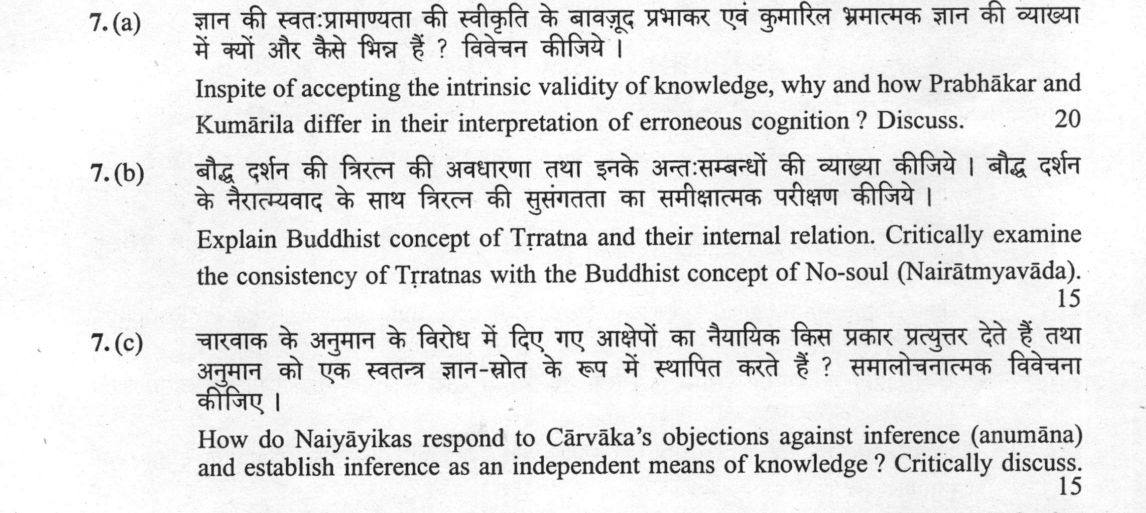
(a) Inspite of accepting the intrinsic validity of knowledge, why and how Prabhākara and Kumārila differ in their interpretation…
Inspite of accepting the intrinsic validity of knowledge, why and how Prabhākara and Kumārila differ in their interpretation of erroneous cognition ? Discuss. 20 marks
Explain Buddhist concept of Trīratna and their internal relation. Critically examine the consistency of Trīratnas with the Buddhist concept of No-soul (Nairātmyavāda). 15 marks
How do Naiyāyikas respond to Cārvāka's objections against inference (anumāna) and establish inference as an independent means of knowledge ? Critically discuss. 15 marks
हिंदी में प्रश्न पढ़ें
ज्ञान की स्वतःप्रामाण्यता की स्वीकृति के बावजूद प्रभाकर एवं कुमारिल भ्रामक ज्ञान की व्याख्या में क्यों और कैसे भिन्न हैं ? विवेचन कीजिये । (20 अंक)
बौद्ध दर्शन की त्रिरत्न की अवधारणा तथा इनके अन्तःसम्बन्धों की व्याख्या कीजिये । बौद्ध दर्शन के नैरात्म्यवाद के साथ त्रिरत्न की सुसंगतता का समीक्षात्मक परीक्षण कीजिये । (15 अंक)
चार्वाक के अनुमान के विरोध में दिए गए आक्षेपों का नैयायिक किस प्रकार प्रत्युत्तर देते हैं तथा अनुमान को एक स्वतन्त्र ज्ञान-स्रोत के रूप में स्थापित करते हैं ? समालोचनात्मक विवेचना कीजिए । (15 अंक)
Model answer
Written by UPSC Answer Check against this question's marking rubric, to the expected length. UPSC does not publish answers for Mains — this is one way to score well, not an official key.
The common thread is functional validity: cognition, refuge and inference are accepted by their efficacy, not by ultimate substance.
Prabhākara and Kumārila on error. Both Mīmāṃsakas accept svataḥ-prāmāṇya: a cognition is valid in itself, not because of later verification. Their difference lies in what error is. Prabhākara, beginning with nirvikalpa perception, holds akhyāti: error is non-apprehension of the real object or relation. In shell-silver, the mistake is not a positive cognition of an unreal silver; it is the failure to cognize that the shell is not silver. Ontologically, there is no positive erroneous object, only absence of cognition of the real. Kumārila, by contrast, stresses savikalpa realism: determinate cognition presents real attributes, and error is viparītakhyāti, a positive cognition that is contrary to the real state of affairs. It is not mere absence; it has determinate content, but it misrepresents reality. Thus, despite shared intrinsic validity, Prabhākara reduces error to a defect in apprehension, while Kumārila treats it as a positive wrong cognition.
Trīratna and no-soul. The Trīratna are Buddha, Dharma and Saṅgha. The Buddha is the awakened teacher who reveals the path; Dharma is the teaching and path; Saṅgha is the community that preserves, practices and embodies that teaching. Their internal relation is functional: the Buddha points to the Dharma, the Dharma is actualized in the Saṅgha, and the Saṅgha preserves the Buddha’s Dharma. As refuge, they are not three independent substances but a soteriological triad: the guide, the path, and the supportive community.
The apparent tension with Nairātmyavāda is that the Trīratna may seem to imply enduring entities: a permanent Buddha, an eternal Dharma, or a substantial Saṅgha. Buddhism, however, denies a substantial self in persons and phenomena, not conventional functional designations. The Buddha is a conventional designation over aggregates, not an eternal soul; Dharma is a causal process and teaching, not an immutable substance; Saṅgha is a collection of momentary aggregates. Dharmakīrti’s arthakriyā resolves the issue: the Trīratna are conventionally real because they have causal efficacy in producing liberation. Prajñāpāramitā adds that all three are empty of intrinsic nature yet functionally effective. Hence the Trīratna are consistent with no-soul: they are refuges because they work, not because they possess permanent selfhood.
Nyāya against Cārvāka. Cārvāka rejects anumāna. Its objections are sādhāraṇa, asādhāraṇa and kalātyayāpadiṣṭa: a reason is either common to many things and cannot pick out the particular conclusion, or unique and cannot be known to be universally related; and the time-gap between hetu and sādhya makes concomitance uncertain. Nyāya responds by distinguishing svārtha and parārtha anumāna, showing that inference is a distinct cognitive operation, and by defending vyāpti. Vyāpti is established through repeated observation, absence of counterexample, and tarka. Gaṅgeśa clarifies vyāpti as the absence of the hetu in the absence of the sādhya, a negative concomitance known through perception and exclusion. Udayana’s Nyāyakusumāñjali argues that the Cārvāka objections fail: common properties can be restricted by the locus and the universal relation, unique properties can be known through perception and memory, and the time-gap does not destroy vyāpti because the relation is not dependent on simultaneity.
Critically, Nyāya’s success depends on whether vyāpti can be known independently of inference. If repeated observation is merely inductive, the Cārvāka charge of circularity remains. Yet for Nyāya, inference is an independent pramāṇa because its validity rests on vyāpti, a real universal relation known through perception and tarka, not on another pramāṇa. It is therefore not derivative from perception or testimony, though it remains conditional on the correct establishment of vyāpti and the absence of defects.
What "Discuss" is asking you to do
Lay the issue out from more than one side — how it arose, what is claimed for it, what is held against it, and where it now stands. UPSC attaches discuss to broad topics with several live dimensions, so coverage of the dimensions earns more than the strength of your opinion.
Structure that answers it
Set the issue up → the case as it is made → the case against → the dimension both sides leave out → where the balance now lies
Where marks are lost
Listing facts with no thread between them, or arguing one side throughout and calling it a discussion.
How this answer will be evaluated
Approach
Framework: Mīmāṃsā Epistemology. (a) discuss: intro > 3-4 dimensions > example > balanced close | (b) examine: intro > how/why with reasoning > evidence > conclusion | (c) discuss: intro > 3-4 dimensions > example > balanced close Full marks: Precise technical vocabulary, clear distinction between views, balanced critical analysis, and accurate use of Sanskrit terms.
Key points expected
- Kumārila's theory of 'anupalabdhi' (absence of object)
- Prabhākara's theory of 'vṛttiviparyaya' (misapprehension)
- Role of 'svatah pramāṇyatā' in both views
- Distinction between 'svatah' and 'paratah' validity
- Definition of Buddha, Dharma, and Saṅgha
- Explanation of Nairātmyavāda (No-soul doctrine)
- Argument for consistency (e.g., Saṅgha as community, not soul)
- Argument for potential inconsistency (e.g., reification of Buddha)
Evaluation rubric
Each sub-part is marked on its own, against the marks and word limit printed on the paper.
- (a) Contrast Kumārila and Prabhākara on the nature of erroneous cognition (apoha) within svatah pramāṇyatā. 20 marks
discuss— intro → 3-4 dimensions → example → balanced close
Must cover
- Kumārila's theory of 'anupalabdhi' (absence of object)
- Prabhākara's theory of 'vṛttiviparyaya' (misapprehension)
- Role of 'svatah pramāṇyatā' in both views
- Distinction between 'svatah' and 'paratah' validity
Loses marks
- Confusing Kumārila with Prabhākara's views
- Vague paraphrase without technical terms
- Biographical details of the philosophers
Earns more
- Use of Sanskrit terms like 'anupalabdhi' and 'vṛttiviparyaya'
- Reference to 'svatah' vs 'paratah' validity
- Mention of 'apoha' (exclusion) theory
- Clear distinction between the two Mīmāṃsā sub-schools
Extra mark
- Reference to specific Mīmāṃsā texts (e.g., Mīmāṃsā-sūtra)
- Mention of later commentators (e.g., Śaṅkara Bhaṭṭa)
- (b) Explain the Tri-ratna (Three Jewels) and critically assess its consistency with Nairātmyavāda (No-soul). 15 marks
examine— intro → how/why with reasoning → evidence → conclusion
Must cover
- Definition of Buddha, Dharma, and Saṅgha
- Explanation of Nairātmyavāda (No-soul doctrine)
- Argument for consistency (e.g., Saṅgha as community, not soul)
- Argument for potential inconsistency (e.g., reification of Buddha)
Loses marks
- Confusing 'soul' with 'self' or 'personality'
- Vague paraphrase without technical terms
- Biographical details of the Buddha
Earns more
- Use of Sanskrit terms like 'Nairātmyavāda' and 'Tri-ratna'
- Reference to specific Buddhist texts (e.g., Pāli Canon)
- Clear distinction between 'soul' and 'self'
- Balanced critical analysis of the consistency
Extra mark
- Reference to specific Buddhist schools (e.g., Theravāda, Mahāyāna)
- Mention of specific sutras or philosophical works
- (c) Analyze Naiyāyika responses to Cārvāka objections against inference (anumāna) and its status as independent pramāṇa. 15 marks
discuss— intro → 3-4 dimensions → example → balanced close
Must cover
- Cārvāka's main objections to inference (e.g., circularity, redundancy)
- Naiyāyika's defense of 'vyāpti' (invariable connection)
- Establishment of inference as independent pramāṇa
- Distinction between 'svatah' and 'paratah' validity in inference
Loses marks
- Confusing Cārvāka with other schools
- Vague paraphrase without technical terms
- Biographical details of the philosophers
Earns more
- Use of Sanskrit terms like 'vyāpti' and 'anumāna'
- Reference to specific Naiyāyika texts (e.g., Naiyāyika-sūtra)
- Clear distinction between 'inference' and 'perception'
- Balanced critical analysis of the objections
Extra mark
- Reference to specific Naiyāyika philosophers (e.g., Udayana)
- Mention of specific logical examples (e.g., smoke and fire)
Practice this exact question
Write your answer and it is marked point by point against the model answer above — what you covered, what you missed, what you got wrong.
Evaluate my answer →More from Philosophy 2022 Paper I
- Q4 (a) How does Soren Kierkegaard define the notion of 'subjectivity'? Explain it with refer…
- Q5 (a) Examine and evaluate the proofs given by Sāmkhya philosophy to prove the existence of…
- Q6 (a) How compatible is Buddhist theory of momentariness with their theory of Karma? In thi…
- Q7 (a) Inspite of accepting the intrinsic validity of knowledge, why and how Prabhākara and…
- Q8 (a) 'Brahma satyam jaganmithyā, jivo Brahmaiva nāparaḥ'. In the light of this statement e…