Paper I — Q4
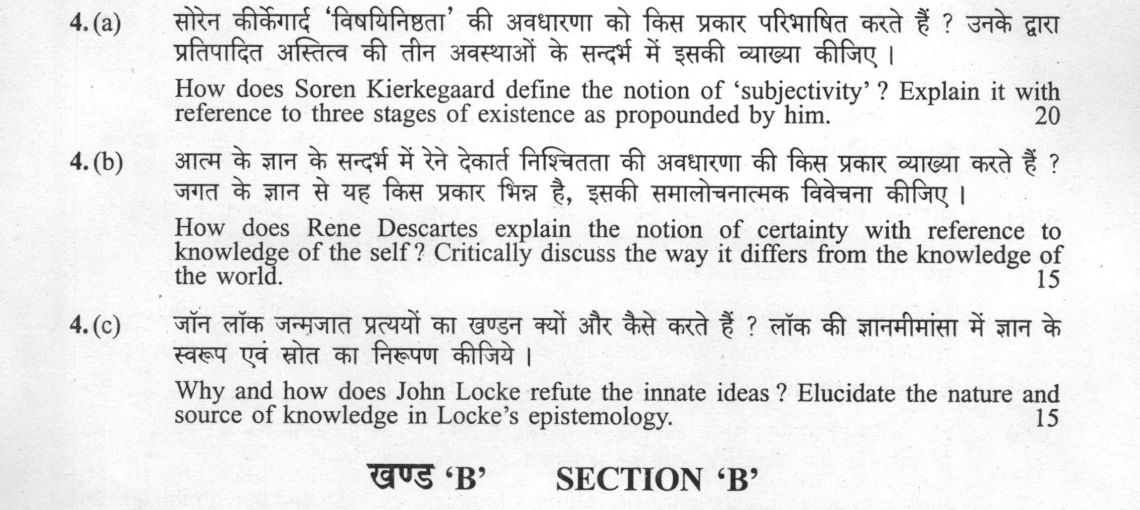
(a) How does Soren Kierkegaard define the notion of 'subjectivity'? Explain it with reference to three stages of existence as…
How does Soren Kierkegaard define the notion of 'subjectivity'? Explain it with reference to three stages of existence as propounded by him. 20 marks
How does Rene Descartes explain the notion of certainty with reference to knowledge of the self? Critically discuss the way it differs from the knowledge of the world. 15 marks
Why and how does John Locke refute the innate ideas? Elucidate the nature and source of knowledge in Locke's epistemology. 15 marks
हिंदी में प्रश्न पढ़ें
सोरेन कीर्केगार्ड 'विषयनिष्ठता' की अवधारणा को किस प्रकार परिभाषित करते हैं ? उनके द्वारा प्रतिपादित अस्तित्व की तीन अवस्थाओं के संदर्भ में इसकी व्याख्या कीजिए । (20 अंक)
आत्म के ज्ञान के संदर्भ में रेने देकार्त निश्चितता की अवधारणा की किस प्रकार व्याख्या करते हैं ? जगत के ज्ञान से यह किस प्रकार भिन्न है, इसकी समालोचनात्मक विवेचना कीजिए । (15 अंक)
जॉन लॉक जन्मजात प्रत्ययों का खण्डन क्यों और कैसे करते हैं ? लॉक की ज्ञानमीमांसा में ज्ञान के स्वरूप एवं स्रोत का निरूपण कीजिये । (15 अंक)
Model answer
Written by UPSC Answer Check against this question's marking rubric, to the expected length. UPSC does not publish answers for Mains — this is one way to score well, not an official key.
The evolution of modern epistemology traces a critical trajectory from rationalist indubitability and empiricist naturalism to the existential revolt against abstract systematic thought.
Kierkegaard’s Subjectivity and the Three Stages of Existence
Soren Kierkegaard defines subjectivity through the dictum that "truth is subjectivity." For Kierkegaard, truth is not an objective, detached appropriation of metaphysical systems, but an inward, passionate commitment to an objective uncertainty. Objective truth treats human existence as a spectator, whereas subjective truth demands living authentically through choice and personal appropriation.
Existence unfolds dialectically through three qualitative stages:
The Aesthetic Stage is anchored in immediate sensuous pleasure, novelty, and the evasion of boredom, epitomised by figures like Don Juan. Because aesthetic immediacy relies on external conditions, it inevitably fragments the self, culminating in dread and despair.
The Ethical Stage is entered through a conscious existential choice. Here, the individual submits to universal moral laws and duties, achieving Socratic self-knowledge and civic responsibility. Yet, the ethical stage eventually collapses under the weight of universal demands because finite individuals inevitably experience guilt and the inability to achieve absolute righteousness.
The Religious Stage represents the summit of existence, accessed not through rational deliberation but via a non-rational "leap of faith" into the absurd. In this stage, a teleological suspension of the ethical occurs, as exemplified by Abraham's willingness to sacrifice Isaac at God's command. Kierkegaard distinguishes between the Knight of Infinite Resignation, who gives up the finite through rational strength, and the Knight of Faith, who embraces the finite back by virtue of the absurd, passionately clinging to God despite objective uncertainty.
Descartes on the Certainty of the Self versus the World
Rene Descartes establishes certainty by applying systematic doubt, stripping away sensory perceptions and mathematical truths via the dream and evil demon hypotheses. This doubt terminates at the indubitable truth: Cogito, ergo sum (I think, therefore I am). The thinking self (res cogitans) cannot be doubted, as the very act of doubting confirms the existence of a thinking agent. Descartes derives his criteria of certainty—clarity and distinctness—from this immediate intuition.
Self-knowledge critically differs from knowledge of the external world (res extensa). Knowledge of the self is direct, immediate, and non-inferential; there is zero ontological gap between the knower and the known, making it immune to hyperbolic doubt. Conversely, knowledge of the external world is indirect, representational, and mediated through ideas. Because ideas might be deceptive or illusory, knowledge of res extensa requires proving the existence of a non-deceiving God to guarantee the veridical nature of clear and distinct sensory perceptions. Thus, res cogitans is known prior to, and with vastly greater certainty than, the physical world.
Locke’s Epistemology and Refutation of Innate Ideas
John Locke refutes the rationalist doctrine of innate ideas by demonstrating that universal consent is non-existent. Children, idiots, and uncultivated minds possess no awareness of speculative maxims (such as the principle of non-contradiction) or practical moral laws. Locke argues that asserting ideas exist in the mind without conscious awareness is contradictory; furthermore, attributing erroneous innate principles to human nature would make God the author of error.
Locke posits the mind as a tabula rasa (white paper), devoid of all characters. Knowledge originates solely in experience, which branches into two sources: Sensation (external objects imparting impressions through the senses) and Reflection (the internal observation of the mind's own operations).
The mind passively receives simple ideas (e.g., coldness, hardness) and actively combines, compares, and abstracts them into complex ideas of substances, modes, and relations. Locke further divides object properties into primary qualities (objective and inseparable from the body, such as solidity, extension, and motion) and secondary qualities (subjective powers producing sensations in us, such as colour, taste, and sound). Knowledge consists in the perception of the agreement or disagreement of ideas, classified into three hierarchical degrees: intuitive (immediate and self-evident, yielding the highest certainty), demonstrative (mediated through proofs, like mathematics), and sensitive (perceiving the particular existence of finite external beings, bearing the lowest certainty).
Modern philosophy thus demonstrates that Descartes' quest for foundational rational certainty and Locke's empirical limits of representation ultimately necessitate Kierkegaard's existential turn, showing that objective epistemological frameworks cannot resolve the inward dilemma of human existence.
What "Explain" is asking you to do
Make the working of something clear — what sets it off, what follows from what, and what it produces. Explain is the Commission's mechanism word: it dominates the technical papers and the “explain why” stems, where the marks sit in the causal chain and not in the label.
Structure that answers it
State what it is → the initiating condition → the chain of cause, step by step → an instance where it plays out → what the chain produces
Where marks are lost
Describing what something looks like instead of why it works that way. Naming the stages without linking them reads as description too.
How this answer will be evaluated
Approach
(a) explain: definition/context > points in order > small example > short close | (b) critically evaluate: positives > negatives/limits > conditions/safeguards > conclusion | (c) critique: the claim > its strengths > its weaknesses > your judgment Full marks: Precise reconstruction of arguments with technical vocabulary and strong counter-arguments.
Key points expected
- Define subjectivity as 'truth' and inwardness
- Describe the Aesthetic stage and its detachment
- Describe the Ethical stage and universal duty
- Describe the Religious stage and the leap of faith
- Explain the Cogito as indubitable foundation
- Describe the method of hyperbolic doubt
- Contrast self-knowledge with world-knowledge
- Critique the gap between mind and world
Evaluation rubric
Each sub-part is marked on its own, against the marks and word limit printed on the paper.
- (a) Define Kierkegaard's 'subjectivity' and map it to the three stages of existence. 20 marks
explain— definition/context → points in order → small example → short close
Must cover
- Define subjectivity as 'truth' and inwardness
- Describe the Aesthetic stage and its detachment
- Describe the Ethical stage and universal duty
- Describe the Religious stage and the leap of faith
Loses marks
- Biographical details of Kierkegaard
- Vague paraphrase of the stages
- Confusing subjectivity with psychological egoism
Earns more
- Reference to 'The Sickness Unto Death'
- Mention of the 'leap of faith'
- Contrast with objective Hegelian system
- Use of 'inwardness' (Indre)
Extra mark
- Reference to 'Fear and Trembling'
- Mention of the 'single individual'
- (b) Explain Cartesian certainty via self-knowledge and critique its difference from world-knowledge. 15 marks
critically evaluate— positives → negatives/limits → conditions/safeguards → conclusion
Must cover
- Explain the Cogito as indubitable foundation
- Describe the method of hyperbolic doubt
- Contrast self-knowledge with world-knowledge
- Critique the gap between mind and world
Loses marks
- Biographical details of Descartes
- Vague paraphrase of the Cogito
- Confusing certainty with empirical verification
Earns more
- Mention of the 'Evil Demon' hypothesis
- Reference to the 'cogito ergo sum'
- Discussion of the 'cogito' as a clear and distinct idea
- Mention of the 'res cogitans'
Extra mark
- Reference to the 'Meditations on First Philosophy'
- Mention of the 'cogito' as a 'res cogitans'
- (c) Refute innate ideas and elucidate the nature and source of knowledge in Locke. 15 marks
critique— the claim → its strengths → its weaknesses → your judgment
Must cover
- Refute innate ideas via the 'consent' argument
- Explain the 'tabula rasa' concept
- Distinguish between simple and complex ideas
- Identify sensation and reflection as sources
Loses marks
- Biographical details of Locke
- Vague paraphrase of the 'tabula rasa'
- Confusing innate ideas with a priori knowledge
Earns more
- Reference to 'Essay Concerning Human Understanding'
- Mention of the 'consent' argument
- Discussion of the 'tabula rasa'
- Mention of 'sensation' and 'reflection'
Extra mark
- Reference to the 'Essay Concerning Human Understanding'
- Mention of the 'consent' argument
Practice this exact question
Write your answer and it is marked point by point against the model answer above — what you covered, what you missed, what you got wrong.
Evaluate my answer →More from Philosophy 2022 Paper I
- Q1 (a) How does Plato use the theory of forms to establish the relation between epistemology…
- Q2 (a) Provide a critical account of Heidegger's Being-in-the-world and discuss the problem…
- Q3 (a) How does Kant construct antinomies to illustrate the illusory tendencies of pure reas…
- Q4 (a) How does Soren Kierkegaard define the notion of 'subjectivity'? Explain it with refer…
- Q5 (a) Examine and evaluate the proofs given by Sāmkhya philosophy to prove the existence of…
- Q6 (a) How compatible is Buddhist theory of momentariness with their theory of Karma? In thi…
- Q7 (a) Inspite of accepting the intrinsic validity of knowledge, why and how Prabhākara and…