Paper I — Q6
(a) How compatible is Buddhist theory of momentariness with their theory of Karma? In this regard how do Buddhists respond to…
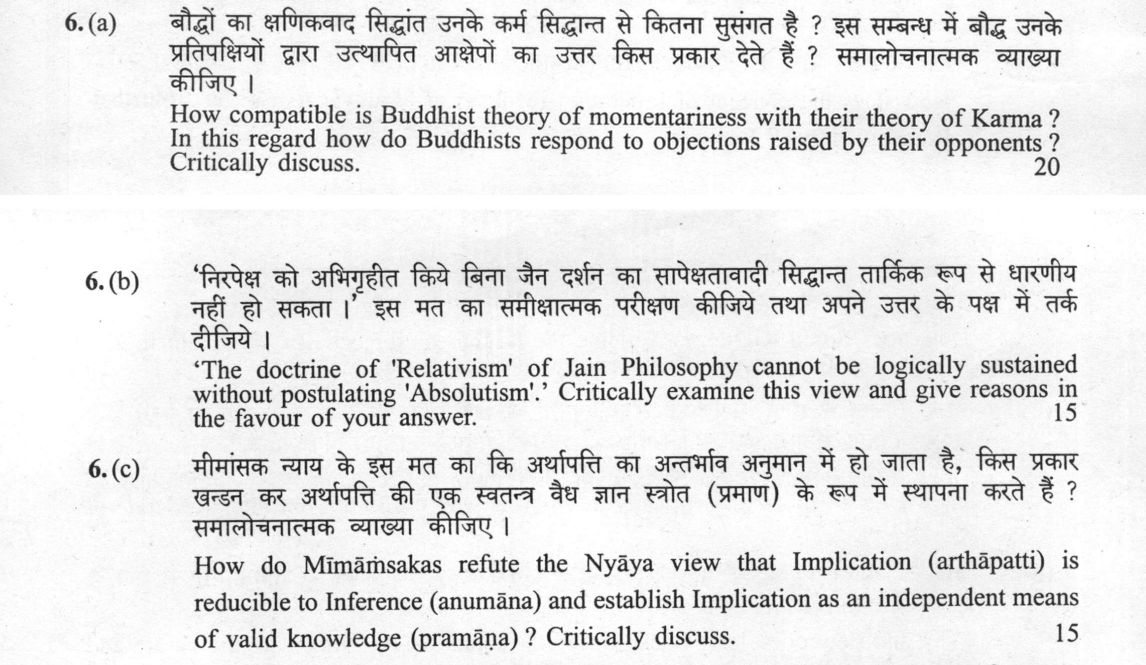
How compatible is Buddhist theory of momentariness with their theory of Karma? In this regard how do Buddhists respond to objections raised by their opponents? Critically discuss. 20 marks
'The doctrine of 'Relativism' of Jain Philosophy cannot be logically sustained without postulating 'Absolutism'.' Critically examine this view and give reasons in the favour of your answer. 15 marks
How do Mīmāṃsakas refute the Nyāya view that Implication (arthāpatti) is reducible to Inference (anumāna) and establish Implication as an independent means of valid knowledge (pramāṇa) ? Critically discuss. 15 marks
हिंदी में प्रश्न पढ़ें
बौद्धों का क्षणिकवाद सिद्धान्त उनके कर्म सिद्धान्त से कितना सुसंगत है ? इस सम्बन्ध में बौद्ध उनके प्रतिपक्षियों द्वारा उत्थापित आक्षेपों का उत्तर किस प्रकार देते हैं ? समालोचनात्मक व्याख्या कीजिए । (20 अंक)
'निरपेक्ष को अभिगृहीत किये बिना जैन दर्शन का सापेक्षतावादी सिद्धान्त तार्किक रूप से धारणीय नहीं हो सकता ।' इस मत का समीक्षात्मक परीक्षण कीजिये तथा अपने उत्तर के पक्ष में तर्क दीजिये । (15 अंक)
मीमांसक न्याय के इस मत का कि अर्थापत्ति का अन्तर्भाव अनुमान में हो जाता है, किस प्रकार खण्डन कर अर्थापत्ति की एक स्वतन्त्र वैद्य ज्ञान स्रोत (प्रमाण) के रूप में स्थापना करते हैं ? समालोचनात्मक व्याख्या कीजिए । (15 अंक)
Model answer
Written by UPSC Answer Check against this question's marking rubric, to the expected length. UPSC does not publish answers for Mains — this is one way to score well, not an official key.
Classical Indian philosophical systems rigorously test the coherence of their metaphysical and epistemological positions through dialectical debate.
Momentariness and the Mechanism of Karma
The Buddhist doctrine of momentariness (kṣaṇikavāda) posits that reality is a flux of momentary entities (kṣaṇa), perishing as soon as they arise. This creates an apparent paradox with the Law of Karma: if the agent perishes in the next moment, who reaps the fruit (karma-phala)? Opponents charge Buddhism with kṛtapraṇāśa (loss of performed deeds) and akṛtābhyāgama (suffering the results of unperformed deeds).
Nyāya philosophers argue that without a permanent ātman, the relation between cause and effect (karma-phala-saṃbandha) collapses. Mīmāṃsakas similarly contend that without an enduring substratum, an unseen potency (apūrva) cannot subsist over time to yield retribution.
Buddhists resolve this through dependent origination (pratītyasamutpāda) operating as a continuum (santāna). Just as a seed transforms into a sprout and fruit without a permanent essence, an action leaves a trace (vāsanā or bīja) that conditions subsequent moments in the stream of consciousness. Theravā 범da explains this via bhāvāṅga (subconscious life-continuum), while Yogācāra articulates ālayavijñāna (storehouse consciousness) as the repository of karmic impressions.
Critically, while the Sautrāntika reliance on mental modifications successfully explains functional continuity, early Nyāya critics contend it fails to explain self-conscious moral responsibility. However, the Svātantrika and Mādhyamika schools overcome this by demonstrating that personal identity and karma are functionally valid at the level of conventional truth (saṃvṛti-satya). Thus, causal continuity (santāna) satisfactorily grounds karmic retribution without positing a static metaphysical soul.
Jain Relativism and the Question of Absolutism
Jain metaphysics posits anekāntavāda (the manifold nature of reality), expressed epistemologically through nayavāda (standpoint theory) and syādvāda (the seven-fold conditional predication or saptabhaṅgīnaya). Critics, notably Śaṅkara, argue that this relativism is internally contradictory: if every proposition is merely conditionally true (syāt), then the proposition "all reality is manifold" must also be merely relative, requiring an absolute ground to avoid infinite regress.
This critique assumes that Jainism demands an absolutist foundation like kevalajñāna (omniscience). However, kevalajñāna does not postulate an abstract monistic absolute; it is the comprehensive, simultaneous perception of infinite relative aspects (ananta-dharmaka-vastu). Just as Mādhyamika śūnyavāda reflexively deconstructs all conceptual constructs including itself, syādvāda reflexively applies to itself (syāt-syādvāda). Far from requiring a hidden absolutism, Jain relativism sustains itself logically because it does not deny truth; it defines truth as multifaceted and contextual, making kevalajñāna the integrated sum of all nayas rather than an absolutist negation of multiplicity.
Mīmāṃsā Defense of Arthāpatti against Nyāya Reductionism
Nyāya attempts to subsume Implication (arthāpatti) under Inference (anumāna), arguing that discovering the unperceived fact (e.g., "Devadatta eats at night") from conflicting premises (he is fat, but does not eat by day) is merely a kevalavyatirekī inference based on an invariable concomitance (vyāpti).
Mīmāṃsakas refute this by showing that arthāpatti is distinct in its origin (karaṇa) and psychological process. In anumāna, knowledge arises from the perception of a middle term (liṅga) known to be pervaded by a major term (sādhya). In arthāpatti, knowledge arises from an apparent contradiction (dṛṣṭa-virodha) or cognitive impasse (anupapatti), which demands the postulation of an explanatory fact (upapādaka-kalpanā).
Within Mīmāṃsā, Kumārila Bhaṭṭa highlights the conflict between two valid cognitions requiring resolution, whereas Prabhākara locates it in the doubt regarding the observed fact. While Nyāya demonstrates formal syllogistic translatability, Mīmāṃsā successfully establishes arthāpatti as an independent pramāṇa because its cognitive mechanism—eliminating mutual inconsistency through postulation—is phenomenologically direct and epistemically irreducible to *vyāpti*-based reasoning.
In conclusion, classical Indian philosophy demonstrates that functional continuity, contextual perspectivism, and distinct epistemic operations provide robust, non-dogmatic foundations for ethics, metaphysics, and logic.
What "Critically discuss" is asking you to do
Lay the issue out from more than one side — how it arose, what is claimed for it, what is held against it, and where it now stands. UPSC attaches discuss to broad topics with several live dimensions, so coverage of the dimensions earns more than the strength of your opinion. “Critically” is not a section added at the end: name the yardstick you are judging by — the evidence, the stated objective, a constitutional principle, a rival explanation — and let a verdict close each part of the body. Where the question quotes a claim, that verdict must land on the claim itself, accepted, qualified or rejected, and not on the theme in general.
Structure that answers it
Set the issue up → the case as it is made → the case against → the dimension both sides leave out → where the balance now lies
Where marks are lost
Merits in one paragraph, demerits in the next, and a conclusion calling for a balanced and holistic approach. That is a survey with the judgement left out and it holds the answer in the middle band. The opposite error is reading “critically” as permission to attack — and with the odd pairings, critically describe or critically explain, the exposition still carries most of the marks, the judgement being a layer on it rather than a substitute for it.
How this answer will be evaluated
Approach
Framework: UPSC Philosophy Paper 1. (a) discuss: intro > 3-4 dimensions > example > balanced close | (b) examine: intro > how/why with reasoning > evidence > conclusion | (c) discuss: intro > 3-4 dimensions > example > balanced close Full marks: Precise technical reconstruction, strong counter-arguments, Sanskrit terms, critical evaluation
Key points expected
- Define momentariness (ksanika-vada) and its conflict with Karma
- Explain the 'gap' problem (kriya-karana gap)
- Detail Buddhist response: Samskara or Vijnana-santana
- Critically evaluate the strength of the Buddhist solution
- Define Syadvada (Relativism) and its seven-fold predication
- Explain the logical necessity of a 'view from nowhere' (Absolutism)
- Present the argument that Relativism is self-refuting without a standard
- Provide reasons supporting or refuting this view
Evaluation rubric
Each sub-part is marked on its own, against the marks and word limit printed on the paper.
- (a) Analyze the tension between momentariness (ksanika-vada) and Karma, and Buddhist responses to objections. 20 marks
discuss— intro → 3-4 dimensions → example → balanced close
Must cover
- Define momentariness (ksanika-vada) and its conflict with Karma
- Explain the 'gap' problem (kriya-karana gap)
- Detail Buddhist response: Samskara or Vijnana-santana
- Critically evaluate the strength of the Buddhist solution
Loses marks
- Confusing momentariness with annihilationism
- Failing to address the specific objection of the 'gap'
- Vague generalities without technical reconstruction
Earns more
- Mention specific schools (Sautrantika vs Yogacara)
- Use Sanskrit terms: Samskara, Vijnana-santana, Kriya
- Reference specific Buddhist texts or thinkers (e.g., Vasubandhu)
Extra mark
- Comparison with Nyaya or Vaisheshika views on Karma
- Reference to specific debates in Buddhist logic (Pramana)
- (b) Critically examine the claim that Jain Relativism (Syadvada) requires Absolutism to be logically sustained. 15 marks
examine— intro → how/why with reasoning → evidence → conclusion
Must cover
- Define Syadvada (Relativism) and its seven-fold predication
- Explain the logical necessity of a 'view from nowhere' (Absolutism)
- Present the argument that Relativism is self-refuting without a standard
- Provide reasons supporting or refuting this view
Loses marks
- Confusing Syadvada with simple skepticism
- Failing to address the 'logical sustainability' aspect
- Biographical details of Jain founders
Earns more
- Use Sanskrit terms: Syadvada, Naya, Drsti
- Reference specific Jain thinkers (e.g., Kundakunda, Siddhasena)
- Clear logical reconstruction of the 'self-refutation' argument
Extra mark
- Comparison with Western Relativism (e.g., Protagoras)
- Reference to specific Jain logical texts
- (c) Explain how Mimamsakas refute Nyaya's reduction of Arthapatti to Anumana and establish it as independent. 15 marks
discuss— intro → 3-4 dimensions → example → balanced close
Must cover
- Define Arthapatti (Implication) and Anumana (Inference)
- State Nyaya view: Arthapatti is reducible to Anumana
- Detail Mimamsaka refutation: 'inexplicable' (avyakhyeya) nature
- Establish Arthapatti as an independent Pramana
Loses marks
- Confusing Arthapatti with simple inference
- Failing to address the 'independence' claim
- Vague paraphrase without technical precision
Earns more
- Use Sanskrit terms: Arthapatti, Anumana, Pramana, Avyakhyeya
- Reference specific Mimamsaka thinkers (e.g., Kumarila Bhatta)
- Clear logical distinction between the two processes
Extra mark
- Comparison with other Pramanas (e.g., Anumati)
- Reference to specific Mimamsaka texts (e.g., Mimamsa-sutra)
Practice this exact question
Write your answer and it is marked point by point against the model answer above — what you covered, what you missed, what you got wrong.
Evaluate my answer →More from Philosophy 2022 Paper I
- Q3 (a) How does Kant construct antinomies to illustrate the illusory tendencies of pure reas…
- Q4 (a) How does Soren Kierkegaard define the notion of 'subjectivity'? Explain it with refer…
- Q5 (a) Examine and evaluate the proofs given by Sāmkhya philosophy to prove the existence of…
- Q6 (a) How compatible is Buddhist theory of momentariness with their theory of Karma? In thi…
- Q7 (a) Inspite of accepting the intrinsic validity of knowledge, why and how Prabhākara and…
- Q8 (a) 'Brahma satyam jaganmithyā, jivo Brahmaiva nāparaḥ'. In the light of this statement e…