Paper I — Q3
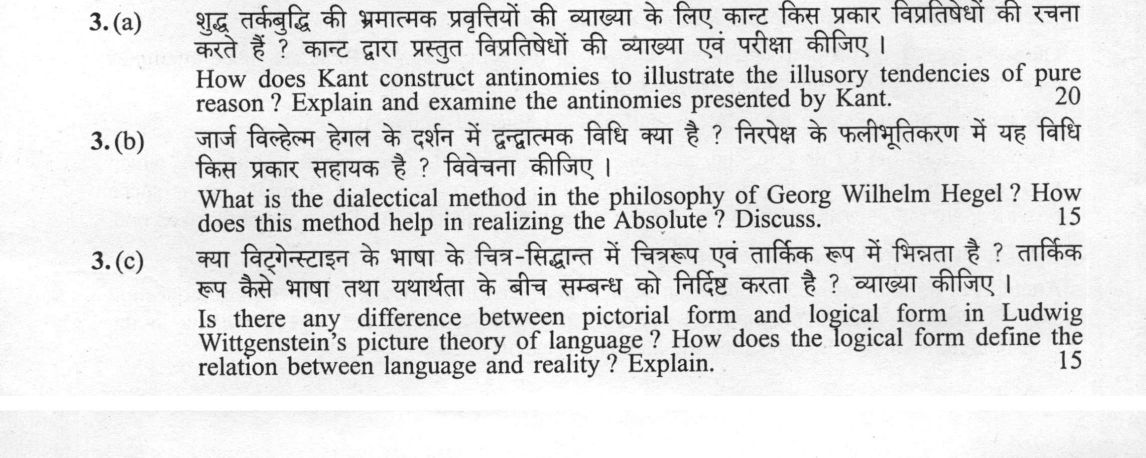
(a) How does Kant construct antinomies to illustrate the illusory tendencies of pure reason ? Explain and examine the antinomies…
How does Kant construct antinomies to illustrate the illusory tendencies of pure reason ? Explain and examine the antinomies presented by Kant. 20 marks
What is the dialectical method in the philosophy of George Wilhelm Hegel ? How does this method help in realizing the Absolute ? Discuss. 15 marks
Is there any difference between pictorial form and logical form in Ludwig Wittgenstein's picture theory of language ? How does the logical form define the relation between language and reality ? Explain. 15 marks
हिंदी में प्रश्न पढ़ें
शुद्ध तर्कबुद्धि की भ्रामक प्रवृत्तियों की व्याख्या के लिए काण्ट किस प्रकार विरोधाभासों की रचना करते हैं ? काण्ट द्वारा प्रस्तुत विरोधाभासों की व्याख्या एवं परीक्षा कीजिए । (20 अंक)
जार्ज विल्हेल्म हेगल के दर्शन में द्वन्द्वात्मक विधि क्या है ? निरपेक्ष के फलीभूतिकरण में यह विधि किस प्रकार सहायक है ? विवेचना कीजिए । (15 अंक)
क्या विट्टगेन्स्टाइन के भाषा के चित्र-सिद्धान्त में चित्ररूप एवं तार्किक रूप में भिन्नता है ? तार्किक रूप कैसे भाषा तथा यथार्थता के बीच सम्बन्ध को निर्दिष्ट करता है ? व्याख्या कीजिए । (15 अंक)
Model answer
Written by UPSC Answer Check against this question's marking rubric, to the expected length. UPSC does not publish answers for Mains — this is one way to score well, not an official key.
Modern epistemology pivots on the critical limits of human reason, its dialectical realization, and its linguistic representation. Immanuel Kant, G.W.F. Hegel, and Ludwig Wittgenstein systematically reconfigured how thought maps onto reality.
Kant’s Construction and Examination of Antinomies
In the Critique of Pure Reason, Kant demonstrates that pure reason harbors an inherent, illusory tendency to seek the unconditioned totality for conditioned phenomena. Antinomies arise when the categories of the understanding—strictly valid only within sensible intuition (phenomena)—are applied transcendentally to cosmological ideas (noumena or the world-as-a-whole). Because sensible intuition is absent, reason generates equally valid, deductively sound, yet mutually contradictory conclusions:
- First Antinomy (Quantity): Thesis posits the world has a beginning in time and is limited in space; Antithesis proves the world is infinite in time and space.
- Second Antinomy (Quality): Thesis holds that every composite substance consists of simple parts; Antithesis proves no composite thing consists of simple parts.
- Third Antinomy (Relation): Thesis asserts causality according to natural laws is insufficient, necessitating causality through freedom; Antithesis claims no freedom exists, everything is deterministic nature.
- Fourth Antinomy (Modality): Thesis argues there belongs to the world an absolutely necessary being; Antithesis maintains no necessary being exists within or outside the world.
Kant constructs their proofs using reductio ad absurdum. Critically, these antinomies expose a natural, inevitable transcendental illusion, not a formal logical error. Kant resolves them through Transcendental Idealism: the first two (mathematical) are both false because they treat the world as a thing-in-itself; the latter two (dynamical) can both be true by restricting the thesis to the noumenal realm and the antithesis to the phenomenal realm. This rescues morality and freedom while safeguarding natural science.
Hegel’s Dialectical Method and the Realization of the Absolute
Hegel transforms Kant’s static antinomies into a dynamic, productive engine of reality. His dialectical method operates through a triadic progression: the Abstract or immediate understanding (Thesis), the Dialectical or negative reason revealing internal contradiction (Antithesis), and the Speculative or positive reason unifying the opposites (Synthesis).
The driving forces are determinate negation (bestimmte Negation), where negating a finite concept produces a richer, specific content, and Aufhebung (sublation), which simultaneously cancels, preserves, and elevates partial truths.
While Kant treated contradiction as a boundary showing reason’s failure, Hegel views contradiction as the vital impulse of Spirit (Geist). The dialectic realizes the Absolute because reality is rational and evolving. The Absolute is not a static substance but self-actualizing subject: through nature, human consciousness, and history, the Absolute Spirit alienates itself into objective form and overcomes this estrangement via dialectical stages, culminating in absolute self-knowledge.
Wittgenstein: Pictorial Form, Logical Form, and Reality
In the Tractatus Logico-Philosophicus, Wittgenstein’s Picture Theory asserts that a proposition is a model of reality.
A pictorial form is the specific way elements of a picture correspond to elements of a fact (e.g., spatial arrangement, color, or physical structure). A spatial picture represents spatial reality through spatial form. In contrast, logical form is the minimal, purely abstract structure that every picture must share with reality to represent it at all. While every spatial picture is logical, a logical picture is not necessarily spatial; logical form is the universal possibility of structure.
Logical form defines the relationship between language and reality through strict structural isomorphism. Simple names combine into elementary propositions; their arrangement mirrors the configuration of simple objects in a state of affairs. Consequently, logical form serves as the condition of representation. It cannot itself be depicted or asserted within language (saying); instead, it manifests itself in the internal structure of meaningful propositions (showing).
Conclusion
The philosophical trajectory moves from Kant establishing the boundaries of sensible experience to avoid metaphysical illusions, to Hegel internalizing contradiction to achieve absolute metaphysical comprehension, and finally to Wittgenstein linguisticizing these limits—confining intelligible discourse to what can be logically mirrored in atomic facts.
What "Explain" is asking you to do
Make the working of something clear — what sets it off, what follows from what, and what it produces. Explain is the Commission's mechanism word: it dominates the technical papers and the “explain why” stems, where the marks sit in the causal chain and not in the label.
Structure that answers it
State what it is → the initiating condition → the chain of cause, step by step → an instance where it plays out → what the chain produces
Where marks are lost
Describing what something looks like instead of why it works that way. Naming the stages without linking them reads as description too.
How this answer will be evaluated
Approach
Framework: Kantian Transcendental Dialectic. (a) examine: intro > how/why with reasoning > evidence > conclusion | (b) discuss: intro > 3-4 dimensions > example > balanced close | (c) explain: definition/context > points in order > small example > short close Full marks: Precise reconstruction of arguments with technical vocabulary and clear distinctions.
Key points expected
- Define antinomy as conflict of reason with itself
- Distinguish mathematical from dynamical antinomies
- State theses and antitheses of all four antinomies
- Explain the transcendental illusion of pure reason
- Define the dialectical method (thesis-antithesis-synthesis)
- Explain the movement of the Spirit (Geist)
- Describe the realization of the Absolute
- Connect the method to the 'Phenomenology of Spirit'
Evaluation rubric
Each sub-part is marked on its own, against the marks and word limit printed on the paper.
- (a) Reconstruct the mechanism of antinomies and evaluate the four specific conflicts. 20 marks
examine— intro → how/why with reasoning → evidence → conclusion
Must cover
- Define antinomy as conflict of reason with itself
- Distinguish mathematical from dynamical antinomies
- State theses and antitheses of all four antinomies
- Explain the transcendental illusion of pure reason
Loses marks
- Summarizing Kant's biography instead of the argument
- Confusing antinomies with paralogisms
- Failing to distinguish the two types of antinomies
Earns more
- Mention the role of the unconditioned
- Reference the 'Critique of Pure Reason' A/B editions
- Discuss the 'transcendental ideal' of the soul
- Use precise terms like 'phenomena' vs 'noumena'
Extra mark
- Reference to the 'Transcendental Dialectic' section
- Mention the 'paralogisms' as related errors
- (b) Explain the dialectical method and its role in realizing the Absolute. 15 marks
discuss— intro → 3-4 dimensions → example → balanced close
Must cover
- Define the dialectical method (thesis-antithesis-synthesis)
- Explain the movement of the Spirit (Geist)
- Describe the realization of the Absolute
- Connect the method to the 'Phenomenology of Spirit'
Loses marks
- Vague paraphrase of 'change' without technical terms
- Confusing Hegel with Marx or other dialectical thinkers
- Failing to link the method to the Absolute
Earns more
- Mention 'Aufhebung' (sublation)
- Reference the 'Science of Logic'
- Discuss the 'Idea' as the Absolute
- Use precise terms like 'negativity' and 'mediation'
Extra mark
- Reference to the 'Encyclopedia of the Philosophical Sciences'
- Mention the 'Hegelian dialectic' in contrast to Kant
- (c) Differentiate pictorial and logical form in Wittgenstein's picture theory. 15 marks
explain— definition/context → points in order → small example → short close
Must cover
- Define the 'picture theory of language'
- Distinguish 'pictorial form' from 'logical form'
- Explain how logical form defines language-reality relation
- Reference the 'Tractatus Logico-Philosophicus'
Loses marks
- Confusing Wittgenstein with other language theorists
- Failing to distinguish the two forms
- Vague description of 'meaning' without logical structure
Earns more
- Mention 'isomorphism' between language and world
- Reference 'logical atomism'
- Discuss the 'limits of language'
- Use precise terms like 'proposition' and 'fact'
Extra mark
- Reference to the 'Tractatus' proposition numbers
- Mention the 'mystical' aspect of the unsayable
Practice this exact question
Write your answer and it is marked point by point against the model answer above — what you covered, what you missed, what you got wrong.
Evaluate my answer →More from Philosophy 2022 Paper I
- Q1 (a) How does Plato use the theory of forms to establish the relation between epistemology…
- Q2 (a) Provide a critical account of Heidegger's Being-in-the-world and discuss the problem…
- Q3 (a) How does Kant construct antinomies to illustrate the illusory tendencies of pure reas…
- Q4 (a) How does Soren Kierkegaard define the notion of 'subjectivity'? Explain it with refer…
- Q5 (a) Examine and evaluate the proofs given by Sāmkhya philosophy to prove the existence of…
- Q6 (a) How compatible is Buddhist theory of momentariness with their theory of Karma? In thi…