GS Paper I — Q1
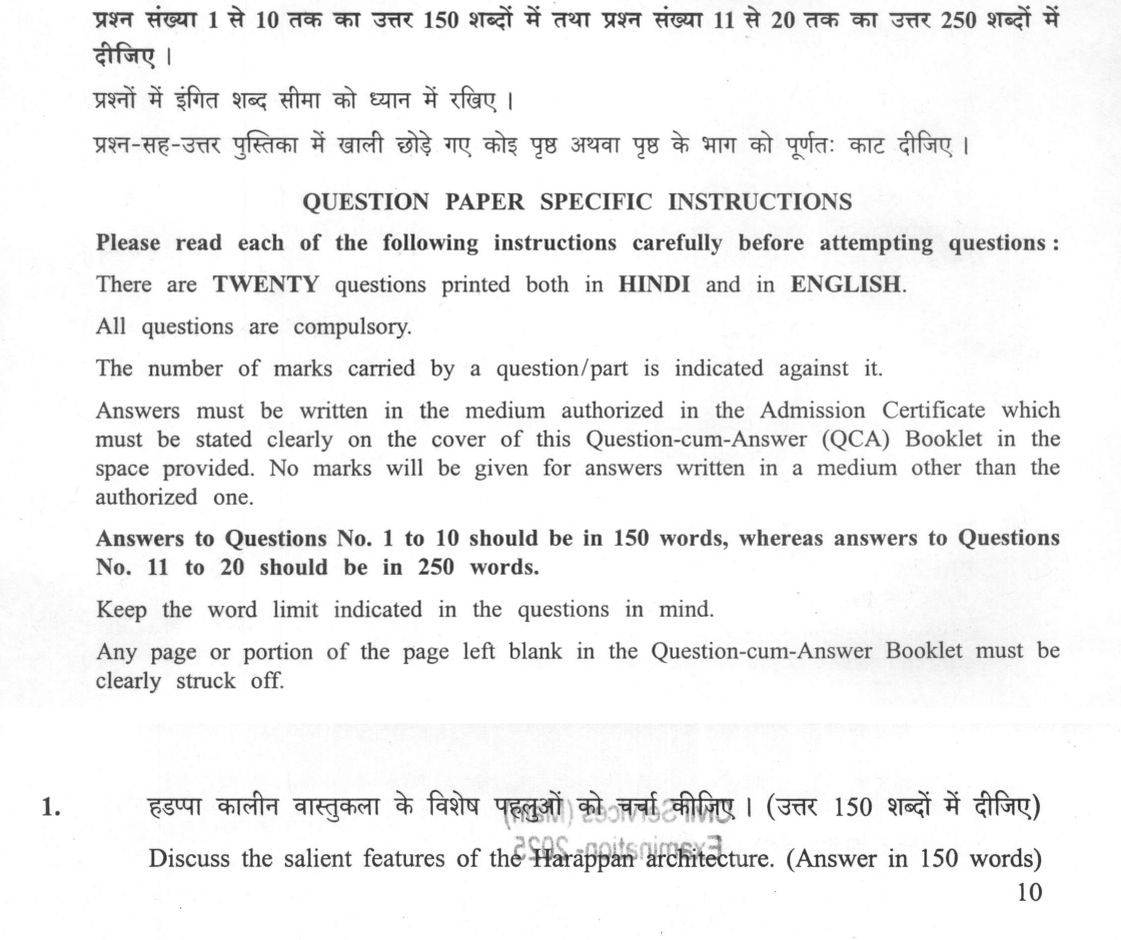
Discuss the salient features of the Harappan architecture. (Answer in 150 words) 10
हिंदी में प्रश्न पढ़ें
हड़प्पा कालीन वास्तुकला के विशेष पहलुओं की चर्चा कीजिए । (उत्तर 150 शब्दों में दीजिए) 10 marks
Model answer
Written by UPSC Answer Check against this question's marking rubric, to the 150-word length. UPSC does not publish answers for Mains — this is one way to score well, not an official key.
Harappan architecture represents the pinnacle of Bronze Age urbanism, characterized by utilitarian design and unprecedented municipal engineering.
Town Planning and Materials: Settlements followed a strict gridiron layout, systematically divided into an elevated Citadel for administrative use and a Lower Town for habitation, as seen at Mohenjodaro and Harappa. Construction relied extensively on durable kiln-burnt bricks manufactured in a standardized 4:2:1 dimensional ratio.
Public Engineering: Urban centers featured specialized public works, including the Great Bath and assembly hall at Mohenjodaro, granaries at Harappa and Lothal, and the tidal dockyard at Lothal. These were integrated with an advanced drainage system of covered street drains, inspection manholes, and soak pits.
Domestic Architecture and Civic Focus: Residential units were designed as courtyard houses with private wells, bathrooms, and upper storeys. Crucially, the absence of grandiose temples or royal palaces highlights an architectural ethos oriented towards public health, sanitation, and civic utility rather than theocratic or monarchical ostentation.
What "Discuss" is asking you to do
Lay the issue out from more than one side — how it arose, what is claimed for it, what is held against it, and where it now stands. UPSC attaches discuss to broad topics with several live dimensions, so coverage of the dimensions earns more than the strength of your opinion.
Structure that answers it
Set the issue up → the case as it is made → the case against → the dimension both sides leave out → where the balance now lies
Where marks are lost
Listing facts with no thread between them, or arguing one side throughout and calling it a discussion.
How this answer will be evaluated
Approach
Framework: GS1 History: Culture as era's manifesto. discuss: intro > 3-4 dimensions > example > balanced close Full marks: Identifies 4+ specific features with clear analytical link to social/urban context.
Key points expected
- Mention standardized brick ratios (1:2:4)
- Describe the Great Bath and drainage system
- Note the absence of monumental temples
- Link features to urban planning and social structure
Evaluation rubric
Each sub-part is marked on its own, against the marks and word limit printed on the paper.
- The answer Analytical overview of Harappan architectural features and their significance. 10 marks · 150 words
discuss— intro → 3-4 dimensions → example → balanced close
Must cover
- Mention standardized brick ratios (1:2:4)
- Describe the Great Bath and drainage system
- Note the absence of monumental temples
- Link features to urban planning and social structure
Loses marks
- Narrating chronology of the civilization
- Focusing on artifacts rather than architecture
- Vague generalizations without specific examples
Earns more
- Reference to Mohenjo-daro or Harappa sites
- Mention of granaries or citadel layout
- Discussion of defensive walls
- Comparison with contemporary Mesopotamian architecture
Extra mark
- 30-second sketch of a typical Harappan house
- Specific statistic on brick dimensions
Practice this exact question
Write your answer and it is marked point by point against the model answer above — what you covered, what you missed, what you got wrong.
Evaluate my answer →More from General Studies 2025 GS Paper I
- Q1 Discuss the salient features of the Harappan architecture. (Answer in 150 words) 10
- Q2 Examine the main aspects of Akbar's religious syncretism. (Answer in 150 words) 10
- Q3 'The sculptors filled the Chandella artform with resilient vigor and breadth of life.' El…
- Q4 How are climate change and the sea level rise affecting the very existence of many island…