GS Paper I — Q3
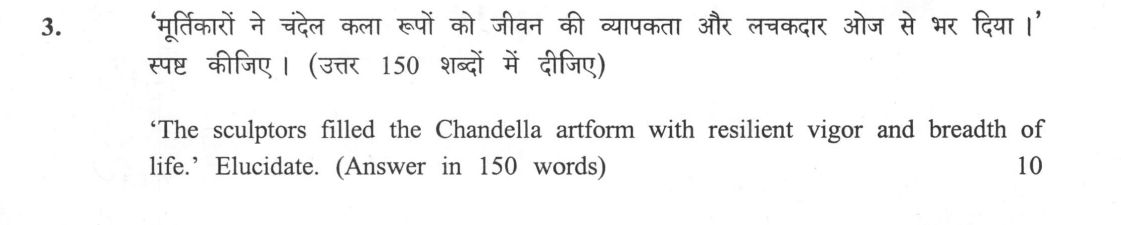
'The sculptors filled the Chandella artform with resilient vigor and breadth of life.' Elucidate. (Answer in 150 words) 10
हिंदी में प्रश्न पढ़ें
'मूर्तिकारों ने चंदेल कला रूपों को जीवन की व्यापकता और लचकदार ओज से भर दिया ।' स्पष्ट कीजिए । (उत्तर 150 शब्दों में दीजिए) 10 marks
Model answer
Written by UPSC Answer Check against this question's marking rubric, to the 150-word length. UPSC does not publish answers for Mains — this is one way to score well, not an official key.
The Chandella sculptural tradition (9th–13th century CE) in the Bundelkhand region represents a climactic phase of Nagara temple architecture, distinguished by kinetic energy and an all-encompassing celebration of existence.
Resilient Vigor in Form and Technique: Sculptors infused fine-grained sandstone with palpable dynamism through exaggerated tribhanga (triple-bend) postures, athletic anatomies, and proportional mastery. In temples like Kandariya Mahadeva and Lakshmana, friezes of warriors, musicians, and rearing vyalas (mythical beasts) exhibit tense, muscular vitality and refined surface treatment, departing from the static rigidity seen in several contemporary regional idioms.
Breadth of Life Across Themes: Chandella art seamlessly synthesizes the sacred, secular, and sensual. Sculptural bands capture the full spectrum of earthly and cosmic life—from warfare, royal courts, and domestic chores to celestial surasundaris and intimate mithuna (amorous) couples, prominently adorning the Vishvanatha temple.
Thus, through unparalleled technical mastery, Chandella sculptors transformed stone into vibrant tableaus, harmonizing mundane reality with transcendent spirituality.
What "Elucidate" is asking you to do
Make a stated proposition plain and then prove it with instances. Elucidate stems almost always carry a claim or a named concept, and very often the words “with examples” or “with suitable diagrams” — the illustration is part of the directive, not decoration.
Structure that answers it
Plain-language statement of what the proposition means → the part that is obscure, resolved → first illustration → second illustration → why the proposition holds
Where marks are lost
Adding terminology; elucidate rewards removing it. The commoner loss is a clean explanation with no example, when the stem asked for examples.
How this answer will be evaluated
Approach
Framework: GS1 Paper 1 Method. explain: definition/context > points in order > small example > short close Full marks: Precisely links specific Chandela sculptures to the concepts of vigor and life with technical detail.
Key points expected
- Identify specific sculptures (e.g., Khajuraho, Mahishasuramardini)
- Explain the 'resilient vigor' through dynamic poses and musculature
- Explain 'breadth of life' through realistic depiction of daily activities
- Link artistic style to the socio-religious context of the era
Evaluation rubric
Each sub-part is marked on its own, against the marks and word limit printed on the paper.
- The answer Define the specific aesthetic and technical qualities of Chandella sculpture that embody 'resilient vigor' and 'breadth of life'. 10 marks · 150 words
explain— definition/context → points in order → small example → short close
Must cover
- Identify specific sculptures (e.g., Khajuraho, Mahishasuramardini)
- Explain the 'resilient vigor' through dynamic poses and musculature
- Explain 'breadth of life' through realistic depiction of daily activities
- Link artistic style to the socio-religious context of the era
Loses marks
- Generalizing about Indian art without specific Chandela examples
- Focusing only on the erotic sculptures while ignoring the 'vigor' aspect
- Narrating the history of the Chandela dynasty instead of the art
Earns more
- Mention the 'Chandela style' as a distinct artistic phase
- Reference the 'Sensuous' or 'Erotic' sculptures as part of life's breadth
- Note the technical mastery of stone carving (e.g., thin drapery)
Extra mark
- Name a specific sculptor or workshop if known
- Reference a specific academic or art-historical critique
Practice this exact question
Write your answer and it is marked point by point against the model answer above — what you covered, what you missed, what you got wrong.
Evaluate my answer →More from General Studies 2025 GS Paper I
- Q1 Discuss the salient features of the Harappan architecture. (Answer in 150 words) 10
- Q2 Examine the main aspects of Akbar's religious syncretism. (Answer in 150 words) 10
- Q3 'The sculptors filled the Chandella artform with resilient vigor and breadth of life.' El…
- Q4 How are climate change and the sea level rise affecting the very existence of many island…
- Q5 What are non-farm primary activities ? How are these activities related to physiographic…
- Q6 Explain briefly the ecological and economic benefits of solar energy generation in India…