GS Paper I — Q7
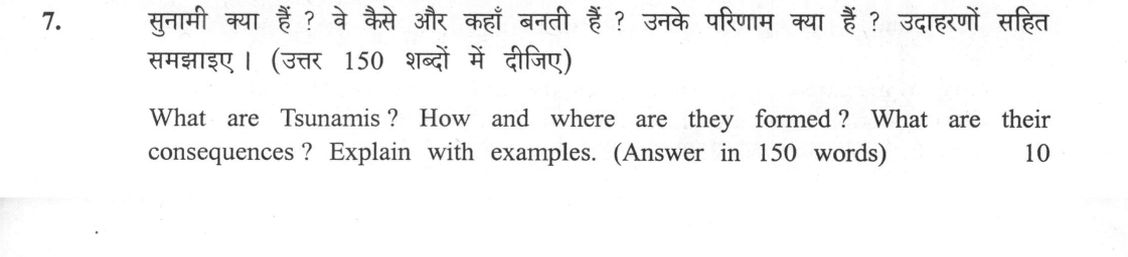
What are Tsunamis ? How and where are they formed ? What are their consequences ? Explain with examples. (Answer in 150 words) 10
हिंदी में प्रश्न पढ़ें
सुनामी क्या हैं ? वे कैसे और कहाँ बनती हैं ? उनके परिणाम क्या हैं ? उदाहरणों सहित समझाइए । (उत्तर 150 शब्दों में दीजिए) 10 marks
Model answer
Written by UPSC Answer Check against this question's marking rubric, to the 150-word length. UPSC does not publish answers for Mains — this is one way to score well, not an official key.
Tsunamis are long-period ocean waves generated by sudden vertical displacement of a large water body, not by tides. They form mainly when submarine earthquakes, especially at convergent plate boundaries and subduction zones, uplift or drop the seafloor; other triggers include coastal landslides, volcanic eruptions and rare meteorite impacts. Geographically, they are most common around the Pacific Ring of Fire, where plate margins are active, and also in the Indian Ocean, such as the Sunda Trench in the eastern Indian Ocean. Consequences include coastal inundation, loss of life, destruction of housing, ports, agriculture and industry, ecological damage to mangroves and fisheries, and industrial disasters, as when Japan’s 2011 tsunami struck Sendai and caused the Fukushima meltdown. The 2004 Indian Ocean tsunami, triggered by a Sumatra earthquake, killed about 2.3 lakh people. Hence, early warning systems, evacuation plans and coastal preparedness are essential.
What "Explain" is asking you to do
Make the working of something clear — what sets it off, what follows from what, and what it produces. Explain is the Commission's mechanism word: it dominates the technical papers and the “explain why” stems, where the marks sit in the causal chain and not in the label.
Structure that answers it
State what it is → the initiating condition → the chain of cause, step by step → an instance where it plays out → what the chain produces
Where marks are lost
Describing what something looks like instead of why it works that way. Naming the stages without linking them reads as description too.
How this answer will be evaluated
Approach
Framework: GS1 Geography: Mechanism, Location, Consequence. explain: definition/context > points in order > small example > short close Full marks: Mechanism explained, location linked to tectonics, consequences detailed with specific examples.
Key points expected
- Define tsunami as seismic sea wave
- Explain mechanism: subduction, vertical displacement
- Identify location: subduction zones, trenches
- Detail consequences: coastal inundation, infrastructure damage
Evaluation rubric
Each sub-part is marked on its own, against the marks and word limit printed on the paper.
- The answer Define tsunami, explain formation mechanism/location, and detail consequences with examples. 10 marks · 150 words
explain— definition/context → points in order → small example → short close
Must cover
- Define tsunami as seismic sea wave
- Explain mechanism: subduction, vertical displacement
- Identify location: subduction zones, trenches
- Detail consequences: coastal inundation, infrastructure damage
Loses marks
- Narrating chronology without mechanism
- Where without why (location without cause)
- Emotive words on social issues
Earns more
- Mention specific examples (e.g., 2004, 2011)
- Link physical geography to human outcome
- Mention 'run-up' or 'fetch' concepts
- Distinguish from storm surge
Extra mark
- 30-second sketch map of subduction zone
- One robust statistic on wave height
Practice this exact question
Write your answer and it is marked point by point against the model answer above — what you covered, what you missed, what you got wrong.
Evaluate my answer →More from General Studies 2025 GS Paper I
- Q4 How are climate change and the sea level rise affecting the very existence of many island…
- Q5 What are non-farm primary activities ? How are these activities related to physiographic…
- Q6 Explain briefly the ecological and economic benefits of solar energy generation in India…
- Q7 What are Tsunamis ? How and where are they formed ? What are their consequences ? Explain…
- Q8 How does smart city in India, address the issues of urban poverty and distributive justic…
- Q9 The ethos of civil service in India stand for the combination of professionalism with nat…
- Q10 Do you think that globalization results in only an aggressive consumer culture ? Justify…