GS Paper I — Q19
Achieving sustainable growth with emphasis on environmental protection could come into conflict with poor people's needs in a…
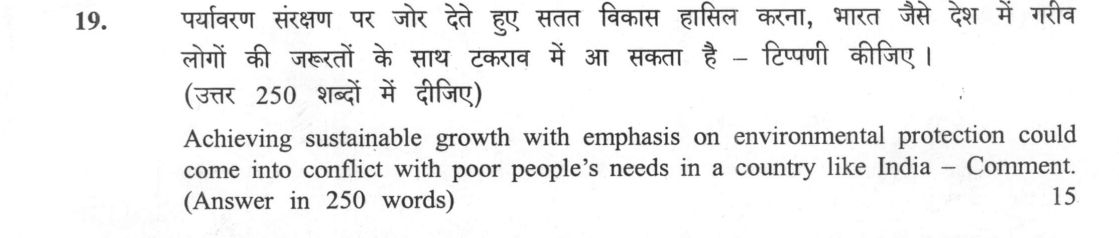
Achieving sustainable growth with emphasis on environmental protection could come into conflict with poor people's needs in a country like India – Comment. (Answer in 250 words) 15 marks
हिंदी में प्रश्न पढ़ें
पर्यावरण संरक्षण पर जोर देते हुए सतत विकास हासिल करना, भारत जैसे देश में गरीब लोगों की जरूरतों के साथ टकराव में आ सकता है – टिप्पणी कीजिए। (उत्तर 250 शब्दों में दीजिए) 15 marks
Model answer
Written by UPSC Answer Check against this question's marking rubric, to the 250-word length. UPSC does not publish answers for Mains — this is one way to score well, not an official key.
The perceived conflict between environmental conservation and poverty alleviation in India arises from immediate structural trade-offs, yet long-term economic security is impossible without ecological stability.
Areas of Conflict and Vulnerability
A significant proportion of India’s poor relies directly on common property resources, forests, and fisheries for daily subsistence. Strict environmental mandates—such as sudden mining halts, the expansion of Protected Areas, or rigid urban industrial pollution controls—often trigger livelihood disruptions. Without swift rehabilitation, such measures disproportionately displace informal workers and forest-dwelling tribal communities, straining rights guaranteed under Articles 21 and 29 of the Constitution.
The Disproportionate Burden of Degradation
Conversely, unbridled environmental degradation inflicts the heaviest cost on the poor. Groundwater depletion, air pollution, and climate-induced extreme weather events directly threaten rain-fed agriculture and informal urban settlements. The resulting loss of productive workdays and escalating health expenditures systematically perpetuate intergenerational poverty traps.
Pathways to Inclusive Sustainable Development
Resolving this tension requires operationalising a "just transition" that aligns environmental protection with social equity:
Rights-based Conservation: Implementing the Forest Rights Act (FRA), 2006 empowers Gram Sabhas with community forest rights, transforming local communities from conservation adversaries into custodians.
Eco-Restoration Livelihoods: Integrating natural resource rejuvenation through MGNREGA and decentralised solar adoption under PM-KUSUM combines income generation with climate resilience, harmonising SDG 1 (No Poverty) with SDG 13 (Climate Action).
The environment-versus-development narrative presents a false binary. For India, environmental protection must not act as a regulatory barrier to the poor, but rather as an equity-driven framework that safeguards the natural capital upon which their survival and prosperity depend.
What "Comment" is asking you to do
Take a position on the statement and support it. Comment usually attaches to a quoted line in the short slots, so the reasoning must be compressed — an opening view, a few load-bearing reasons, and the limit of the claim.
Structure that answers it
Unpack what the statement asserts → your stance → two or three supporting reasons → the qualification that limits it
Where marks are lost
Neutral summary; a comment without a stance has not answered. Equally costly is accepting the quoted line wholesale and never testing where it fails.
How this answer will be evaluated
Approach
Framework: GS1 General Studies. comment: context > arguments both sides > judgment > close Full marks: Balanced, well-argued, with specific examples and a clear judgment.
Key points expected
- Contextualize India's development needs vs environmental limits
- Arguments for prioritizing environmental protection
- Arguments for prioritizing poor people's immediate needs
- Balanced judgment on reconciling the two
Evaluation rubric
Each sub-part is marked on its own, against the marks and word limit printed on the paper.
- The answer Contextualize the conflict, present arguments for both sides, and offer a balanced judgment. 15 marks · 250 words
comment— context → arguments both sides → judgment → close
Must cover
- Contextualize India's development needs vs environmental limits
- Arguments for prioritizing environmental protection
- Arguments for prioritizing poor people's immediate needs
- Balanced judgment on reconciling the two
Loses marks
- One-sided argument without acknowledging the other side
- Vague generalities without specific examples or data
- Ignoring the specific context of India
Earns more
- Mention of specific environmental laws (e.g., EIA, Forest Act)
- Reference to sustainable development goals (SDGs)
- Examples of green jobs or renewable energy benefits
- Mention of climate change impact on the poor
Extra mark
- Reference to a specific Supreme Court judgment on environment
- Mention of a specific green technology or policy
Practice this exact question
Write your answer and it is marked point by point against the model answer above — what you covered, what you missed, what you got wrong.
Evaluate my answer →More from General Studies 2025 GS Paper I
- Q16 Discuss how the changes in shape and sizes of continents and ocean basins of the planet t…
- Q17 Discuss the distribution and density of population in the Ganga River Basin with special…
- Q18 How do you account for the growing fast food industries given that there are increased he…
- Q19 Achieving sustainable growth with emphasis on environmental protection could come into co…
- Q20 Does tribal development in India centre around two axes, those of displacement and of reh…