GS Paper I — Q16
Discuss how the changes in shape and sizes of continents and ocean basins of the planet take place due to tectonic movements of…
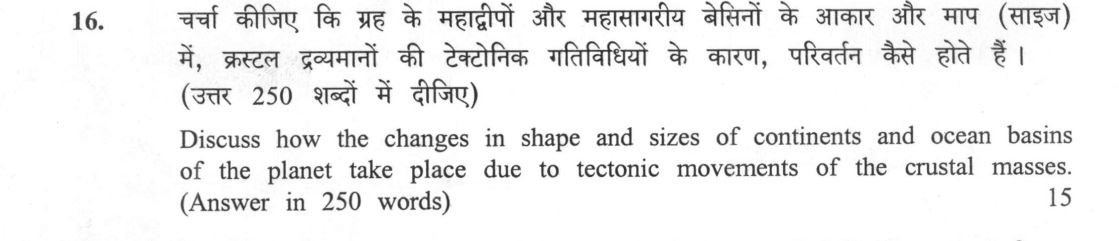
Discuss how the changes in shape and sizes of continents and ocean basins of the planet take place due to tectonic movements of the crustal masses. (Answer in 250 words) 15 marks
हिंदी में प्रश्न पढ़ें
चर्चा कीजिए कि ग्रह के महाद्वीपों और महासागरीय बेसिनों के आकार और माप (साइज) में, क्रस्टल द्रव्यमानों की टेक्टोनिक गतिविधियों के कारण, परिवर्तन कैसे होते हैं। (उत्तर 250 शब्दों में दीजिए) 15 marks
Model answer
Written by UPSC Answer Check against this question's marking rubric, to the 250-word length. UPSC does not publish answers for Mains — this is one way to score well, not an official key.
Plate tectonics theory explains that the Earth's lithosphere is fragmented into buoyant continental and denser oceanic plates moving over the ductile asthenosphere, driving continuous changes in the shape, size, and distribution of landmasses and water bodies.
Mechanisms of Crustal Evolution Continental rifting and seafloor spreading at divergent boundaries generate new oceanic crust at mid-ocean ridges, causing ocean basins to expand, as seen in the widening Atlantic Ocean. Contemporarily, the East African Rift System and the widening Red Sea represent nascent stages of ocean basin formation through continental fragmentation. Conversely, at convergent boundaries, oceanic crust subducts into the mantle along trenches, progressively shrinking basins such as the Pacific Ocean.
Continental Collision and the Indian Context The closure of intervening ocean basins leads to continental collisions. The northward drift of the Indian plate from Gondwanaland, marked by the volcanic Deccan Traps, culminated in its collision with the Eurasian plate. This closed the ancient Tethys Sea, expanded the Indian Ocean basin, and uplifted the Himalayas through intense crustal shortening.
Temporal Scales and Supercontinent Cycles These morphological shifts operate across varying timescales. While episodic events like earthquakes and tsunamis induce instantaneous coastal and bathymetric modifications, macro-scale restructuring follows the Wilson Cycle over hundreds of millions of years. This cyclic opening and closing of ocean basins drives transitions from ancient supercontinents like Pangaea and Gondwanaland toward future configurations such as Amasia.
Understanding these ongoing tectonic dynamics is vital for predicting long-term geomorphic changes, mapping critical mineral and energy resources, and enhancing spatial planning against plate-boundary geohazards.
What "Discuss" is asking you to do
Lay the issue out from more than one side — how it arose, what is claimed for it, what is held against it, and where it now stands. UPSC attaches discuss to broad topics with several live dimensions, so coverage of the dimensions earns more than the strength of your opinion.
Structure that answers it
Set the issue up → the case as it is made → the case against → the dimension both sides leave out → where the balance now lies
Where marks are lost
Listing facts with no thread between them, or arguing one side throughout and calling it a discussion.
How this answer will be evaluated
Approach
Framework: Plate Tectonics / Continental Drift. discuss: intro > 3-4 dimensions > example > balanced close Full marks: Mechanism clearly linked to specific shape changes with map.
Key points expected
- Define tectonic movements (horizontal/vertical)
- Explain divergent boundaries (mid-ocean ridges)
- Explain convergent boundaries (subduction zones)
- Link movement to specific shape changes
Evaluation rubric
Each sub-part is marked on its own, against the marks and word limit printed on the paper.
- The answer Explain the mechanism of crustal movement causing changes in continental and oceanic shapes. 15 marks · 250 words
discuss— intro → 3-4 dimensions → example → balanced close
Must cover
- Define tectonic movements (horizontal/vertical)
- Explain divergent boundaries (mid-ocean ridges)
- Explain convergent boundaries (subduction zones)
- Link movement to specific shape changes
Loses marks
- Narrating history without mechanism
- Confusing weathering with tectonics
- Listing features without explaining 'how'
Earns more
- Mention transform boundaries (San Andreas)
- Reference Pangaea or specific plate names
- Explain isostasy or crustal density
- Mention specific mountain ranges (Himalayas)
Extra mark
- 30-second sketch map of plate boundaries
- Specific statistic on plate movement rate
Practice this exact question
Write your answer and it is marked point by point against the model answer above — what you covered, what you missed, what you got wrong.
Evaluate my answer →More from General Studies 2025 GS Paper I
- Q13 The French Revolution has enduring relevance to the contemporary world. Explain. (Answer…
- Q14 Give a geographical explanation of the distribution of off-shore oil reserves of the worl…
- Q15 How can Artificial Intelligence (AI) and drones be effectively used along with GIS and RS…
- Q16 Discuss how the changes in shape and sizes of continents and ocean basins of the planet t…
- Q17 Discuss the distribution and density of population in the Ganga River Basin with special…
- Q18 How do you account for the growing fast food industries given that there are increased he…
- Q19 Achieving sustainable growth with emphasis on environmental protection could come into co…