GS Paper I — Q5
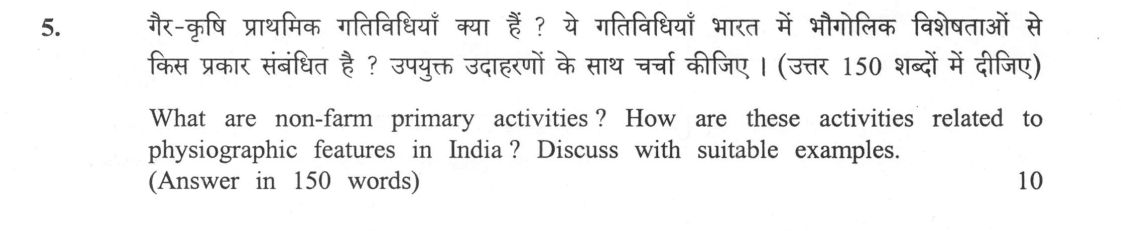
What are non-farm primary activities ? How are these activities related to physiographic features in India ? Discuss with…
What are non-farm primary activities ? How are these activities related to physiographic features in India ? Discuss with suitable examples. (Answer in 150 words) 10 marks
हिंदी में प्रश्न पढ़ें
गैर-कृषि प्राथमिक गतिविधियाँ क्या हैं ? ये गतिविधियाँ भारत में भौगोलिक विशेषताओं से किस प्रकार संबंधित हैं ? उपयुक्त उदाहरणों के साथ चर्चा कीजिए । (उत्तर 150 शब्दों में दीजिए) 10 marks
Model answer
Written by UPSC Answer Check against this question's marking rubric, to the 150-word length. UPSC does not publish answers for Mains — this is one way to score well, not an official key.
Non-farm primary activities comprise economic pursuits that directly harvest or extract natural resources outside crop cultivation, including forestry, fishing, mining, quarrying, and animal husbandry. In India, their distribution is intrinsically shaped by physiographic diversity:
Peninsular Plateau: Ancient crystalline formations support extensive mineral extraction, notably coal in the Damodar Valley, iron ore across the Odisha-Jharkhand belt, and bauxite in the Eastern Ghats.
Himalayan Region: Diverse altitudinal zones sustain timber logging and medicinal plant collection in temperate forests, while alpine meadows enable pastoralism, including yak and sheep rearing in Ladakh and Sikkim.
Coastal Plains and Islands: Extensive shorelines foster marine fishing in Gujarat and Kerala, alongside brackish-water aquaculture, especially commercial shrimp farming in Andhra Pradesh.
Thar Desert: Arid topography limits extraction primarily to salt harvesting from inland playas like Sambhar Lake, gypsum mining, and pastoral rearing of camels and goats.
Indo-Gangetic Plains: Despite agricultural dominance, alluvial river basins support freshwater fisheries in oxbow lakes and widespread riverbed sand mining.
Harnessing these physiographic advantages through sustainable resource extraction and value-addition is vital for diversifying rural livelihoods and achieving balanced regional development.
What "Discuss" is asking you to do
Lay the issue out from more than one side — how it arose, what is claimed for it, what is held against it, and where it now stands. UPSC attaches discuss to broad topics with several live dimensions, so coverage of the dimensions earns more than the strength of your opinion.
Structure that answers it
Set the issue up → the case as it is made → the case against → the dimension both sides leave out → where the balance now lies
Where marks are lost
Listing facts with no thread between them, or arguing one side throughout and calling it a discussion.
How this answer will be evaluated
Approach
Framework: GS1 Geography: Physical-Human Linkage. discuss: intro > 3-4 dimensions > example > balanced close Full marks: Clear definition, precise physiographic linkage, specific Indian examples, and mechanism explained.
Key points expected
- Define non-farm primary activities (e.g., fishing, forestry, mining).
- Link activities to physiographic features (e.g., coasts, plateaus, mountains).
- Provide specific Indian examples (e.g., Kerala fishing, Jharkhand mining).
- Explain the mechanism of the physical-human relationship.
Evaluation rubric
Each sub-part is marked on its own, against the marks and word limit printed on the paper.
- The answer Define non-farm primary activities and link them to specific Indian physiographic features with examples. 10 marks · 150 words
discuss— intro → 3-4 dimensions → example → balanced close
Must cover
- Define non-farm primary activities (e.g., fishing, forestry, mining).
- Link activities to physiographic features (e.g., coasts, plateaus, mountains).
- Provide specific Indian examples (e.g., Kerala fishing, Jharkhand mining).
- Explain the mechanism of the physical-human relationship.
Loses marks
- Confusing non-farm primary with secondary/tertiary activities.
- Listing activities without linking to physiography.
- Vague examples without specific Indian locations.
Earns more
- Mention specific regions (e.g., Western Ghats, Deccan Plateau).
- Distinguish between primary and secondary activities clearly.
- Reference specific physiographic zones (e.g., alluvial plains, peninsular ghat).
- Use precise geographical terminology.
Extra mark
- 30-second sketch map showing activity distribution.
- One robust statistic on employment or output.
Practice this exact question
Write your answer and it is marked point by point against the model answer above — what you covered, what you missed, what you got wrong.
Evaluate my answer →More from General Studies 2025 GS Paper I
- Q2 Examine the main aspects of Akbar's religious syncretism. (Answer in 150 words) 10
- Q3 'The sculptors filled the Chandella artform with resilient vigor and breadth of life.' El…
- Q4 How are climate change and the sea level rise affecting the very existence of many island…
- Q5 What are non-farm primary activities ? How are these activities related to physiographic…
- Q6 Explain briefly the ecological and economic benefits of solar energy generation in India…
- Q7 What are Tsunamis ? How and where are they formed ? What are their consequences ? Explain…
- Q8 How does smart city in India, address the issues of urban poverty and distributive justic…