GS Paper I — Q18
How do you account for the growing fast food industries given that there are increased health concerns in modern society ?…
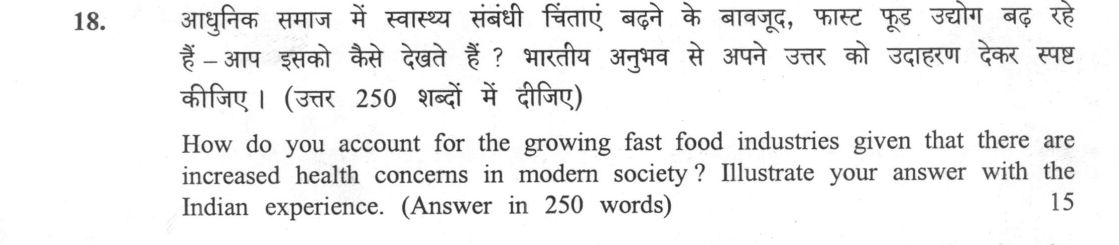
How do you account for the growing fast food industries given that there are increased health concerns in modern society ? Illustrate your answer with the Indian experience. (Answer in 250 words) 15 marks
हिंदी में प्रश्न पढ़ें
आधुनिक समाज में स्वास्थ्य संबंधी चिंताएं बढ़ने के बावजूद, फास्ट फूड उद्योग बढ़ रहे हैं – आप इसको कैसे देखते हैं ? भारतीय अनुभव से अपने उत्तर को उदाहरण देकर स्पष्ट कीजिए। (उत्तर 250 शब्दों में दीजिए) 15 marks
Model answer
Written by UPSC Answer Check against this question's marking rubric, to the 250-word length. UPSC does not publish answers for Mains — this is one way to score well, not an official key.
The coexistence of fast-food growth and health anxiety is not a contradiction but a market response to changing incomes, time scarcity and tastes. India illustrates this: even as ICMR (2023) estimates 101 million diabetics and obesity/NCDs rise, the organised quick-service restaurant sector has expanded at an 18–20% CAGR.
Economic and household changes drive demand. Rising disposable incomes, urbanisation, smaller nuclear families and time-poor working households—where overall female labour-force participation is about 37% and urban female participation is around 25%—make ready-to-eat meals economically rational.
Socio-cultural shifts reinforce it. A large youth cohort, about 43% under 25 in 2023, is exposed to westernised, aspirational consumption and convenience culture. Fast food is not merely food; it signals modernity, peer identity and leisure.
Industry strategy explains the paradox. Chains localise menus—McDonald’s McAloo Tikki and Paneer Wrap, Burger King’s Indian items—while using aggressive pricing such as ₹99 combos. Digital platforms like Swiggy and Zomato lower search and delivery costs, extending reach beyond malls to homes and offices.
Health concerns are producing counter-trends, not collapse. “Healthy fast food” formats (Subway, Salad Days), FSSAI’s trans-fat regulation and awareness campaigns are nudging reformulation. Yet taste, price and convenience still dominate.
Thus, the Indian experience shows transformation rather than decline: fast food is now rapidly segmenting into cheaper, localised and healthier options, while public health needs a regulatory-public health nexus to manage the market. The paradox will persist, but its form will change: indulgent, localised and healthier segments will coexist, making regulation and consumer choice the decisive variables.
What "Illustrate" is asking you to do
Carry the point with concrete cases rather than assert it, so the examples do the work of proving it. In the technical papers illustrate is often literal — a labelled diagram, a map, a graph — and an answer without the figure has not complied with the instruction.
Structure that answers it
The point stated → example 1 with the feature it demonstrates → example 2 → example 3 or the required diagram → what the set of examples establishes
Where marks are lost
Examples named and then abandoned. A case listed without the sentence showing what it demonstrates is marked as recall of information, not as illustration.
How this answer will be evaluated
Approach
Framework: GS1 Society: Continuity, Data, Intersectionality, Solution. account for: state the phenomenon > the causes in order of weight > conclusion Full marks: Clear causes, strong Indian examples, balanced conclusion
Key points expected
- State the phenomenon of fast food growth
- List causes in order of weight
- Illustrate with specific Indian experience
- Conclude with a synthesis
Evaluation rubric
Each sub-part is marked on its own, against the marks and word limit printed on the paper.
- The answer Explain the drivers of fast food growth despite health concerns, using Indian examples. 15 marks · 250 words
account for— state the phenomenon → the causes in order of weight → conclusion
Must cover
- State the phenomenon of fast food growth
- List causes in order of weight
- Illustrate with specific Indian experience
- Conclude with a synthesis
Loses marks
- Narrating chronology without analysis
- Emotive words on health issues
- Ignoring the 'Indian experience' requirement
Earns more
- Mention urbanization and lifestyle changes
- Cite specific Indian brands or data
- Discuss the paradox of health vs convenience
- Reference government regulations or health policies
Extra mark
- Cite a specific statistic on fast food market size
- Mention a specific health study or report
Practice this exact question
Write your answer and it is marked point by point against the model answer above — what you covered, what you missed, what you got wrong.
Evaluate my answer →More from General Studies 2025 GS Paper I
- Q15 How can Artificial Intelligence (AI) and drones be effectively used along with GIS and RS…
- Q16 Discuss how the changes in shape and sizes of continents and ocean basins of the planet t…
- Q17 Discuss the distribution and density of population in the Ganga River Basin with special…
- Q18 How do you account for the growing fast food industries given that there are increased he…
- Q19 Achieving sustainable growth with emphasis on environmental protection could come into co…
- Q20 Does tribal development in India centre around two axes, those of displacement and of reh…