GS Paper I — Q9
The ethos of civil service in India stand for the combination of professionalism with nationalistic consciousness – Elucidate…
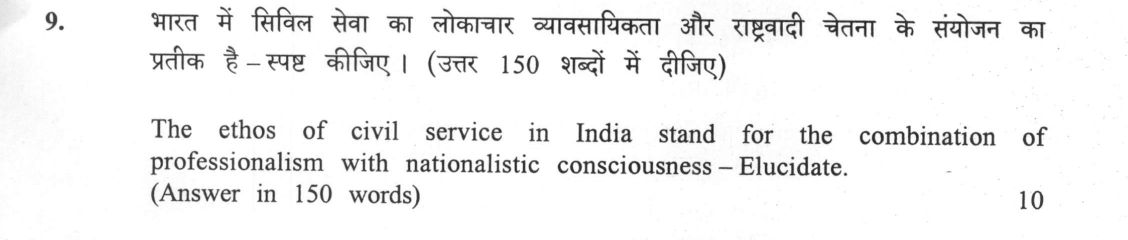
The ethos of civil service in India stand for the combination of professionalism with nationalistic consciousness – Elucidate. (Answer in 150 words) 10 marks
हिंदी में प्रश्न पढ़ें
भारत में सिविल सेवा का लोकाचार व्यावसायिकता और राष्ट्रवादी चेतना के संयोजन का प्रतीक है – स्पष्ट कीजिए । (उत्तर 150 शब्दों में दीजिए) 10 marks
Model answer
Written by UPSC Answer Check against this question's marking rubric, to the 150-word length. UPSC does not publish answers for Mains — this is one way to score well, not an official key.
Civil service ethos in India defines the normative framework guiding administrative conduct, grounded constitutionally in Articles 311 and 312 and animated by the Preamble and Directive Principles.
Professionalism constitutes the operational bedrock, demanding merit-based competence, administrative efficiency, political neutrality, anonymity, and strict adherence to the rule of law and due procedure.
Nationalistic Consciousness provides the driving purpose, orienting administrative power toward nation-building, safeguarding territorial integrity, and advancing inclusive development through a "service before self" orientation rooted in Fundamental Duties (Article 51A).
The Synthesis: Professionalism without national consciousness degenerates into an unfeeling technocracy, while nationalism without professionalism risks administrative incompetence and partisanship.
In contemporary governance, this synthesis enables civil servants to adapt global best practices to indigenous priorities—seen in the localization of Sustainable Development Goals (SDGs), Mission Karmayogi reforms, and unified disaster response—ensuring the "Steel Frame" combines functional competence with constitutional patriotism.
What "Elucidate" is asking you to do
Make a stated proposition plain and then prove it with instances. Elucidate stems almost always carry a claim or a named concept, and very often the words “with examples” or “with suitable diagrams” — the illustration is part of the directive, not decoration.
Structure that answers it
Plain-language statement of what the proposition means → the part that is obscure, resolved → first illustration → second illustration → why the proposition holds
Where marks are lost
Adding terminology; elucidate rewards removing it. The commoner loss is a clean explanation with no example, when the stem asked for examples.
How this answer will be evaluated
Approach
explain: definition/context > points in order > small example > short close Full marks: Clearly defines both concepts and provides a strong example of their synthesis.
Key points expected
- Define 'professionalism' (competence, neutrality, efficiency)
- Define 'nationalistic consciousness' (public interest, nation-building)
- Explain the synthesis of both in the role of the officer
- Provide a concrete example of this combination in action
Evaluation rubric
Each sub-part is marked on its own, against the marks and word limit printed on the paper.
- The answer Define the dual ethos and demonstrate how professional competence and nationalistic duty coexist in the Indian civil service. 10 marks · 150 words
explain— definition/context → points in order → small example → short close
Must cover
- Define 'professionalism' (competence, neutrality, efficiency)
- Define 'nationalistic consciousness' (public interest, nation-building)
- Explain the synthesis of both in the role of the officer
- Provide a concrete example of this combination in action
Loses marks
- Treating the two concepts as contradictory
- Focusing only on the 'nationalistic' aspect
- Focusing only on the 'professional' aspect
Earns more
- Reference to the 'Steel Frame' concept
- Mention of the 'Doer' vs 'Thinker' distinction
- Reference to the 'Trustee' model of governance
- Mention of the 'Service' ethos vs 'Career' ethos
Extra mark
- Reference to the 'Nehruvian' ideal of the civil servant
- Reference to the 'Karnataka' or 'Andhra' model of development
Practice this exact question
Write your answer and it is marked point by point against the model answer above — what you covered, what you missed, what you got wrong.
Evaluate my answer →More from General Studies 2025 GS Paper I
- Q6 Explain briefly the ecological and economic benefits of solar energy generation in India…
- Q7 What are Tsunamis ? How and where are they formed ? What are their consequences ? Explain…
- Q8 How does smart city in India, address the issues of urban poverty and distributive justic…
- Q9 The ethos of civil service in India stand for the combination of professionalism with nat…
- Q10 Do you think that globalization results in only an aggressive consumer culture ? Justify…
- Q11 Mahatma Jotirao Phule's writings and efforts of social reforms touched issues of almost a…
- Q12 Trace India's consolidation process during early phase of independence in terms of polity…