GS Paper I — Q20
Does tribal development in India centre around two axes, those of displacement and of rehabilitation ? Give your opinion. (Answer…
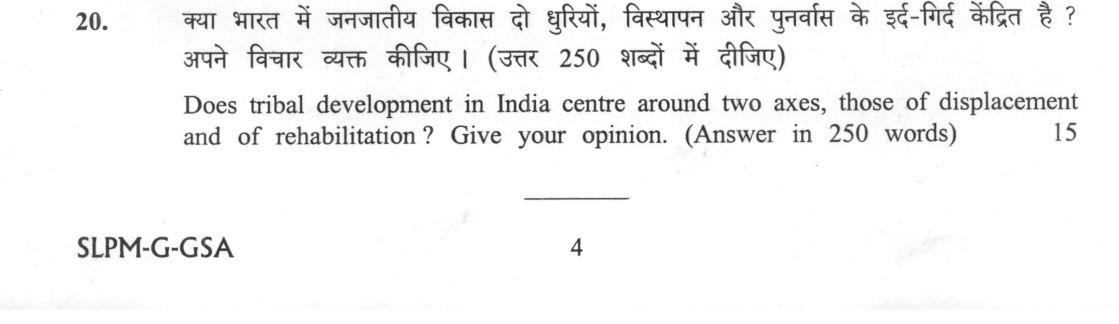
Does tribal development in India centre around two axes, those of displacement and of rehabilitation ? Give your opinion. (Answer in 250 words) 15 marks
हिंदी में प्रश्न पढ़ें
क्या भारत में जनजातीय विकास दो धुरियों, विस्थापन और पुनर्वास के इर्द-गिर्द केंद्रित है ? अपने विचार व्यक्त कीजिए। (उत्तर 250 शब्दों में दीजिए) 15 marks
Model answer
Written by UPSC Answer Check against this question's marking rubric, to the 250-word length. UPSC does not publish answers for Mains — this is one way to score well, not an official key.
Tribal development in post-independence India has undeniably been shaped by the twin axes of displacement and rehabilitation, yet characterizing it solely through this binary is reductive as it overlooks progressive rights-based and self-governance frameworks.
The Dominance of the Dual Axes Historically, national developmental imperatives have disproportionately burdened Scheduled Tribes. Mega-infrastructure projects like the Sardar Sarovar and Polavaram dams, intensive mineral extraction in Odisha, Jharkhand, and Chhattisgarh, alongside conservation-induced evictions, have caused extensive developmental and conservation-induced displacement. Rehabilitation has predominantly functioned as a reactive, compensatory mechanism. Despite legislative measures like the RFCTLARR Act 2013 and Supreme Court judgments mandating "land-for-land" compensation, implementation gaps persist, resulting in loss of cultural identity, community cohesion, and customary livelihoods.
Counter-Perspectives: Autonomous and Rights-Based Pathways However, tribal development cannot be restricted to this cycle. The state has also instituted distinct pathways of autonomous empowerment:
- Constitutional and Statutory Agency: The Fifth and Sixth Schedules, the PESA Act 1996, and the Forest Rights Act (FRA) 2006 empower Gram Sabhas with self-rule and ownership over minor forest produce.
- Livelihood and Human Development: Mechanisms such as the Tribal Sub-Plan, Van Dhan Vikas Yojana, and decentralized participatory development models (seen in Kerala) promote socio-economic growth without structural uprooting.
Evaluation and Verdict Tribal policy reflects an ideological evolution from colonial isolation and post-colonial integrationist assimilation toward an empowerment paradigm rooted in Nehru’s Tribal Panchsheel. While displacement and deficient rehabilitation remain critical structural vulnerabilities, reducing tribal development entirely to these two axes ignores institutional gains in tribal agency. Genuine development must definitively pivot from reactive compensatory welfare to rights-based, self-determined, and participatory growth.
What "Evaluate" is asking you to do
Judge how well something has performed against the standard it set for itself — its stated aim, mandate or promise — and commit to a verdict. Name the yardstick before you judge; an unanchored judgement reads as opinion.
Structure that answers it
Name the yardstick — stated aim, mandate or benchmark → performance against it → shortfall against it → why the gap exists → verdict
Where marks are lost
Presenting both sides and then declining to decide, or delivering a verdict against a standard you never stated, which makes it look arbitrary.
How this answer will be evaluated
Approach
Framework: GS1 Society: Continuity, Data, Intersectionality, Solution. comment: context > arguments both sides > judgment > close Full marks: Nuanced critique of the dichotomy with specific statutory and case law references.
Key points expected
- Define displacement and rehabilitation in tribal context
- Identify causes of displacement (infrastructure, mining, dams)
- Critique rehabilitation mechanisms (resettlement, compensation)
- Provide a balanced judgment on the 'two axes' claim
Evaluation rubric
Each sub-part is marked on its own, against the marks and word limit printed on the paper.
- The answer Contextualize tribal development, argue for/against the displacement-rehabilitation dichotomy, and provide a judgment. 15 marks · 250 words
comment— context → arguments both sides → judgment → close
Must cover
- Define displacement and rehabilitation in tribal context
- Identify causes of displacement (infrastructure, mining, dams)
- Critique rehabilitation mechanisms (resettlement, compensation)
- Provide a balanced judgment on the 'two axes' claim
Loses marks
- Narrating chronology of tribal history
- Emotive language without analytical depth
- Ignoring the 'rehabilitation' aspect entirely
Earns more
- Mention specific schemes (e.g., PESA, FRA)
- Cite specific examples (e.g., Narmada, Vedanta)
- Discuss intersectionality (gender, caste, ecology)
- Suggest alternative development models
Extra mark
- Cite a specific Supreme Court judgment
- Reference a specific committee report
Practice this exact question
Write your answer and it is marked point by point against the model answer above — what you covered, what you missed, what you got wrong.
Evaluate my answer →More from General Studies 2025 GS Paper I
- Q17 Discuss the distribution and density of population in the Ganga River Basin with special…
- Q18 How do you account for the growing fast food industries given that there are increased he…
- Q19 Achieving sustainable growth with emphasis on environmental protection could come into co…
- Q20 Does tribal development in India centre around two axes, those of displacement and of reh…