GS Paper IV — Q1
(a) Wisdom lies in knowing what to reckon with and what to overlook. An officer being engrossed with the periphery, ignoring the…
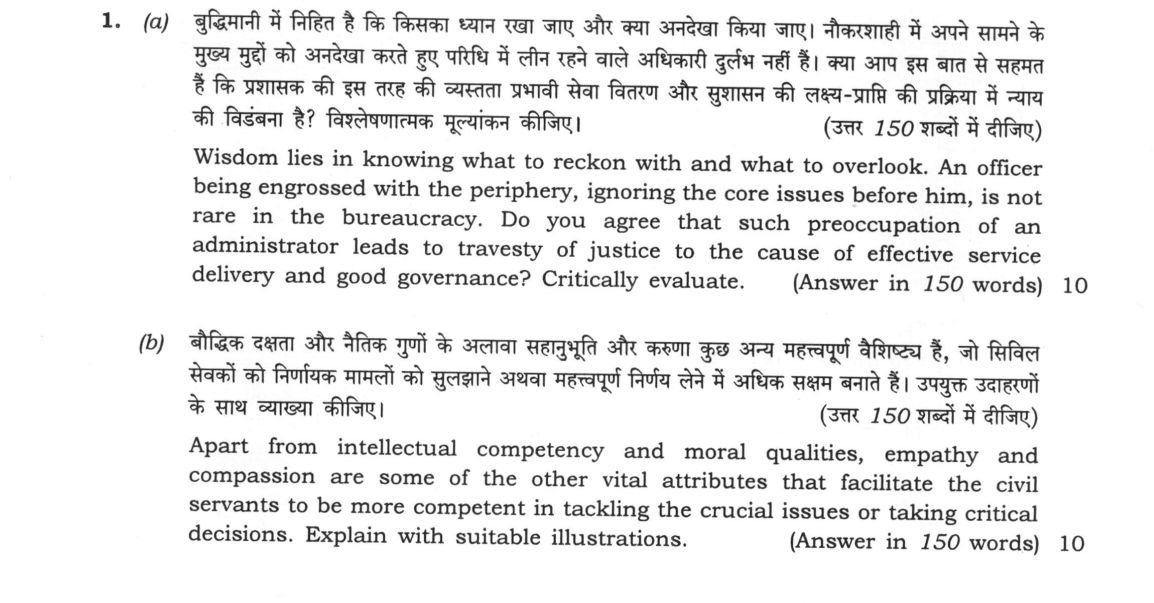
Wisdom lies in knowing what to reckon with and what to overlook. An officer being engrossed with the periphery, ignoring the core issues before him, is not rare in the bureaucracy. Do you agree that such preoccupation of an administrator leads to travesty of justice to the cause of effective service delivery and good governance? Critically evaluate. (Answer in 150 words) 10 marks
Apart from intellectual competency and moral qualities, empathy and compassion are some of the other vital attributes that facilitate the civil servants to be more competent in tackling the crucial issues or taking critical decisions. Explain with suitable illustrations. (Answer in 150 words) 10 marks
हिंदी में प्रश्न पढ़ें
बुद्धिमानी में निहित है कि किसका ध्यान रखा जाए और क्या अनदेखा किया जाए। नौकरशाही में अपने सामने के मुख्य मुद्दों को अनदेखा करते हुए परिधि में लीन रहने वाले अधिकारी दुर्लभ नहीं हैं। क्या आप इस बात से सहमत हैं कि प्रशासक की इस तरह की व्यस्तता प्रभावी सेवा वितरण और सुशासन की लक्ष्य-प्राप्ति की प्रक्रिया में न्याय की विडंबना है? विश्लेषणात्मक मूल्यांकन कीजिए। (उत्तर 150 शब्दों में दीजिए)
बौद्धिक दक्षता और नैतिक गुणों के अलावा सहानुभूति और करुणा कुछ अन्य महत्वपूर्ण विशिष्ट्य हैं, जो सिविल सेवकों को निर्णायक मामलों को सुलझाने अथवा महत्वपूर्ण निर्णय लेने में अधिक सक्षम बनाते हैं। उपयुक्त उदाहरणों के साथ व्याख्या कीजिए। (उत्तर 150 शब्दों में दीजिए)
Model answer
Written by UPSC Answer Check against this question's marking rubric, to the 150-word length. UPSC does not publish answers for Mains — this is one way to score well, not an official key.
Peripheral Focus vs Core Governance
Administrative wisdom requires selective attention—prioritizing substantive justice and systemic welfare over procedural formalism and political noise. Excessive engrossment with peripheral red-tapism causes a travesty of justice through delayed delivery, elite capture, and eroded public trust. However, measured attention to due process and statutory compliance is essential to prevent administrative arbitrariness. Thus, preoccupation with the periphery becomes a travesty only when rigid rule-fetishism subverts substantive constitutional outcomes.
Role of Empathy and Compassion
While intellect ensures technical competence, empathy provides the emotional intelligence required to contextualize rules and humanize governance. In disaster response, civil servants physically managing relief alongside citizens during the Kerala floods exemplified compassionate leadership. In welfare delivery under PM-JAY and NFSA, compassionate discretion overrides rigid biometric errors to prevent the exclusion of the destitute. Similarly, empathetic adjudication under the Forest Rights Act, 2006 harmonizes ecological conservation with vulnerable tribal livelihoods.
Ultimately, administrative wisdom and empathy are complementary: prioritization focuses state capacity on the core, while compassion ensures its execution remains humane.
What "Critically evaluate" is asking you to do
Judge how well something has performed against the standard it set for itself — its stated aim, mandate or promise — and commit to a verdict. Name the yardstick before you judge; an unanchored judgement reads as opinion. “Critically” is not a section added at the end: name the yardstick you are judging by — the evidence, the stated objective, a constitutional principle, a rival explanation — and let a verdict close each part of the body. Where the question quotes a claim, that verdict must land on the claim itself, accepted, qualified or rejected, and not on the theme in general.
Structure that answers it
Name the yardstick — stated aim, mandate or benchmark → performance against it → shortfall against it → why the gap exists → verdict
Where marks are lost
Merits in one paragraph, demerits in the next, and a conclusion calling for a balanced and holistic approach. That is a survey with the judgement left out and it holds the answer in the middle band. The opposite error is reading “critically” as permission to attack — and with the odd pairings, critically describe or critically explain, the exposition still carries most of the marks, the judgement being a layer on it rather than a substitute for it.
How this answer will be evaluated
Approach
Framework: GS4 Ethical Dilemma & Administrative Competence. (a) critically evaluate: positives > negatives/limits > conditions/safeguards > conclusion | (b) explain: definition/context > points in order > small example > short close Full marks: Precise definitions, strong administrative examples, balanced judgment, clear link to public trust.
Key points expected
- Define 'periphery' vs 'core' in administrative context
- Link preoccupation to 'travesty of justice'
- Connect to 'effective service delivery' and 'good governance'
- Provide balanced judgment on the statement
- Define empathy and compassion in administrative context
- Show how they facilitate 'tackling crucial issues'
- Show how they aid 'critical decisions'
- Provide suitable illustrations
Evaluation rubric
Each sub-part is marked on its own, against the marks and word limit printed on the paper.
- (a) Assess the impact of bureaucratic focus on periphery vs core issues on service delivery. 10 marks · 150 words
critically evaluate— positives → negatives/limits → conditions/safeguards → conclusion
Must cover
- Define 'periphery' vs 'core' in administrative context
- Link preoccupation to 'travesty of justice'
- Connect to 'effective service delivery' and 'good governance'
- Provide balanced judgment on the statement
Loses marks
- Preaching without administrative reasoning
- Ignoring the 'travesty of justice' aspect
- Vague generalities without specific examples
Earns more
- Mention 'red tape' or 'proceduralism' as the periphery
- Cite specific example of delayed justice (e.g., land records)
- Reference 'outcome-oriented' vs 'process-oriented' administration
- Mention 'accountability' vs 'responsiveness' trade-off
Extra mark
- Reference 'Right to Information' as a corrective
- Mention 'e-governance' as a tool to reduce periphery
- (b) Explain how empathy and compassion aid civil servants in critical decision-making. 10 marks · 150 words
explain— definition/context → points in order → small example → short close
Must cover
- Define empathy and compassion in administrative context
- Show how they facilitate 'tackling crucial issues'
- Show how they aid 'critical decisions'
- Provide suitable illustrations
Loses marks
- Listing values without explaining their utility
- Ignoring the 'critical decision' aspect
- Preaching moral lessons instead of administrative analysis
Earns more
- Example: Disaster management (empathy for victims)
- Example: Policy formulation (compassion for marginalized)
- Mention 'human-centric' administration
- Link to 'emotional intelligence' in leadership
Extra mark
- Reference 'Nudge theory' in policy design
- Mention 'Restorative justice' as an application
Practice this exact question
Write your answer and it is marked point by point against the model answer above — what you covered, what you missed, what you got wrong.
Evaluate my answer →More from General Studies 2022 GS Paper IV
- Q1 (a) Wisdom lies in knowing what to reckon with and what to overlook. An officer being eng…
- Q2 (a) The Rules and Regulations provided to all the civil servants are same, yet there is d…
- Q3 What does each of the following quotations mean to you? (a) "Ethics is knowing the differ…
- Q4 (a) What do you understand by the term 'good governance'? How far recent initiatives in t…