GS Paper IV — Q9
The Supreme Court has banned mining in the Aravalli Hills to stop degradation of the forest cover and to maintain ecological…
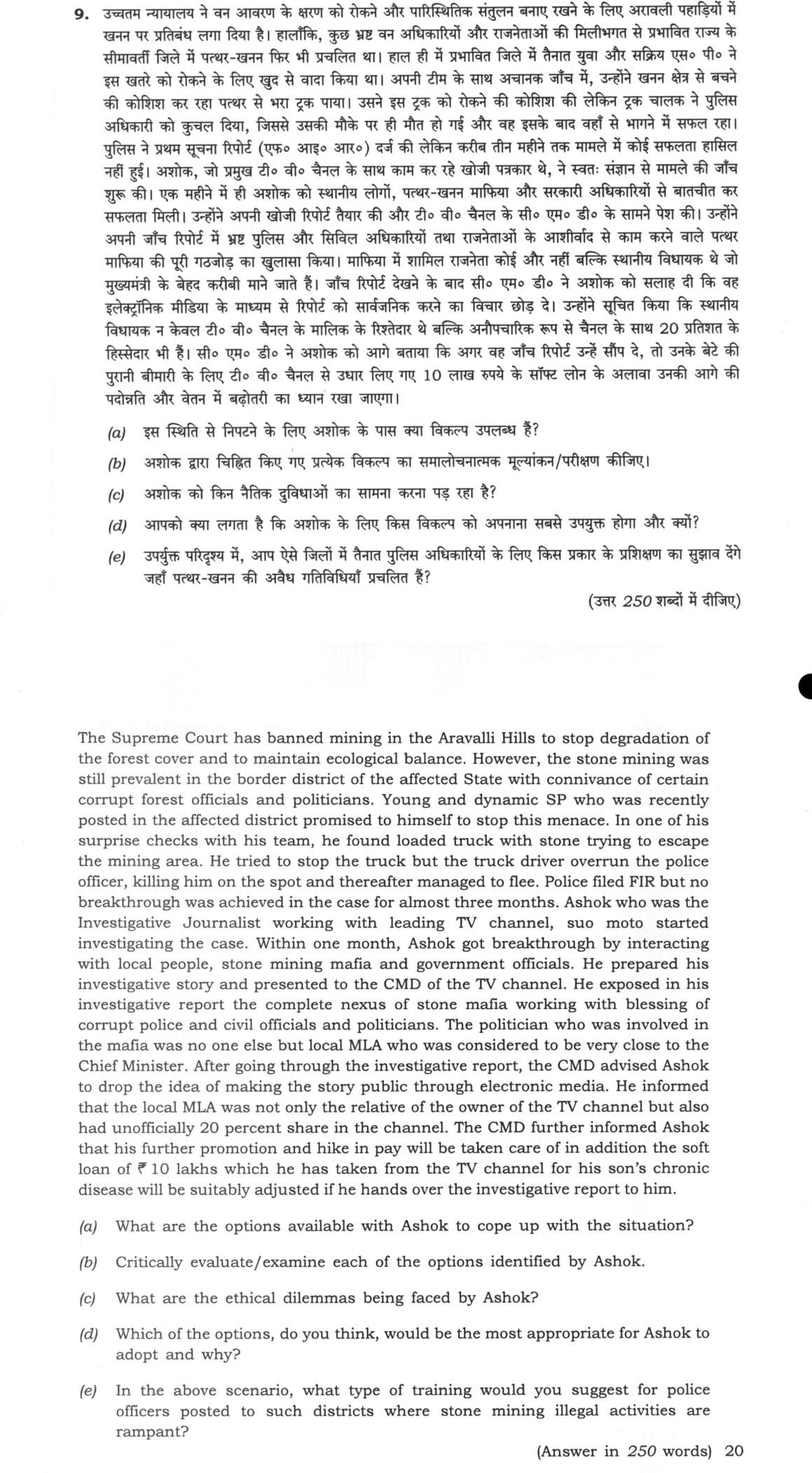
The Supreme Court has banned mining in the Aravalli Hills to stop degradation of the forest cover and to maintain ecological balance. However, the stone mining was still prevalent in the border district of the affected State with connivance of certain corrupt forest officials and politicians. Young and dynamic SP who was recently posted in the affected district promised to himself to stop this menace. In one of his surprise checks with his team, he found loaded truck with stone trying to escape the mining area. He tried to stop the truck but the truck driver overrun the police officer, killing him on the spot and thereafter managed to flee. Police filed FIR but no breakthrough was achieved in the case for almost three months. Ashok who was the Investigative Journalist working with leading TV channel, suo moto started investigating the case. Within one month, Ashok got breakthrough by interacting with local people, stone mining mafia and government officials. He prepared his investigative story and presented to the CMD of the TV channel. He exposed in his investigative report the complete nexus of stone mafia working with blessing of corrupt police and civil officials and politicians. The politician who was involved in the mafia was no one else but local MLA who was considered to be very close to the Chief Minister. After going through the investigative report, the CMD advised Ashok to drop the idea of making the story public through electronic media. He informed that the local MLA was not only the relative of the owner of the TV channel but also had unofficially 20 percent share in the channel. The CMD further informed Ashok that his further promotion and hike in pay will be taken care of in addition the soft loan of ₹ 10 lakhs which he has taken from the TV channel for his son's chronic disease will be suitably adjusted if he hands over the investigative report to him.
What are the options available with Ashok to cope up with the situation?
Critically evaluate/examine each of the options identified by Ashok.
What are the ethical dilemmas being faced by Ashok?
Which of the options, do you think, would be the most appropriate for Ashok to adopt and why?
In the above scenario, what type of training would you suggest for police officers posted to such districts where stone mining illegal activities are rampant?
हिंदी में प्रश्न पढ़ें
उच्चतम न्यायालय ने वन आवरण के क्षरण को रोकने और पारिस्थितिक संतुलन बनाए रखने के लिए अरावली पहाड़ियों में खनन पर प्रतिबंध लगा दिया है। हालांकि, कुछ भ्रष्ट वन अधिकारियों और राजनेताओं की मिलीभगत से प्रभावित राज्य के सीमावर्ती जिले में पत्थर-खनन फिर भी प्रचलित था। हाल ही में प्रभावित जिले में तैनात युवा और सक्रिय एस० पी० ने इस खतरे को रोकने के लिए खुद से वादा किया था। अपनी टीम के साथ अचानक जाँच में, उन्होंने खनन क्षेत्र से बचने की कोशिश कर रहा पत्थर से भरा ट्रक पाया। उसने इस ट्रक को रोकने की कोशिश की लेकिन ट्रक चालक ने पुलिस अधिकारी को कुचल दिया, जिससे उसकी मौके पर ही मौत हो गई और वह इसके बाद वहाँ से भागने में सफल रहा। पुलिस ने प्रथम सूचना रिपोर्ट (एफ० आई० आर०) दर्ज की लेकिन करीब तीन महीने तक मामले में कोई सफलता हासिल नहीं हुई। अशोक, जो प्रमुख टी० वी० चैनल के साथ काम कर रहे खोजी पत्रकार थे, ने स्वतः संज्ञान से मामले की जाँच शुरू की। एक महीने में ही अशोक को स्थानीय लोगों, पत्थर-खनन माफिया और सरकारी अधिकारियों से बातचीत कर सफलता मिली। उन्होंने अपनी खोजी रिपोर्ट तैयार की और टी० वी० चैनल के सी० एम० डी० के सामने पेश की। उन्होंने अपनी जाँच रिपोर्ट में भ्रष्ट पुलिस और सिविल अधिकारियों तथा राजनेताओं के आशीर्वाद से काम करने वाले पत्थर माफिया की पूरी गठजोड़ का खुलासा किया। माफिया में शामिल राजनेता कोई और नहीं बल्कि स्थानीय विधायक थे जो मुख्यमंत्री के बेहद करीबी माने जाते हैं। जाँच रिपोर्ट देखने के बाद सी० एम० डी० ने अशोक को सलाह दी कि वह इलेक्ट्रॉनिक मीडिया के माध्यम से रिपोर्ट को सार्वजनिक करने का विचार छोड़ दे। उन्होंने सूचित किया कि स्थानीय विधायक न केवल टी० वी० चैनल के मालिक के रिश्तेदार थे बल्कि अनौपचारिक रूप से चैनल के साथ 20 प्रतिशत के हिस्सेदार भी हैं। सी० एम० डी० ने अशोक को आगे बताया कि अगर वह जाँच रिपोर्ट उन्हें सौंप दे, तो उनके बेटे की पुरानी बीमारी के लिए टी० वी० चैनल से उधार लिए गए 10 लाख रुपये के सॉफ्ट लोन के अलावा उनकी आगे की पदोन्नति और वेतन में बढ़ोतरी का ध्यान रखा जाएगा।
इस स्थिति से निपटने के लिए अशोक के पास क्या विकल्प उपलब्ध हैं?
अशोक द्वारा चिह्नित किए गए प्रत्येक विकल्प का समालोचनात्मक मूल्यांकन/परीक्षण कीजिए।
अशोक को किन नैतिक दुविधाओं का सामना करना पड़ रहा है?
आपको क्या लगता है कि अशोक के लिए किस विकल्प को अपनाना सबसे उपयुक्त होगा और क्यों?
उपर्युक्त परिदृश्य में, आप ऐसे जिले में तैनात पुलिस अधिकारियों के लिए किस प्रकार के प्रशिक्षण का सुझाव देंगे जहाँ पत्थर-खनन की अवैध गतिविधियाँ प्रचलित हैं?
Model answer
Written by UPSC Answer Check against this question's marking rubric, to the 250-word length. UPSC does not publish answers for Mains — this is one way to score well, not an official key.
The case highlights the grim nexus among illegal stone-mining mafias, politicians, and compromised administration, which claimed the life of an upright Superintendent of Police and subverted the rule of law. It places the investigative journalist, Ashok, at a profound ethical crossroads where Fourth Estate accountability collides with corporate media corruption, personal financial vulnerabilities, and familial obligations.
Options Available to Ashok
Ashok has several potential courses of action to deal with the crisis:
First, he can accept the CMD's proposal, surrender his investigative dossier, accept the loan waiver of ten lakh rupees along with the promised promotion and salary hike, and bury the story completely.
Second, he can covertly leak the entire investigation, including evidence of the SP's murder and the political-corporate nexus, to rival media houses or anonymous whistleblower platforms.
Third, he can submit the evidence formally to statutory and constitutional oversight bodies, such as the Central Bureau of Investigation, the Supreme Court-appointed Central Empowered Committee on Aravalli mining, the Press Council of India, and the News Broadcasting & Digital Standards Authority.
Fourth, he can bypass mainstream television channels and publish the investigation directly on his personal social media accounts, an independent digital blog, or YouTube.
Fifth, he can resign from his employment, repay or restructure his debt legally, and seek employment with an independent, non-corporate investigative news portal to publish the report with institutional backing.
Sixth, he can negotiate with the CMD for a conditional or calibrated publication that redacts direct corporate-promoter links while exposing the ground-level mining mafia and the truck driver responsible for the officer's death.
Critical Evaluation of the Options
Weighing each option against professional ethics, legal viability, public interest, and personal repercussions reveals distinct merits and hazards.
Option one: Complying with the CMD resolves Ashok's pressing domestic crisis by securing funding for his son's chronic illness and advancing his career. However, against the standard of journalistic deontology, this represents moral capitulation and active complicity in the cover-up of a heinous murder and environmental destruction. It destroys his inner moral conscience, silences the sacrifice of the deceased SP, and makes him vulnerable to future institutional blackmail. Thus, it is ethically untenable.
Option two: Leaking the files anonymously protects the public interest by bringing the truth into the public domain without directly inviting immediate termination. However, this carries severe legal liabilities, including potential civil and criminal suits for breach of employment contract, theft of intellectual property, and lack of source protection. An unverified anonymous leak also risks being dismissed as politically motivated disinformation, thereby diluting its investigative potency.
Option three: Submitting the evidence to statutory authorities such as the CBI, the Supreme Court, or judicial monitoring bodies ensures that the material is treated as legal evidence rather than mere media sensationalism. It creates an official investigative trail, triggers contempt proceedings against illegal Aravalli mining, and mobilizes institutional power against the nexus. While it does not guarantee immediate media broadcast, it guarantees legal accountability under judicial protection.
Option four: Unilateral publication on personal social media or blogs achieves immediate public dissemination and bypasses editorial censorship. Nevertheless, it strips Ashok of legal and institutional backing, exposing him and his family to targeted physical violence from the mafia, strategic lawsuits for defamation, and rapid algorithmic takedowns without institutional verification.
Option five: Resigning and joining an independent consortium restores professional autonomy and journalistic integrity. It enables ethical publication under professional scrutiny. The downside is the immediate financial distress regarding his son's medical treatment and the risk of the former employer demanding instantaneous recovery of the ten lakh rupee loan, which requires a pre-arranged legal and financial safety net.
Option six: Negotiating conditional publication with the CMD attempts a pragmatic middle ground. Yet, this compromises journalistic truth by creating a selective, half-hearted exposure that shields the political mastermind, thereby violating the fundamental obligation of fearless reporting.
Ethical Dilemmas Faced by Ashok
Ashok is caught in multi-dimensional moral conflicts:
Duty to Employer versus Duty to the Public: As an employee, Ashok owes contractual fidelity to his channel, yet as a journalist, his sovereign duty under Article 19(1)(a) is to inform the public and uphold the rule of law.
Professional Integrity versus Familial Duty: Kantian deontology demands adherence to truth and justice for the slain SP, whereas teleological care ethics compels him to protect his ailing son's life through the financial relief offered by the CMD.
Safety of Sources and Self versus Exposure of Truth: Releasing the names of local whistleblowers and exposing a powerful MLA risks life-threatening retaliation against his sources and his own family.
Career Opportunism versus Moral Courage: Choosing between lucrative personal advancement through silence versus occupational ruin and hardship for the sake of public righteousness.
Utilitarian Calculus of Harm: Ashok must weigh the concentrated, immediate suffering of his family against the diffuse, long-term societal damage caused by unchecked environmental degradation and organized criminal impunity.
Most Appropriate Course of Action and Justification
The most appropriate course of action for Ashok is a phased, legally sound institutional strategy combining statutory whistleblowing with independent publication.
First, Ashok must secure multiple encrypted digital copies of the entire investigation, including field recordings, source statements, and the CMD's extortionate offer, placing them in secure legal custody.
Second, he must officially petition the Supreme Court of India or its Central Empowered Committee overseeing the Aravalli mining ban, while simultaneously submitting a formal complaint to the CBI and the National Green Tribunal. The Supreme Court, in landmark rulings such as Romesh Thappar v. State of Madras and Indian Express Newspapers v. Union of India, underscored that the freedom of the press is an essential pillar of constitutional democracy that cannot be bartered away for private profit. Approaching the judiciary invokes judicial oversight, insulating the evidence from political interference and conferring de facto whistleblower protection.
Third, Ashok must tender his resignation from the TV channel, refusing the unethical loan waiver to prevent future criminal extortion or moral compromise. To manage his son's medical care and the outstanding loan, he can approach independent journalist welfare bodies, crowdsourcing platforms, or seek legal recourse for equitable loan restructuring.
Fourth, he should share the vetted investigative dossier with non-partisan media collectives or the Press Council of India. Adhering to the Press Council of India's Norms of Journalistic Conduct, which mandate that public interest supersedes commercial and private affiliations, provides legitimacy, institutional protection, and nationwide amplification that an individual leak cannot achieve.
Suggested Training Modules for Police Officers in Mining-Affected Districts
To prevent the recurrence of tragedies like the dynamic SP's murder and to break the organized mafia-bureaucracy nexus, police officers deployed in vulnerable zones require specialized institutional capacity building:
Ethical Decision-Making and Integrity under Pressure: Specialized curriculum utilizing real-life case studies of fallen officers to build moral fortitude, resist political coercion, and navigate systemic pressure without compromising standard operating procedures.
Intelligence-Led Policing and Source Protection: Advanced training in clandestine intelligence gathering, developing local human intelligence networks, secure handling of community informants, and counter-surveillance tactics against organized syndicates.
Inter-Agency Tactical Coordination: Joint operational simulation drills involving the State Police, Forest Department, Department of Mines and Geology, and the Central Empowered Committee to institutionalize real-time intelligence sharing and unified enforcement raids.
Technological Surveillance and Evidence Gathering: Operational training in deploying unmanned aerial vehicles (drones), satellite remote sensing, night-vision cameras, automated number plate recognition (ANPR) systems at border check-posts, and tamper-proof GPS geo-fencing of mineral corridors to eliminate physical vulnerability during surprise checks.
Tactical Self-Defence, Stress Management, and Family Support: High-risk vehicle interception protocols (such as using spike strips and tactical roadblock barriers instead of physical interdiction by personnel), coupled with institutionalized mental resilience workshops and comprehensive risk-insurance frameworks for families of frontline personnel.
Conclusion
Journalism and law enforcement are sacred covenants with the public interest. While the personal stakes for Ashok are exceptionally high, capitulating to corporate corruption would normalize the murder of an honest public servant and destroy the ecological integrity of the Aravalli range. By placing the evidence before the judiciary and independent statutory watchdogs, Ashok upholds the highest traditions of the Fourth Estate, transforming a private crisis into an instrument of systemic justice.
What "Critically evaluate" is asking you to do
Judge how well something has performed against the standard it set for itself — its stated aim, mandate or promise — and commit to a verdict. Name the yardstick before you judge; an unanchored judgement reads as opinion. “Critically” is not a section added at the end: name the yardstick you are judging by — the evidence, the stated objective, a constitutional principle, a rival explanation — and let a verdict close each part of the body. Where the question quotes a claim, that verdict must land on the claim itself, accepted, qualified or rejected, and not on the theme in general.
Structure that answers it
Name the yardstick — stated aim, mandate or benchmark → performance against it → shortfall against it → why the gap exists → verdict
Where marks are lost
Merits in one paragraph, demerits in the next, and a conclusion calling for a balanced and holistic approach. That is a survey with the judgement left out and it holds the answer in the middle band. The opposite error is reading “critically” as permission to attack — and with the odd pairings, critically describe or critically explain, the exposition still carries most of the marks, the judgement being a layer on it rather than a substitute for it.
How this answer will be evaluated
Approach
Framework: GS4 Case Study Framework (Crux, Stakeholders, Dilemmas, Options, Course of Action). (a) enumerate: list the items in order > one line each > no commentary | (b) critically evaluate: positives > negatives/limits > conditions/safeguards > conclusion | (c) highlight: name the salient points > one line of substance each > close | (d) justify: claim > 3-4 reasons > evidence > conclusion | (e) suggest: the problem in one line > implementable measures > who acts > conclusion Full marks: Comprehensive options, deep ethical analysis, clear justification, specific training measures.
Key points expected
- Option to comply with CMD (drop story)
- Option to publish story via electronic media
- Option to report to higher authorities (Press Council/Police)
- Option to resign/leave the channel
- Pros/cons of complying (job security vs ethics)
- Pros/cons of publishing (public interest vs career risk)
- Pros/cons of reporting (legal recourse vs retaliation)
- Pros/cons of resigning (integrity vs financial loss)
Evaluation rubric
Each sub-part is marked on its own, against the marks and word limit printed on the paper.
- (a) List distinct courses of action available to Ashok.
enumerate— list the items in order → one line each → no commentary
Must cover
- Option to comply with CMD (drop story)
- Option to publish story via electronic media
- Option to report to higher authorities (Press Council/Police)
- Option to resign/leave the channel
Loses marks
- Listing vague options like 'do the right thing'
- Missing the option to resign
Earns more
- Option to seek legal protection
- Option to approach other media houses
Extra mark
- Mention of 'whistleblower' protection context
- (b) Assess pros and cons of each option identified in (a).
critically evaluate— positives → negatives/limits → conditions/safeguards → conclusion
Must cover
- Pros/cons of complying (job security vs ethics)
- Pros/cons of publishing (public interest vs career risk)
- Pros/cons of reporting (legal recourse vs retaliation)
- Pros/cons of resigning (integrity vs financial loss)
Loses marks
- One-sided evaluation (only pros)
- Ignoring the financial pressure on the journalist
Earns more
- Analysis of 'soft loan' as a trap
- Impact on son's treatment in each scenario
Extra mark
- Reference to 'duty of care' to family
- (c) Identify the specific ethical conflicts Ashok faces.
highlight— name the salient points → one line of substance each → close
Must cover
- Duty to public (truth) vs Duty to employer
- Personal financial need (son's health) vs Professional integrity
- Loyalty to organization vs Social responsibility
- Fear of retaliation vs Justice
Loses marks
- Generic ethical terms without context
- Missing the family/financial dilemma
Earns more
- Conflict of interest (CMD's stake in the story)
- Pressure of 'soft loan' as coercion
Extra mark
- Mention of 'moral courage' vs 'prudence'
- (d) Select the best option and provide reasoned arguments.
justify— claim → 3-4 reasons → evidence → conclusion
Must cover
- Clear selection of one option
- Argument based on 'Public Interest' (journalism core)
- Argument based on 'Rule of Law' (accountability)
- Addressing the financial issue (e.g., legal aid, other jobs)
Loses marks
- Choosing to comply with the CMD
- Vague justification without specific ethical principles
Earns more
- Balancing act: protecting family while serving public
- Long-term career reputation vs short-term gain
Extra mark
- Reference to 'Press Council of India' guidelines
- (e) Propose specific training modules for police in mining areas.
suggest— the problem in one line → implementable measures → who acts → conclusion
Must cover
- Training on 'Mines Act' and environmental laws
- Ethical training to resist political pressure
- Physical/Combat training for high-risk enforcement
- Legal awareness regarding FIR and evidence handling
Loses marks
- Generic suggestions like 'better training'
- Ignoring the specific context of illegal mining
Earns more
- Training on 'Right to Information' (RTI) for transparency
- Mental health support for high-stress postings
Extra mark
- Mention of 'National Police Academy' modules
Practice this exact question
Write your answer and it is marked point by point against the model answer above — what you covered, what you missed, what you got wrong.
Evaluate my answer →More from General Studies 2022 GS Paper IV
- Q6 (a) Whistle-blower, who reports corruption and illegal activities, wrongdoing and miscond…
- Q7 Prabhat was working as Vice President (Marketing) at Sterling Electric Ltd., a reputed mu…
- Q8 Ramesh is State Civil Services Officer who got the opportunity of getting posted to the c…
- Q9 The Supreme Court has banned mining in the Aravalli Hills to stop degradation of the fore…
- Q10 You have done MBA from a reputed institution three years back but could not get campus pl…
- Q11 Rakesh was working as Joint Commissioner in Transport Department of a city. As a part of…
- Q12 You are appointed as an officer heading the section in Environment Pollution Control Boar…