GS Paper IV — Q10
You have done MBA from a reputed institution three years back but could not get campus placement due to COVID-19 generated…
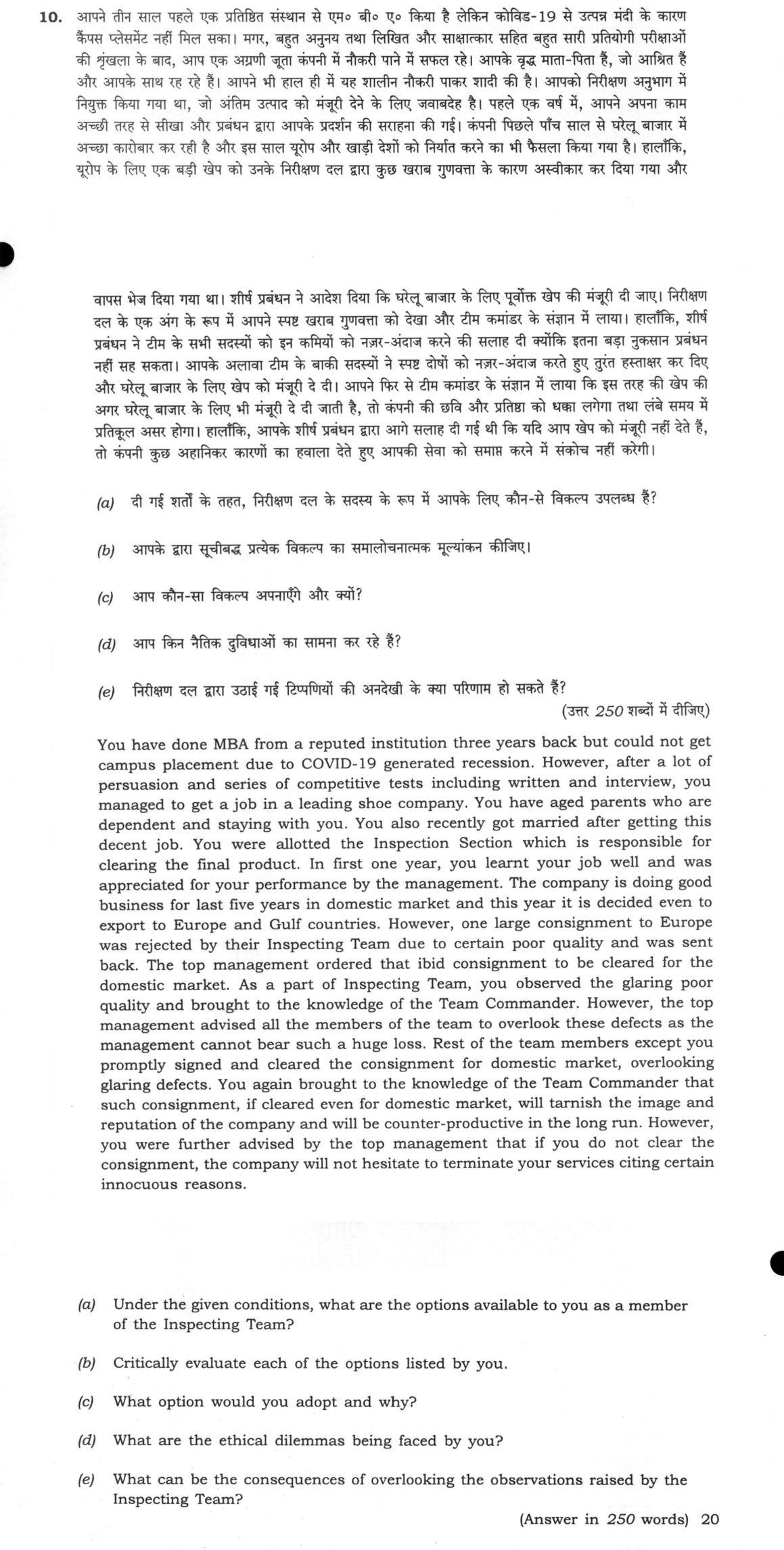
You have done MBA from a reputed institution three years back but could not get campus placement due to COVID-19 generated recession. However, after a lot of persuasion and series of competitive tests including written and interview, you managed to get a job in a leading shoe company. You have aged parents who are dependent and staying with you. You also recently got married after getting this decent job. You were allotted the Inspection Section which is responsible for clearing the final product. In first one year, you learnt your job well and was appreciated for your performance by the management. The company is doing good business for last five years in domestic market and this year it is decided even to export to Europe and Gulf countries. However, one large consignment to Europe was rejected by their Inspecting Team due to certain poor quality and was sent back. The top management ordered that ibid consignment to be cleared for the domestic market. As a part of Inspecting Team, you observed the glaring poor quality and brought to the knowledge of the Team Commander. However, the top management advised all the members of the team to overlook these defects as the management cannot bear such a huge loss. Rest of the team members except you promptly signed and cleared the consignment for domestic market, overlooking glaring defects. You again brought to the knowledge of the Team Commander that such consignment, if cleared even for domestic market, will tarnish the image and reputation of the company and will be counter-productive in the long run. However, you were further advised by the top management that if you do not clear the consignment, the company will not hesitate to terminate your services citing certain innocuous reasons.
Under the given conditions, what are the options available to you as a member of the Inspecting Team?
Critically evaluate each of the options listed by you.
What option would you adopt and why?
What are the ethical dilemmas being faced by you?
What can be the consequences of overlooking the observations raised by the Inspecting Team?
(Answer in 250 words)
हिंदी में प्रश्न पढ़ें
आपने तीन साल पहले एक प्रतिष्ठित संस्थान से एम. बी. ए. किया है लेकिन कोविड-19 से उत्पन्न मंदी के कारण कैंपस प्लेसमेंट नहीं मिल सका। मगर, बहुत अनुभव तथा लिखित और साक्षात्कार सहित बहुत सारी प्रतियोगी परीक्षाओं की मुश्किल के बाद, आप एक अग्रणी जूता कंपनी में नौकरी पाने में सफल रहे। आपके वृद्ध माता-पिता हैं, जो अशक्त हैं और आपके साथ रह रहे हैं। आपने भी हाल ही में यह शालीन नौकरी पाकर शादी की है। आपको निरीक्षण अनुभाग में नियुक्त किया गया था, जो अंतिम उत्पाद को मंजूरी देने के लिए जवाबदेह है। पहले एक वर्ष में, आपने अपना काम अच्छी तरह से सीखा और प्रबंधन द्वारा आपके प्रदर्शन की सराहना की गई। कंपनी पिछले पांच साल से घरेलू बाजार में अच्छा कारोबार कर रही है और इस साल यूरोप और खाड़ी देशों को निर्यात करने का भी फैसला किया गया है। हालांकि, यूरोप के लिए एक बड़ी खेप को उनके निरीक्षण दल द्वारा कुछ खराब गुणवत्ता के कारण अस्वीकार कर दिया गया और वापस भेज दिया गया था। शीर्ष प्रबंधन ने आदेश दिया कि घरेलू बाजार के लिए पूर्वोक्त खेप की मंजूरी दी जाए। निरीक्षण दल के एक अंग के रूप में आपने स्पष्ट खराब गुणवत्ता को देखा और टीम कमांडर के संज्ञान में लाया। हालांकि, शीर्ष प्रबंधन ने टीम के सभी सदस्यों को इन कमियों को नजर-अंदाज करने की सलाह दी क्योंकि इतना बड़ा नुकसान प्रबंधन नहीं सह सकता। आपके अलावा टीम के बाकी सदस्यों ने स्पष्ट दोषों को नजर-अंदाज करते हुए तुरंत हस्ताक्षर कर दिए और घरेलू बाजार के लिए खेप को मंजूरी दे दी। आपने फिर से टीम कमांडर के संज्ञान में लाया कि इस तरह की खेप की अगर घरेलू बाजार के लिए भी मंजूरी दे दी जाती है, तो कंपनी की छवि और प्रतिष्ठा को धक्का लगेगा तथा लंबे समय में प्रतिकूल असर होगा। हालांकि, आपके शीर्ष प्रबंधन द्वारा आगे सलाह दी गई थी कि यदि आप खेप को मंजूरी नहीं देते हैं, तो कंपनी कुछ अहानिकर कारणों का हवाला देते हुए आपकी सेवा को समाप्त करने में संकोच नहीं करेगी।
दी गई शर्तों के तहत, निरीक्षण दल के सदस्य के रूप में आपके लिए कौन-से विकल्प उपलब्ध हैं?
आपके द्वारा सूचीबद्ध प्रत्येक विकल्प का समालोचनात्मक मूल्यांकन कीजिए।
आप कौन-सा विकल्प अपनाएंगे और क्यों?
आप किन नैतिक दुविधाओं का सामना कर रहे हैं?
निरीक्षण दल द्वारा उठाई गई टिप्पणियों की अनदेखी के क्या परिणाम हो सकते हैं?
(उत्तर 250 शब्दों में दीजिए)
What "Critically evaluate" is asking you to do
Judge how well something has performed against the standard it set for itself — its stated aim, mandate or promise — and commit to a verdict. Name the yardstick before you judge; an unanchored judgement reads as opinion. “Critically” is not a section added at the end: name the yardstick you are judging by — the evidence, the stated objective, a constitutional principle, a rival explanation — and let a verdict close each part of the body. Where the question quotes a claim, that verdict must land on the claim itself, accepted, qualified or rejected, and not on the theme in general.
Structure that answers it
Name the yardstick — stated aim, mandate or benchmark → performance against it → shortfall against it → why the gap exists → verdict
Where marks are lost
Merits in one paragraph, demerits in the next, and a conclusion calling for a balanced and holistic approach. That is a survey with the judgement left out and it holds the answer in the middle band. The opposite error is reading “critically” as permission to attack — and with the odd pairings, critically describe or critically explain, the exposition still carries most of the marks, the judgement being a layer on it rather than a substitute for it.
How this answer will be evaluated
Approach
Framework: GS4 Ethical Dilemma Framework (Crux, Stakeholders, Options, Course of Action). (a) enumerate: list the items in order > one line each > no commentary | (b) critically evaluate: positives > negatives/limits > conditions/safeguards > conclusion | (c) justify: claim > 3-4 reasons > evidence > conclusion | (d) highlight: name the salient points > one line of substance each > close | (e) analyse: intro > causes > effects > stakeholders/linkages > way forward Full marks: Balanced reasoning, clear course of action, addresses personal and public stakes.
Key points expected
- Refuse to sign and report to higher authority
- Comply with management order to save job
- Resign from the position
- Whistleblow to external regulatory bodies
- Identify the 'easy-but-wrong' option (compliance)
- Analyze impact on personal livelihood (parents/spouse)
- Analyze impact on company reputation
- Weigh legal liability vs. job security
Evaluation rubric
Each sub-part is marked on its own, against the marks and word limit printed on the paper.
- (a) List distinct courses of action available to the officer.
enumerate— list the items in order → one line each → no commentary
Must cover
- Refuse to sign and report to higher authority
- Comply with management order to save job
- Resign from the position
- Whistleblow to external regulatory bodies
Loses marks
- Listing only one option
- Vague options like 'do the right thing'
Earns more
- Negotiate for a recall/repair of consignment
- Seek transfer to another department
Extra mark
- Reference to specific labor or consumer protection laws
- (b) Assess the pros and cons of each option listed in (a).
critically evaluate— positives → negatives/limits → conditions/safeguards → conclusion
Must cover
- Identify the 'easy-but-wrong' option (compliance)
- Analyze impact on personal livelihood (parents/spouse)
- Analyze impact on company reputation
- Weigh legal liability vs. job security
Loses marks
- Preaching instead of reasoning
- Ignoring the personal constraints mentioned in the case
Earns more
- Mentioning the 'silent stakeholder' (consumer)
- Discussing the 'wall' of financial pressure
Extra mark
- Citing a specific case of corporate fraud
- (c) Select the best option and provide a reasoned argument.
justify— claim → 3-4 reasons → evidence → conclusion
Must cover
- Clear selection of one option
- Argument based on 'higher right' (public trust)
- Action plan in immediate/short/long horizons
- Addressing the threat of termination
Loses marks
- Conclusion repeating the intro
- Choosing an option without addressing the threat
Earns more
- Balancing duty to employer vs. duty to public
- Pragmatic approach to handling the threat
Extra mark
- One short accurate quote on integrity
- (d) Identify the specific ethical conflicts in the scenario.
highlight— name the salient points → one line of substance each → close
Must cover
- Loyalty to employer vs. duty to public
- Personal financial security vs. professional integrity
- Peer pressure vs. individual conscience
Loses marks
- Dumping fifteen generic values
- Failing to link dilemmas to the specific case
Earns more
- Short-term gain vs. long-term reputation
- Institutional pressure vs. legal compliance
Extra mark
- Reference to a specific ethical theory (e.g., Utilitarianism)
- (e) Explain the consequences of ignoring the inspection report.
analyse— intro → causes → effects → stakeholders/linkages → way forward
Must cover
- Impact on consumer safety (shoes)
- Legal liability for the company
- Long-term damage to brand reputation
- Erosion of internal organizational ethics
Loses marks
- Focusing only on immediate financial loss
- Ignoring the 'counter-productive' long-run aspect
Earns more
- Financial loss from potential recalls
- Loss of export market trust
Extra mark
- Reference to specific product liability laws
Model answer coming soon
Every evaluation on this site is marked against a verified model answer. This question's answer is still being written; evaluation opens the moment it lands.
More from General Studies 2022 GS Paper IV
- Q7 Prabhat was working as Vice President (Marketing) at Sterling Electric Ltd., a reputed mu…
- Q8 Ramesh is State Civil Services Officer who got the opportunity of getting posted to the c…
- Q9 The Supreme Court has banned mining in the Aravalli Hills to stop degradation of the fore…
- Q10 You have done MBA from a reputed institution three years back but could not get campus pl…
- Q11 Rakesh was working as Joint Commissioner in Transport Department of a city. As a part of…
- Q12 You are appointed as an officer heading the section in Environment Pollution Control Boar…