GS Paper IV — Q2
(a) The Rules and Regulations provided to all the civil servants are same, yet there is difference in the performance. Positive…
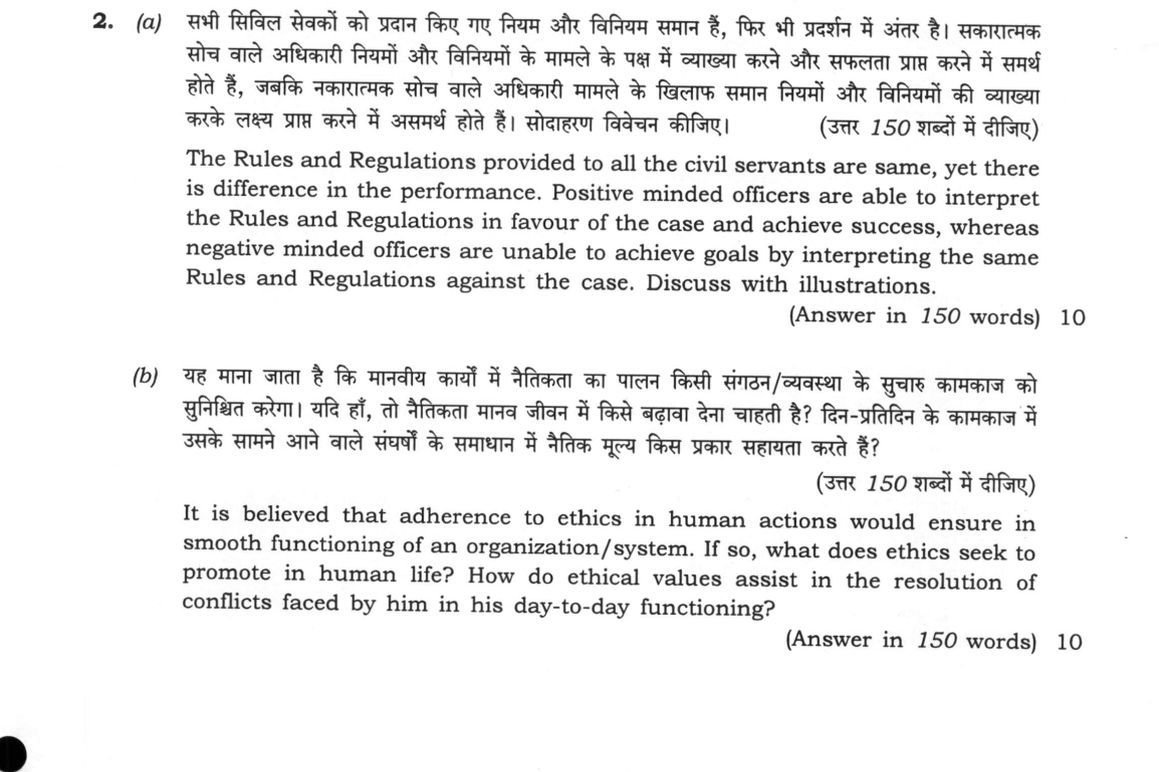
The Rules and Regulations provided to all the civil servants are same, yet there is difference in the performance. Positive minded officers are able to interpret the Rules and Regulations in favour of the case and achieve success, whereas negative minded officers are unable to achieve goals by interpreting the same Rules and Regulations against the case. Discuss with illustrations. (Answer in 150 words) 10 marks
It is believed that adherence to ethics in human actions would ensure in smooth functioning of an organization/system. If so, what does ethics seek to promote in human life? How do ethical values assist in the resolution of conflicts faced by him in his day-to-day functioning? (Answer in 150 words) 10 marks
हिंदी में प्रश्न पढ़ें
सभी सिविल सेवकों को प्रदान किए गए नियम और विनियम समान हैं, फिर भी प्रदर्शन में अंतर है। सकारात्मक सोच वाले अधिकारी नियमों और विनियमों के मामले के पक्ष में व्याख्या करने और सफलता प्राप्त करने में समर्थ होते हैं, जबकि नकारात्मक सोच वाले अधिकारी मामले के खिलाफ समान नियमों और विनियमों की व्याख्या करके लक्ष्य प्राप्त करने में असमर्थ होते हैं। सोदाहरण विवेचन कीजिए। (उत्तर 150 शब्दों में दीजिए)
यह माना जाता है कि मानवीय कार्यों में नैतिकता का पालन किसी संगठन/व्यवस्था के सुचारु कामकाज को सुनिश्चित करेगा। यदि हाँ, तो नैतिकता मानव जीवन में किसे बढ़ावा देना चाहती है? दिन-प्रतिदिन के कामकाज में उसके सामने आने वाले संघर्षों के समाधान में नैतिक मूल्य किस प्रकार सहायता करते हैं? (उत्तर 150 शब्दों में दीजिए)
Model answer
Written by UPSC Answer Check against this question's marking rubric, to the 150-word length. UPSC does not publish answers for Mains — this is one way to score well, not an official key.
Rules and Officer Mindset Rules provide the framework of governance, but an administrator's mindset determines whether they act as enablers or barriers. Positive-minded officers adopt a purposive interpretation to achieve public welfare—such as T.N. Seshan operationalizing latent powers under Article 324 to enforce the Model Code of Conduct, or administrators creatively utilizing Section 144 CrPC for logistics and relief during disasters. Conversely, a negative mindset treats rules as disabling constraints, using literal interpretations and procedural red-tape to evade responsibility, resulting in administrative inertia.
Ethics in Action and Conflict Resolution Ethics promotes social trust, cooperation, fairness, and long-term institutional health. In day-to-day functioning, ethical values provide an objective compass to resolve acute dilemmas:
- Public Interest vs. Political Pressure: Integrity and fortitude ensure adherence to constitutional morality over partisan demands.
- Inter-Departmental Friction: Empathy and transparency facilitate reasoned dialogue and collaborative problem-solving over turf wars.
- Resource Allocation: Equity and non-partisanship prevent nepotism, ensuring just distribution.
Fostering an ethical orientation alongside a progressive, solution-oriented interpretation of rules transforms bureaucratic machinery from rigid compliance into dynamic, responsive public service.
What "Discuss" is asking you to do
Lay the issue out from more than one side — how it arose, what is claimed for it, what is held against it, and where it now stands. UPSC attaches discuss to broad topics with several live dimensions, so coverage of the dimensions earns more than the strength of your opinion.
Structure that answers it
Set the issue up → the case as it is made → the case against → the dimension both sides leave out → where the balance now lies
Where marks are lost
Listing facts with no thread between them, or arguing one side throughout and calling it a discussion.
How this answer will be evaluated
Approach
Framework: GS4 Ethical Dilemma & Administrative Ethics Framework. (a) discuss: intro > 3-4 dimensions > example > balanced close | (b) explain: definition/context > points in order > small example > short close Full marks: Clear illustrations for (a); specific mechanism for (b); balanced, actionable, within word limit.
Key points expected
- Define positive vs negative mindset in rule interpretation
- Provide one specific illustration of positive interpretation
- Provide one specific illustration of negative interpretation
- Link mindset to administrative success or failure
- Define what ethics seeks to promote in human life
- Explain mechanism of ethics in conflict resolution
- Provide example of day-to-day functional conflict
- Show how ethical values guide the resolution
Evaluation rubric
Each sub-part is marked on its own, against the marks and word limit printed on the paper.
- (a) Contrast positive vs negative interpretation of rules with specific illustrations. 10 marks · 150 words
discuss— intro → 3-4 dimensions → example → balanced close
Must cover
- Define positive vs negative mindset in rule interpretation
- Provide one specific illustration of positive interpretation
- Provide one specific illustration of negative interpretation
- Link mindset to administrative success or failure
Loses marks
- Abstract discussion without concrete illustrations
- Preaching about 'good attitude' without administrative context
- Ignoring the 'same rules' constraint in the prompt
Earns more
- Mention 'spirit of the law' vs 'letter of the law'
- Reference specific administrative context (e.g., disaster relief, licensing)
Extra mark
- Cite a specific Supreme Court judgment on interpretation
- Reference a specific administrative reform or policy
- (b) Explain what ethics promotes and how it resolves day-to-day conflicts. 10 marks · 150 words
explain— definition/context → points in order → small example → short close
Must cover
- Define what ethics seeks to promote in human life
- Explain mechanism of ethics in conflict resolution
- Provide example of day-to-day functional conflict
- Show how ethical values guide the resolution
Loses marks
- Listing values without explaining their conflict-resolution role
- Vague generalities about 'good behavior'
- Ignoring the 'day-to-day functioning' aspect
Earns more
- Distinguish ethics from mere rules or laws
- Mention specific ethical values (integrity, empathy, fairness)
Extra mark
- Reference a specific ethical framework (utilitarian, deontological)
- Cite a specific administrative code of conduct
Practice this exact question
Write your answer and it is marked point by point against the model answer above — what you covered, what you missed, what you got wrong.
Evaluate my answer →More from General Studies 2022 GS Paper IV
- Q1 (a) Wisdom lies in knowing what to reckon with and what to overlook. An officer being eng…
- Q2 (a) The Rules and Regulations provided to all the civil servants are same, yet there is d…
- Q3 What does each of the following quotations mean to you? (a) "Ethics is knowing the differ…
- Q4 (a) What do you understand by the term 'good governance'? How far recent initiatives in t…
- Q5 (a) Russia and Ukraine war has been going on for the last seven months. Different countri…