GS Paper IV — Q4
(a) What do you understand by the term 'good governance'? How far recent initiatives in terms of e-Governance steps taken by the…
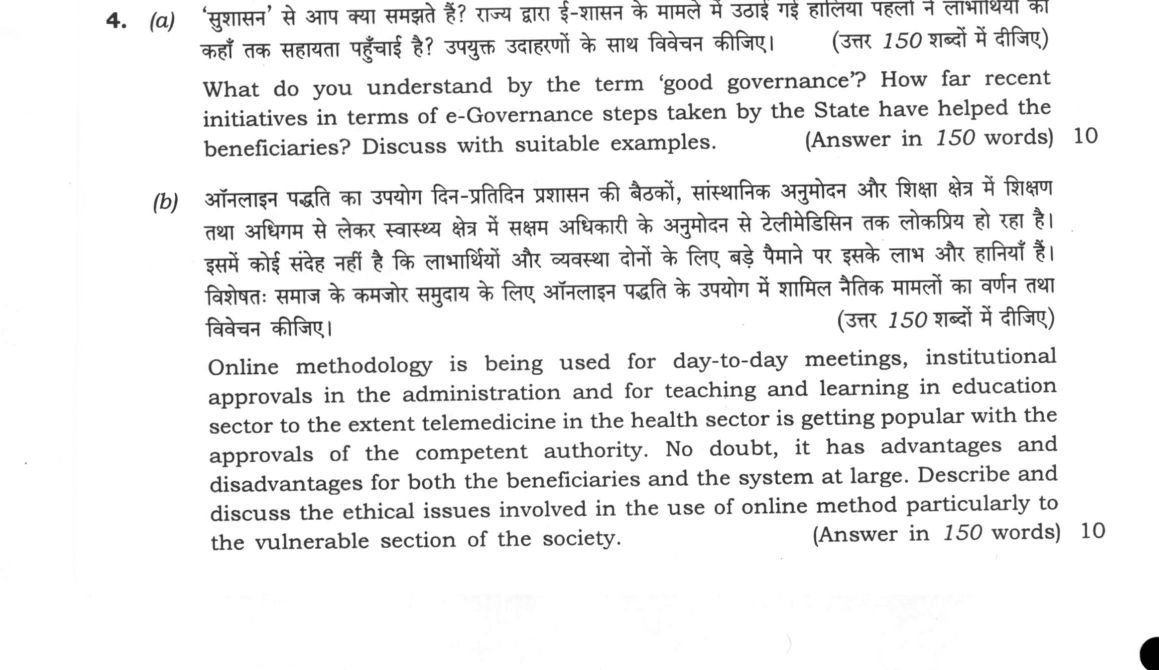
What do you understand by the term 'good governance'? How far recent initiatives in terms of e-Governance steps taken by the State have helped the beneficiaries? Discuss with suitable examples. (Answer in 150 words) 10 marks
Online methodology is being used for day-to-day meetings, institutional approvals in the administration and for teaching and learning in education sector to the extent telemedicine in the health sector is getting popular with the approvals of the competent authority. No doubt, it has advantages and disadvantages for both the beneficiaries and the system at large. Describe and discuss the ethical issues involved in the use of online method particularly to the vulnerable section of the society. (Answer in 150 words) 10 marks
हिंदी में प्रश्न पढ़ें
'सुशासन' से आप क्या समझते हैं? राज्य द्वारा ई-शासन के मामले में उठाई गई हालिया पहलों ने लाभार्थियों को कहां तक सहायता पहुंचाई है? उपयुक्त उदाहरणों के साथ विवेचन कीजिए। (उत्तर 150 शब्दों में दीजिए) 10 marks
ऑनलाइन पद्धति का उपयोग दिन-प्रतिदिन प्रशासन की बैठकों, संस्थागत अनुमोदन और शिक्षा क्षेत्र में शिक्षण तथा अधिगम से लेकर स्वास्थ्य क्षेत्र में सक्षम अधिकारी के अनुमोदन से टेलीमेडिसिन तक लोकप्रिय हो रहा है। इसमें कोई संदेह नहीं है कि लाभार्थियों और व्यवस्था दोनों के लिए बड़े पैमाने पर इसके लाभ और हानियां हैं। विशेषतः समाज के कमजोर समुदाय के लिए ऑनलाइन पद्धति के उपयोग में शामिल नैतिक मामलों का वर्णन तथा विवेचन कीजिए। (उत्तर 150 शब्दों में दीजिए) 10 marks
Model answer
Written by UPSC Answer Check against this question's marking rubric, to the 150-word length. UPSC does not publish answers for Mains — this is one way to score well, not an official key.
(a) Good Governance and e-Governance
Good governance, as conceptualised by UNESCAP, embodies eight vital characteristics: transparency, accountability, responsiveness, equity, rule of law, effectiveness, consensus-orientation, and citizen participation.
e-Governance has significantly advanced these tenets. Direct Benefit Transfer (DBT) via the JAM trinity and UMANG have minimized bureaucratic discretion and leakages, while DigiLocker and Common Service Centres (CSCs) have decentralized public service delivery. However, structural deficits limit their reach. Digital illiteracy, rural-urban network disparities, biometric authentication failures in welfare schemes, and system-generated exclusion errors demonstrate that digitisation without grievance redressal risks undermining the core principle of equitable inclusion.
(b) Ethical Dimensions of Online Delivery
While online platforms and telemedicine enhance administrative efficiency, reduce transaction costs, and expand geographical reach, they generate critical ethical challenges, particularly for vulnerable groups such as the rural poor, elderly, differently-abled, women, and tribal communities.
The resulting digital divide perpetuates structural injustice, converting digital gaps into social exclusion from fundamental education and healthcare. Key ethical concerns include the erosion of informed consent, surveillance and data privacy risks (in violation of K.S. Puttaswamy principles), depersonalisation of doctor-patient trust, and variable quality in remote diagnosis. Mitigating these inequities requires institutionalising hybrid delivery models, expanding digital literacy (e.g., PMGDISHA), and enforcing strict data protection safeguards to ensure technology remains compassionate and inclusive.
What "Discuss" is asking you to do
Lay the issue out from more than one side — how it arose, what is claimed for it, what is held against it, and where it now stands. UPSC attaches discuss to broad topics with several live dimensions, so coverage of the dimensions earns more than the strength of your opinion.
Structure that answers it
Set the issue up → the case as it is made → the case against → the dimension both sides leave out → where the balance now lies
Where marks are lost
Listing facts with no thread between them, or arguing one side throughout and calling it a discussion.
How this answer will be evaluated
Approach
Framework: GS4 Ethical Governance & Public Administration. (a) discuss: intro > 3-4 dimensions > example > balanced close | (b) discuss: intro > 3-4 dimensions > example > balanced close Full marks: Precise definitions, specific state examples, and deep ethical analysis of digital exclusion.
Key points expected
- Define 'good governance' (transparency, accountability, efficiency)
- Identify specific state e-Governance initiatives
- Assess impact on beneficiaries (time/cost reduction)
- Provide suitable examples of these initiatives
- Identify ethical issues in online administration/education/health
- Focus specifically on 'vulnerable sections' (digital divide)
- Discuss privacy and data security concerns
- Address exclusion of those without digital access
Evaluation rubric
Each sub-part is marked on its own, against the marks and word limit printed on the paper.
- (a) Define good governance and evaluate state e-Governance initiatives with examples. 10 marks · 150 words
discuss— intro → 3-4 dimensions → example → balanced close
Must cover
- Define 'good governance' (transparency, accountability, efficiency)
- Identify specific state e-Governance initiatives
- Assess impact on beneficiaries (time/cost reduction)
- Provide suitable examples of these initiatives
Loses marks
- Generic definition without state-specific context
- Listing initiatives without assessing beneficiary impact
- Ignoring the 'good governance' definition
Earns more
- Mention specific state portals (e.g., e-District, e-Stamping)
- Link to administrative efficiency and corruption reduction
- Reference 'Digital India' or similar national context
Extra mark
- Cite specific data on time saved by beneficiaries
- Mention a specific state's unique digital initiative
- (b) Discuss ethical issues of online methods for vulnerable sections of society. 10 marks · 150 words
discuss— intro → 3-4 dimensions → example → balanced close
Must cover
- Identify ethical issues in online administration/education/health
- Focus specifically on 'vulnerable sections' (digital divide)
- Discuss privacy and data security concerns
- Address exclusion of those without digital access
Loses marks
- General discussion of online pros/cons without ethical focus
- Ignoring the 'vulnerable section' constraint
- Preaching values without analyzing specific ethical dilemmas
Earns more
- Mention 'digital literacy' gap as a barrier
- Discuss telemedicine consent and data privacy
- Reference 'right to information' vs 'right to privacy'
Extra mark
- Cite specific ethical framework (e.g., utilitarianism vs deontology)
- Mention specific vulnerable group (elderly, rural poor)
Practice this exact question
Write your answer and it is marked point by point against the model answer above — what you covered, what you missed, what you got wrong.
Evaluate my answer →More from General Studies 2022 GS Paper IV
- Q1 (a) Wisdom lies in knowing what to reckon with and what to overlook. An officer being eng…
- Q2 (a) The Rules and Regulations provided to all the civil servants are same, yet there is d…
- Q3 What does each of the following quotations mean to you? (a) "Ethics is knowing the differ…
- Q4 (a) What do you understand by the term 'good governance'? How far recent initiatives in t…
- Q5 (a) Russia and Ukraine war has been going on for the last seven months. Different countri…
- Q6 (a) Whistle-blower, who reports corruption and illegal activities, wrongdoing and miscond…
- Q7 Prabhat was working as Vice President (Marketing) at Sterling Electric Ltd., a reputed mu…