GS Paper IV — Q8
Ramesh is State Civil Services Officer who got the opportunity of getting posted to the capital of a border State after rendering…
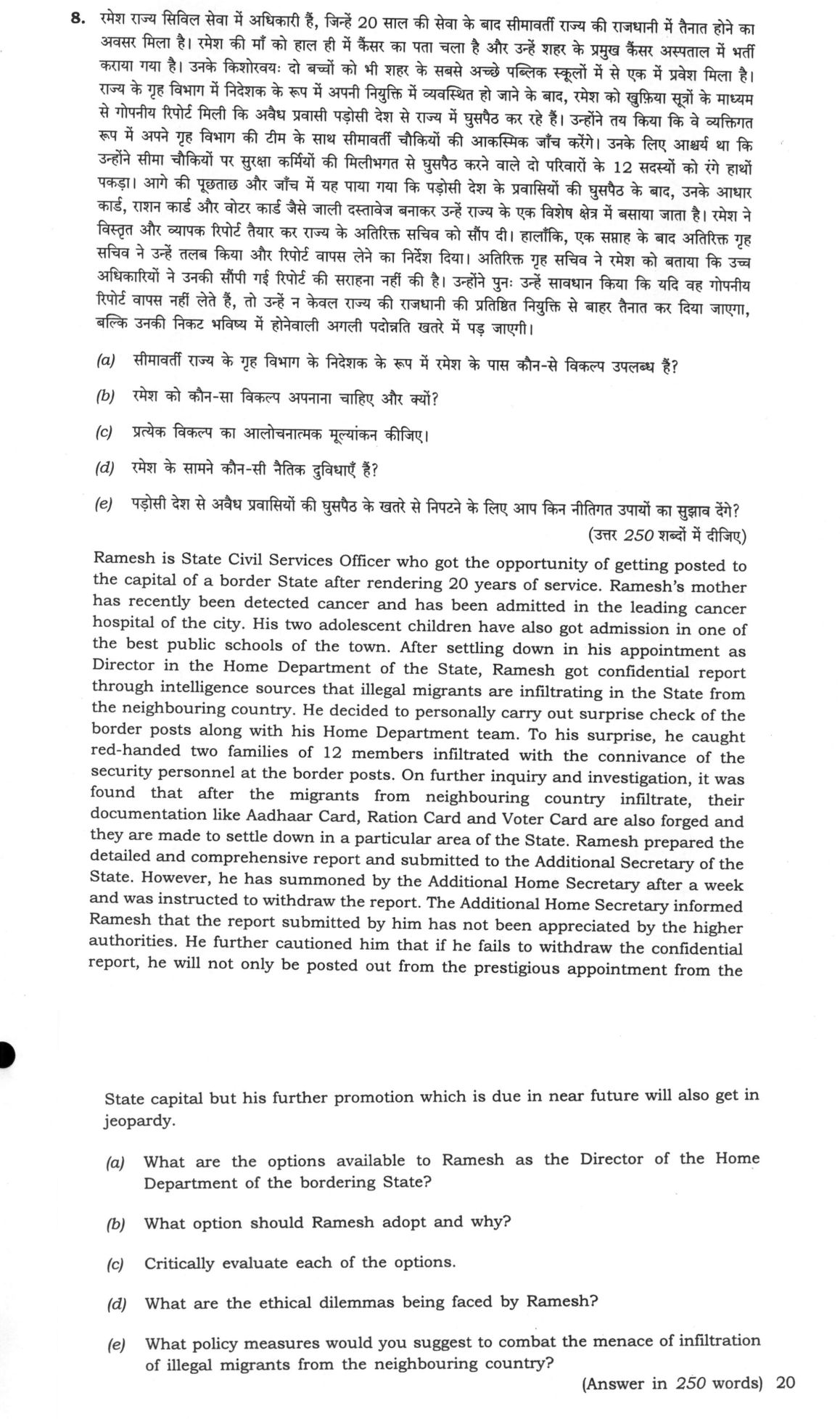
Ramesh is State Civil Services Officer who got the opportunity of getting posted to the capital of a border State after rendering 20 years of service. Ramesh's mother has recently been detected cancer and has been admitted in the leading cancer hospital of the city. His two adolescent children have also got admission in one of the best public schools of the town. After settling down in his appointment as Director in the Home Department of the State, Ramesh got confidential report through intelligence sources that illegal migrants are infiltrating in the State from the neighbouring country. He decided to personally carry out surprise check of the border posts along with his Home Department team. To his surprise, he caught red-handed two families of 12 members infiltrated with the connivance of the security personnel at the border posts. On further inquiry and investigation, it was found that after the migrants from neighbouring country infiltrate, their documentation like Aadhaar Card, Ration Card and Voter Card are also forged and they are made to settle down in a particular area of the State. Ramesh prepared the detailed and comprehensive report and submitted to the Additional Secretary of the State. However, he has summoned by the Additional Home Secretary after a week and was instructed to withdraw the report. The Additional Home Secretary informed Ramesh that the report submitted by him has not been appreciated by the higher authorities. He further cautioned him that if he fails to withdraw the confidential report, he will not only be posted out from the prestigious appointment from the State capital but his further promotion which is due in near future will also get in jeopardy.
What are the options available to Ramesh as the Director of the Home Department of the bordering State?
What option should Ramesh adopt and why?
Critically evaluate each of the options.
What are the ethical dilemmas being faced by Ramesh?
What policy measures would you suggest to combat the menace of infiltration of illegal migrants from the neighbouring country?
(Answer in 250 words)
हिंदी में प्रश्न पढ़ें
रमेश राज्य सिविल सेवा में अधिकारी हैं, जिन्हें 20 साल की सेवा के बाद सीमावर्ती राज्य की राजधानी में तैनात होने का अवसर मिला है। रमेश की माँ को हाल ही में कैंसर का पता चला है और उन्हें शहर के प्रमुख कैंसर अस्पताल में भर्ती कराया गया है। उनके किशोरवयः दो बच्चों को भी शहर के सबसे अच्छे पब्लिक स्कूलों में से एक में प्रवेश मिला है। राज्य के गृह विभाग में निदेशक के रूप में अपनी नियुक्ति में व्यवस्थित हो जाने के बाद, रमेश को खुफ़िया सूत्रों के माध्यम से गोपनीय रिपोर्ट मिली कि अवैध प्रवासी पड़ोसी देश से राज्य में घुसपैठ कर रहे हैं। उन्होंने तय किया कि वे व्यक्तिगत रूप में अपने गृह विभाग की टीम के साथ सीमावर्ती चौकियों की आकस्मिक जाँच करेंगे। उनके लिए आश्चर्य था कि उन्होंने सीमा चौकियों पर सुरक्षा कर्मियों की मिलीभगत से घुसपैठ करने वाले दो परिवारों के 12 सदस्यों को रंगे हाथों पकड़ा। आगे की पूछताछ और जाँच में यह पाया गया कि पड़ोसी देश के प्रवासियों की घुसपैठ के बाद, उनके आधार कार्ड, राशन कार्ड और वोटर कार्ड जैसे जाली दस्तावेज बनाकर उन्हें राज्य के एक विशेष क्षेत्र में बसाया जाता है। रमेश ने विस्तृत और व्यापक रिपोर्ट तैयार कर राज्य के अतिरिक्त सचिव को सौंप दी। हालाँकि, एक सप्ताह के बाद अतिरिक्त गृह सचिव ने उन्हें तलब किया और रिपोर्ट वापस लेने का निर्देश दिया। अतिरिक्त गृह सचिव ने रमेश को बताया कि उच्च अधिकारियों ने उनकी सौंपी गई रिपोर्ट की सराहना नहीं की है। उन्होंने पुनः उन्हें सावधान किया कि यदि वह गोपनीय रिपोर्ट वापस नहीं लेते हैं, तो उन्हें न केवल राज्य की राजधानी की प्रतिष्ठित नियुक्ति से बाहर तैनात कर दिया जाएगा, बल्कि उनकी निकट भविष्य में होनेवाली अगली पदोन्नति खतरे में पड़ जाएगी।
सीमावर्ती राज्य के गृह विभाग के निदेशक के रूप में रमेश के पास कौन-से विकल्प उपलब्ध हैं?
रमेश को कौन-सा विकल्प अपनाना चाहिए और क्यों?
प्रत्येक विकल्प का आलोचनात्मक मूल्यांकन कीजिए।
रमेश के सामने कौन-सी नैतिक दुविधाएँ हैं?
पड़ोसी देश से अवैध प्रवासियों की घुसपैठ के खतरे से निपटने के लिए आप किन नीतिगत उपायों का सुझाव देंगे?
(उत्तर 250 शब्दों में दीजिए)
Model answer
Written by UPSC Answer Check against this question's marking rubric, to the 250-word length. UPSC does not publish answers for Mains — this is one way to score well, not an official key.
Stakeholders and ethical frame Ramesh’s dilemma is not merely a career problem; it is a conflict between administrative obedience and public duty. The stakeholders include Ramesh and his family, whose security and livelihood are threatened; the Additional Home Secretary and higher authorities, who may have political or institutional interests; the security personnel, whose connivance undermines the border; the illegal migrants, who may be vulnerable but are also subject to law; the citizens of the State, whose identity documents, electoral rolls and public services are affected; and the State itself, whose sovereignty, internal security and rule of law are at stake. The ethical question is how a public servant should act when a superior asks him to suppress a truthful report that touches national security. Utilitarianism points to the greatest good: allowing infiltration and document forgery to continue would harm public trust, security and democratic processes. Deontology requires Ramesh to tell the truth, preserve evidence and perform his duty without being swayed by personal interest. Rawlsian justice asks for fair procedure: even if the migrants are illegal, they must be dealt with through law, not arbitrary violence, and Ramesh’s own career action must be justified by public interest, not punishment. Indian ethical traditions add dharma and niti: the officer’s duty is to the public trust, while compassion and non-violence require humane treatment of vulnerable persons.
Options available Ramesh has five realistic options. First, he can withdraw the report and accept the implied bargain of career safety. Second, he can refuse to withdraw, seek a written order, record his dissent and continue to preserve the evidence. Third, he can escalate the matter to the Home Secretary, Chief Secretary or, if the order is illegal or corrupt, to vigilance and anti-corruption authorities. Fourth, he can seek a transfer, leave or medical relief to remove himself from the conflict. Fifth, as a last resort, he can consider a public-interest disclosure, but only after exhausting internal remedies and without breaching confidentiality in a way that prejudices investigation. These options are not mutually exclusive; the ethical course is to combine refusal, written clarification, escalation and strict procedural caution.
Recommended option Ramesh should not withdraw the report. The report is not a personal complaint; it records infiltration, forged Aadhaar, ration and voter documents, and the possible participation of security personnel. Suppressing it would damage the State’s ability to protect its borders, maintain accurate citizen records and uphold the rule of law. Article 51A(e) imposes a fundamental duty to safeguard sovereignty, unity and integrity, and the Home Department is the natural custodian of internal security. At the same time, Ramesh should not respond with open defiance. He should ask the Additional Home Secretary to put the instruction in writing, explain that withdrawal would amount to suppressing material relevant to public safety, and request a reasoned review of the facts. If the written order persists, he should escalate it to the Home Secretary or Chief Secretary and, where corruption by public servants is indicated, to the appropriate vigilance or anti-corruption authority. He should maintain the original report, preserve the chain of custody, avoid leaking confidential material to the media, and continue his duties. This course respects lawful authority while refusing to become an instrument of concealment. It also protects Ramesh by creating a record that his resistance was based on public interest, not insubordination.
Constitutional and administrative safeguards Ramesh’s career rights are not irrelevant. Under Article 311, dismissal, removal or reduction in rank generally requires a written charge and a reasonable opportunity of hearing. The exceptional route under Article 311(2)(c) is available only where the President or Governor is satisfied that inquiry is not expedient in the interest of the security of the State; it cannot be assumed merely because a border report is sensitive. This does not give Ramesh a licence to disobey, but it means that a threat of punitive transfer or dismissal must be justified, documented and proportionate. The same principle appears in service jurisprudence: transfer should serve public interest, not punish an officer for doing duty.
Critical evaluation Withdrawing the report is the least risky option for Ramesh personally, but it is ethically unsound. It saves his posting and promotion in the short term, yet it betrays the public trust, encourages the infiltration network and may later expose him to moral and legal responsibility if the matter emerges. It also treats the threat of transfer as a legitimate reason to suppress evidence, which weakens administrative ethics. Refusing to withdraw and escalating is more demanding. It may lead to transfer, non-promotion or stigma, but it is defensible because the report concerns public safety and the integrity of state records. Service jurisprudence, including T.S.R. Subramanian v. State of Karnataka, cautions against punitive transfer and expects public-interest justification; if the threat is merely to remove him from a prestigious posting, it can be examined under administrative law. Seeking transfer or leave is a compromise, but it is essentially abdication: it avoids confrontation without solving the problem, and it may be interpreted as guilt. Public-interest disclosure is the most dangerous option. The report is confidential, may contain sensitive security information, and premature disclosure could prejudice investigation or violate service discipline. It should be considered only if internal remedies fail, the danger is imminent, and the disclosure is carefully limited. Thus, the best option is not blind obedience or public confrontation, but principled resistance through proper channels.
Ethical dilemmas The central dilemma is duty to superior versus duty to the public. Ramesh owes obedience to lawful orders, but he also owes integrity to the office. The second dilemma is personal security versus public interest: his mother’s cancer treatment and children’s schooling make the threat of transfer especially painful, yet private hardship cannot justify suppressing evidence of border crime. The third is confidentiality versus transparency: the report must be protected from misuse, but it cannot be buried if it concerns serious wrongdoing. The fourth is national security versus individual rights: the migrants may be illegal, but they are entitled to humane treatment, due process and protection from arbitrary action. The fifth is career versus conscience: promotion is a legitimate personal interest, but it cannot be bought by betraying public duty. These dilemmas interact. If Ramesh yields to fear, he normalises corruption; if he reacts impulsively, he may damage the investigation. The ethical resolution is therefore procedural: preserve truth, follow proper channels, protect vulnerable persons, and let law decide the migrants’ status.
Policy way forward To combat infiltration, the State needs a layered, lawful and humane approach. Border management should combine physical fencing, C4I, drones, sensors, joint BSF and ITBP operations, and community intelligence. Documentation should be tightened through NRC, Aadhaar, voter-list and ration-card verification, with inter-ministry data sharing and periodic audits. The NRC and document verification must be conducted with transparency, grievance redressal and protection against misuse, because identity fraud harms both migrants and citizens. Security personnel must be made accountable through vigilance, rotation, performance monitoring and strict action under the Prevention of Corruption Act where public servants are involved. Illegal migrants should be processed under the Foreigners Act, 1946 and applicable law, with due process, not profiling, and grievance redressal. International cooperation with the neighbouring country for verification and lawful repatriation should also be explored. Periodic audits of border posts, random checks and performance-linked accountability will reduce the space for collusion. Training in human rights, border ethics and document verification is essential. Finally, a transparent review mechanism should ensure that confidential reports are assessed on facts, not political convenience, so that public servants can act without fear of punitive transfer.
What "Analyse" is asking you to do
Break the subject into its working parts and show how they act on each other. The marks are in the interconnections — which factor drives which, and what the resulting structure explains — not in the inventory of factors.
Structure that answers it
Define the whole → separate it into its parts → show which part drives which → what that interaction produces → what the structure implies
Where marks are lost
A flat list of causes with no account of which drives which. An answer of neatly separated headings, each self-contained, scores as description.
How this answer will be evaluated
Approach
Framework: GS4 Ethical Dilemma & Policy Analysis. (a) enumerate: list the items in order > one line each > no commentary | (b) justify: claim > 3-4 reasons > evidence > conclusion | (c) critically evaluate: positives > negatives/limits > conditions/safeguards > conclusion | (d) highlight: name the salient points > one line of substance each > close | (e) suggest: the problem in one line > implementable measures > who acts > conclusion Full marks: Balanced ethical reasoning, specific policy measures, clear distinction between options.
Key points expected
- Withdraw report to save career
- Refuse to withdraw and face transfer
- Escalate to higher authorities (IG/PMO)
- Resign from service
- Prioritize national security over personal gain
- Duty to public trust over career
- Constitutional obligation to protect borders
- Rejection of the 'easy-but-wrong' option
Evaluation rubric
Each sub-part is marked on its own, against the marks and word limit printed on the paper.
- (a) List the distinct courses of action available to Ramesh.
enumerate— list the items in order → one line each → no commentary
Must cover
- Withdraw report to save career
- Refuse to withdraw and face transfer
- Escalate to higher authorities (IG/PMO)
- Resign from service
Loses marks
- Listing vague options like 'think more'
- Missing the option of resignation
Earns more
- Mentioning 'whistleblower' protection
- Option of seeking legal advice
Extra mark
- Reference to Whistle Blowers Protection Act
- (b) Select the best option and provide ethical/administrative reasoning.
justify— claim → 3-4 reasons → evidence → conclusion
Must cover
- Prioritize national security over personal gain
- Duty to public trust over career
- Constitutional obligation to protect borders
- Rejection of the 'easy-but-wrong' option
Loses marks
- Choosing to withdraw the report
- Preaching without reasoning
Earns more
- Reference to 'higher right over lesser right'
- Mentioning integrity as a core value
Extra mark
- Citing a specific ethical thinker (e.g., Kant)
- (c) Assess the pros and cons of the options listed in (a).
critically evaluate— positives → negatives/limits → conditions/safeguards → conclusion
Must cover
- Consequences of withdrawal (complicity)
- Consequences of escalation (career risk)
- Impact on public trust
- Institutional integrity implications
Loses marks
- One-sided evaluation
- Ignoring the 'jeopardy' threat
Earns more
- Balanced view of personal vs public interest
- Analysis of 'jeopardy' threat
Extra mark
- Reference to 'silent stakeholders' (the migrants)
- (d) Identify the specific ethical conflicts Ramesh faces.
highlight— name the salient points → one line of substance each → close
Must cover
- Loyalty to organization vs public interest
- Personal career vs national security
- Pressure from superiors vs duty
- Family welfare vs professional integrity
Loses marks
- Listing generic values (honesty, hard work)
- Missing the family pressure angle
Earns more
- Mentioning 'emotional blackmail' (mother's health)
- Conflict of interest
Extra mark
- Reference to 'ethical dilemma' definition
- (e) Propose policy measures to combat illegal infiltration.
suggest— the problem in one line → implementable measures → who acts → conclusion
Must cover
- Strengthening border security (tech/infrastructure)
- Inter-state data sharing (Aadhaar/Voter ID)
- Regular audits of border posts
- Strict action against corrupt officials
Loses marks
- Vague suggestions like 'be strict'
- Ignoring the role of corrupt officials
Earns more
- Mentioning 'NIRBHAAN' or specific border tech
- Citizen reporting mechanisms
Extra mark
- Reference to 'National Register of Citizens' (NRC)
Practice this exact question
Write your answer and it is marked point by point against the model answer above — what you covered, what you missed, what you got wrong.
Evaluate my answer →More from General Studies 2022 GS Paper IV
- Q5 (a) Russia and Ukraine war has been going on for the last seven months. Different countri…
- Q6 (a) Whistle-blower, who reports corruption and illegal activities, wrongdoing and miscond…
- Q7 Prabhat was working as Vice President (Marketing) at Sterling Electric Ltd., a reputed mu…
- Q8 Ramesh is State Civil Services Officer who got the opportunity of getting posted to the c…
- Q9 The Supreme Court has banned mining in the Aravalli Hills to stop degradation of the fore…
- Q10 You have done MBA from a reputed institution three years back but could not get campus pl…
- Q11 Rakesh was working as Joint Commissioner in Transport Department of a city. As a part of…