GS Paper IV — Q5
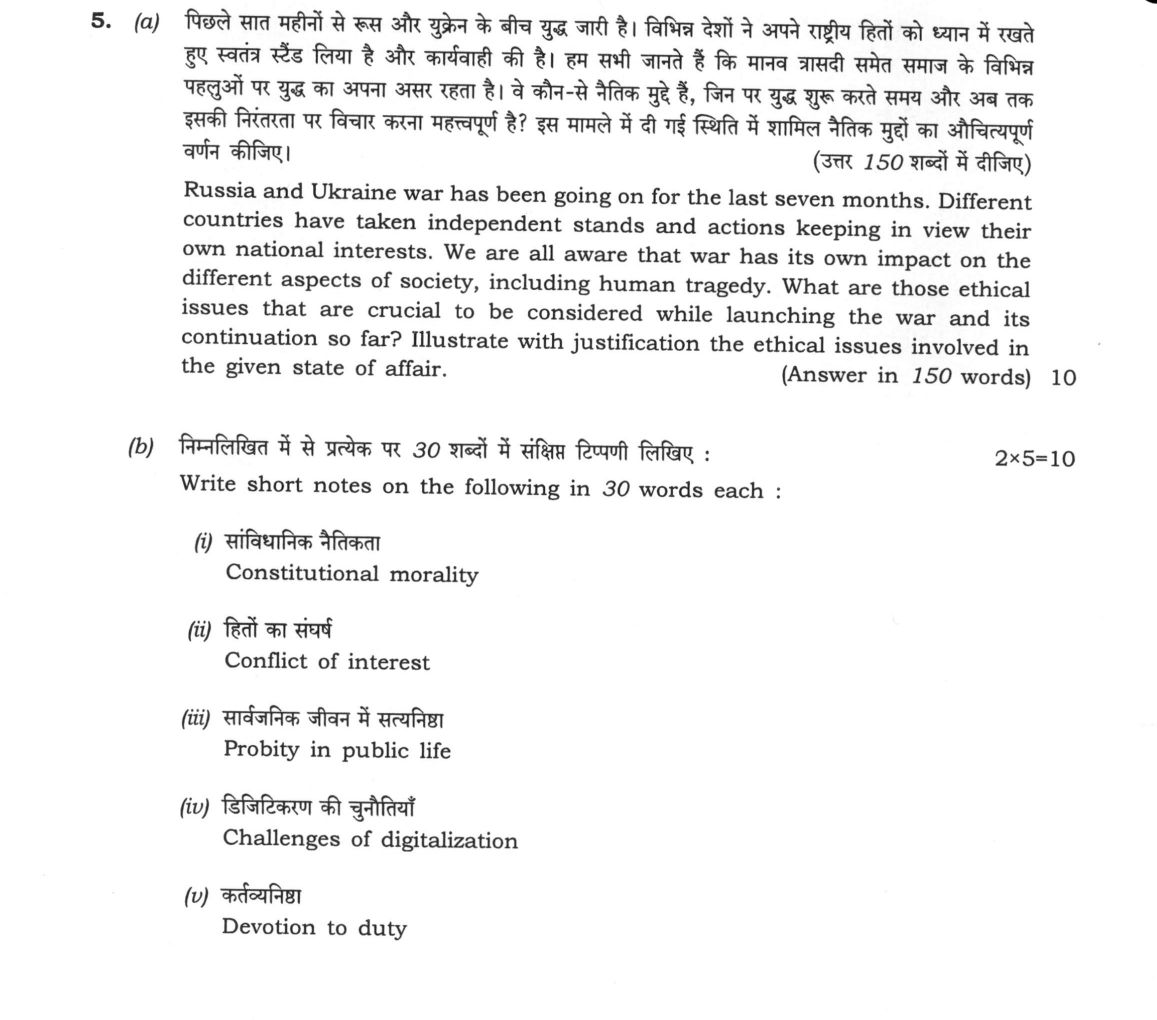
(a) Russia and Ukraine war has been going on for the last seven months. Different countries have taken independent stands and…
Russia and Ukraine war has been going on for the last seven months. Different countries have taken independent stands and actions keeping in view their own national interests. We are all aware that war has its own impact on the different aspects of society, including human tragedy. What are those ethical issues that are crucial to be considered while launching the war and its continuation so far? Illustrate with justification the ethical issues involved in the given state of affair. (Answer in 150 words) 10 marks
Write short notes on the following in 30 words each: 2×5=10
Constitutional morality
Conflict of interest
Probity in public life
Challenges of digitalization
Devotion to duty
हिंदी में प्रश्न पढ़ें
पिछले सात महीनों से रूस और यूक्रेन के बीच युद्ध जारी है। विभिन्न देशों ने अपने राष्ट्रीय हितों को ध्यान में रखते हुए स्वतंत्र स्टैंड लिया है और कार्यवाही की है। हम सभी जानते हैं कि मानव त्रासदी समेत समाज के विभिन्न पहलुओं पर युद्ध का अपना असर रहता है। वे कौन-से नैतिक मुद्दे हैं, जिन पर युद्ध शुरू करते समय और अब तक इसकी निरंतरता पर विचार करना महत्वपूर्ण है? इस मामले में दी गई स्थिति में शामिल नैतिक मुद्दों का औचित्यपूर्ण वर्णन कीजिए। (उत्तर 150 शब्दों में दीजिए) 10 marks
निम्नलिखित में से प्रत्येक पर 30 शब्दों में संक्षिप्त टिप्पणी लिखिए : 2×5=10
संवैधानिक नैतिकता
हितों का संघर्ष
सार्वजनिक जीवन में सत्यनिष्ठा
डिजिटीकरण की चुनौतियाँ
कर्तव्यनिष्ठा
Model answer
Written by UPSC Answer Check against this question's marking rubric, to the 150-word length. UPSC does not publish answers for Mains — this is one way to score well, not an official key.
Ethical Issues in the Russia-Ukraine War
Launching the war violated jus ad bellum principles, as state sovereignty under the UN Charter was breached without just cause, legitimate authority, or exhaustion of peaceful diplomatic alternatives. Its continuation violates jus in bello through disproportionate warfare, indiscriminate targeting of civilian infrastructure (e.g., power grids), and a mounting refugee crisis. Furthermore, weaponized economic sanctions disproportionately inflict food and energy insecurity on the vulnerable Global South.
India's stance reconciles realism with ethics through strategic autonomy. By dispatching humanitarian aid to Ukraine, advocating dialogue ("not an era of war"), and securing domestic energy needs via affordable oil imports, India balances its ethical duty toward citizens with global moral responsibility.
Short Notes
(i) Constitutional morality: Dr. B.R. Ambedkar conceptualized constitutional morality as paramount adherence to constitutional values over transient public morality, a doctrine upheld by the Supreme Court in the Sabarimala judgment to guarantee equality and fundamental rights.
(ii) Conflict of interest: As defined by the 2nd ARC, it arises when private interests clash with official public duty. It demands ethical mitigation through proactive disclosure, recusal, and statutory disqualification norms under the Representation of the People Act.
(iii) Probity in public life: It implies unyielding integrity, honesty, and adherence to highest ethical standards in governance. Enabled by the RTI Act, 2005 and Prevention of Corruption Act, it guarantees objectivity and corruption-free public decision-making.
(iv) Challenges of digitalization: Digital expansion breeds critical ethical concerns, including algorithmic and AI bias, surveillance and privacy erosion, cyber warfare vulnerabilities, and the socioeconomic digital divide, necessitating robust ethical AI governance frameworks.
(v) Devotion to duty: A foundational civil service value reflecting total dedication to public welfare, political impartiality, and anonymity. It prioritizes institutional responsibility and the constitutional oath above personal convenience or external pressures.
What "Illustrate" is asking you to do
Carry the point with concrete cases rather than assert it, so the examples do the work of proving it. In the technical papers illustrate is often literal — a labelled diagram, a map, a graph — and an answer without the figure has not complied with the instruction.
Structure that answers it
The point stated → example 1 with the feature it demonstrates → example 2 → example 3 or the required diagram → what the set of examples establishes
Where marks are lost
Examples named and then abandoned. A case listed without the sentence showing what it demonstrates is marked as recall of information, not as illustration.
How this answer will be evaluated
Approach
Framework: GS4 Ethical Issues & Case Study Framework. (a) justify: claim > 3-4 reasons > evidence > conclusion | (b(i)) write short notes: define > 3-4 key features > one example > one-line significance | (b(ii)) write short notes: define > 3-4 key features > one example > one-line significance | (b(iii)) write short notes: define > 3-4 key features > one example > one-line significance | (b(iv)) write short notes: define > 3-4 key features > one example > one-line significance | (b(v)) write short notes: define > 3-4 key features > one example > one-line significance Full marks: Precise, context-specific, well-justified with ethical frameworks
Key points expected
- Identify at least two specific ethical issues
- Justify issues with reference to war context
- Mention impact on human tragedy/society
- Link to national interests vs ethics
- Define Constitutional morality
- Mention rule of law
- Reference to fundamental rights
- Link to democratic values
Evaluation rubric
Each sub-part is marked on its own, against the marks and word limit printed on the paper.
- (a) Identify and justify ethical issues in the Russia-Ukraine war context. 10 marks · 150 words
justify— claim → 3-4 reasons → evidence → conclusion
Must cover
- Identify at least two specific ethical issues
- Justify issues with reference to war context
- Mention impact on human tragedy/society
- Link to national interests vs ethics
Loses marks
- General statements without specific war context
- Ignoring the 'justification' requirement
- Focusing only on political aspects
Earns more
- Reference to international humanitarian law
- Mention of civilian casualties
- Discussion of proportionality in war
- Reference to UN Charter principles
Extra mark
- Citing specific Geneva Convention articles
- Mentioning specific ethical frameworks (utilitarianism/deontology)
- (b(i)) Define Constitutional morality and its key features. 2 marks · 30 words
write short notes— define → 3-4 key features → one example → one-line significance
Must cover
- Define Constitutional morality
- Mention rule of law
- Reference to fundamental rights
- Link to democratic values
Loses marks
- Confusing with general morality
- Ignoring constitutional context
- Exceeding word limit significantly
Earns more
- Reference to Ambedkar
- Mention of secularism
- Reference to judicial review
Extra mark
- Citing specific Supreme Court judgment
- Mentioning specific Article of Constitution
- (b(ii)) Define Conflict of interest and its implications. 2 marks · 30 words
write short notes— define → 3-4 key features → one example → one-line significance
Must cover
- Define Conflict of interest
- Mention personal vs public interest
- Reference to decision-making
- Mention of transparency
Loses marks
- Vague definition
- Ignoring public interest aspect
- No mention of consequences
Earns more
- Example of COI in public office
- Mention of disclosure requirements
- Reference to ethical guidelines
Extra mark
- Citing specific COI policy
- Mentioning specific case study
- (b(iii)) Define Probity in public life and its importance. 2 marks · 30 words
write short notes— define → 3-4 key features → one example → one-line significance
Must cover
- Define Probity in public life
- Mention integrity and honesty
- Reference to public trust
- Mention of accountability
Loses marks
- Confusing with mere legality
- Ignoring public trust aspect
- No mention of accountability
Earns more
- Example of probity in action
- Mention of anti-corruption measures
- Reference to ethical governance
Extra mark
- Citing specific probity initiative
- Mentioning specific ethical code
- (b(iv)) Identify challenges of digitalization in public life. 2 marks · 30 words
write short notes— define → 3-4 key features → one example → one-line significance
Must cover
- Identify at least two digitalization challenges
- Mention data privacy
- Reference to digital divide
- Mention of cybersecurity
Loses marks
- General statements without specific challenges
- Ignoring privacy aspect
- No mention of public impact
Earns more
- Example of digital governance challenge
- Mention of AI ethics
- Reference to digital literacy
Extra mark
- Citing specific digital policy
- Mentioning specific technology risk
- (b(v)) Define Devotion to duty and its ethical significance. 2 marks · 30 words
write short notes— define → 3-4 key features → one example → one-line significance
Must cover
- Define Devotion to duty
- Mention commitment to public service
- Reference to ethical responsibility
- Mention of dedication
Loses marks
- Confusing with mere job performance
- Ignoring ethical dimension
- No mention of public service
Earns more
- Example of duty devotion
- Mention of public service ethos
- Reference to ethical leadership
Extra mark
- Citing specific duty framework
- Mentioning specific ethical code
Practice this exact question
Write your answer and it is marked point by point against the model answer above — what you covered, what you missed, what you got wrong.
Evaluate my answer →More from General Studies 2022 GS Paper IV
- Q2 (a) The Rules and Regulations provided to all the civil servants are same, yet there is d…
- Q3 What does each of the following quotations mean to you? (a) "Ethics is knowing the differ…
- Q4 (a) What do you understand by the term 'good governance'? How far recent initiatives in t…
- Q5 (a) Russia and Ukraine war has been going on for the last seven months. Different countri…
- Q6 (a) Whistle-blower, who reports corruption and illegal activities, wrongdoing and miscond…
- Q7 Prabhat was working as Vice President (Marketing) at Sterling Electric Ltd., a reputed mu…
- Q8 Ramesh is State Civil Services Officer who got the opportunity of getting posted to the c…