GS Paper IV — Q6
(a) Whistle-blower, who reports corruption and illegal activities, wrongdoing and misconduct to the concerned authorities, runs…
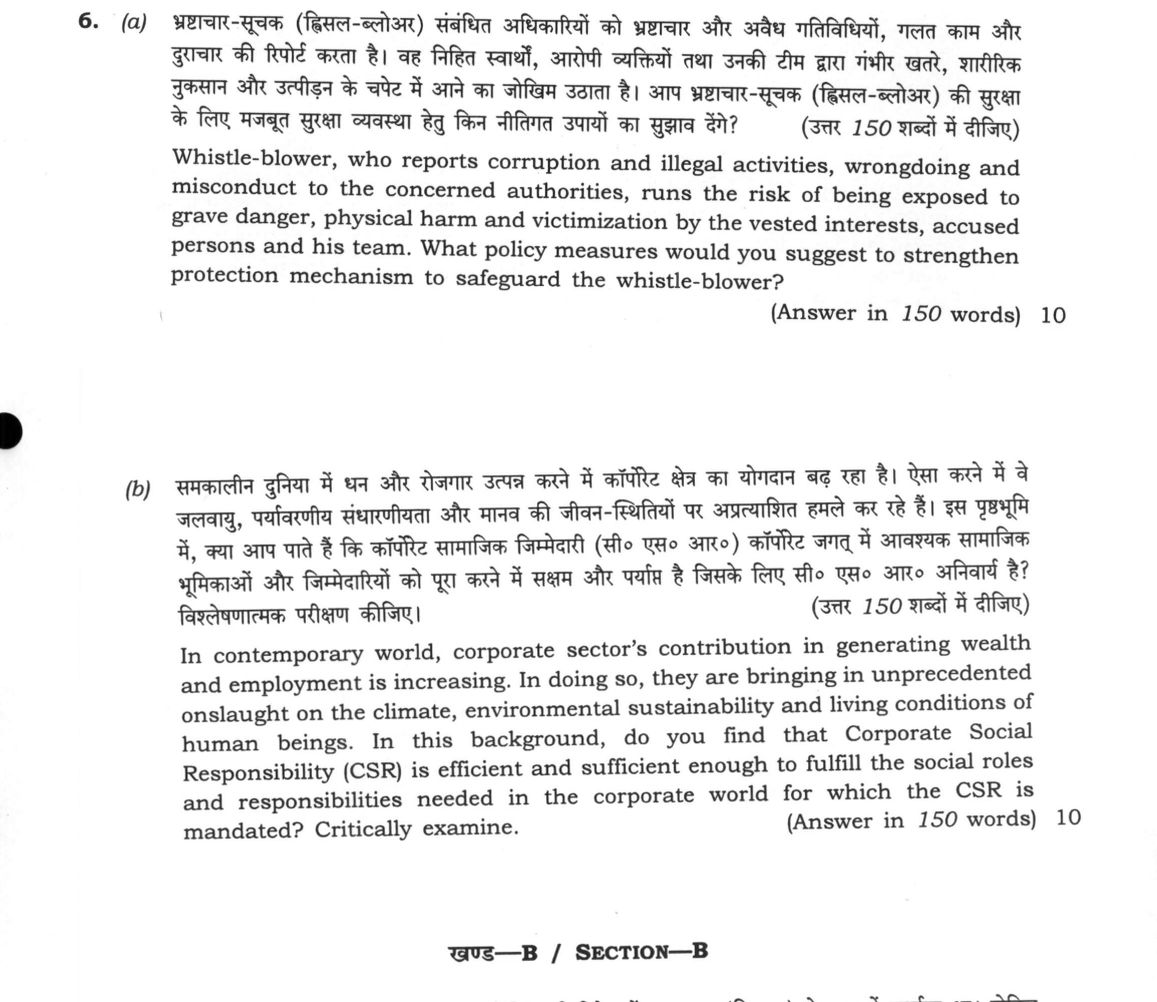
Whistle-blower, who reports corruption and illegal activities, wrongdoing and misconduct to the concerned authorities, runs the risk of being exposed to grave danger, physical harm and victimization by the vested interests, accused persons and his team. What policy measures would you suggest to strengthen protection mechanism to safeguard the whistle-blower? (Answer in 150 words) 10 marks
In contemporary world, corporate sector's contribution in generating wealth and employment is increasing. In doing so, they are bringing in unprecedented onslaught on the climate, environmental sustainability and living conditions of human beings. In this background, do you find that Corporate Social Responsibility (CSR) is efficient and sufficient enough to fulfill the social roles and responsibilities needed in the corporate world for which the CSR is mandated? Critically examine. (Answer in 150 words) 10 marks
हिंदी में प्रश्न पढ़ें
भ्रष्टाचार-सूचक (विसल-ब्लोअर) संबंधित अधिकारियों को भ्रष्टाचार और अवैध गतिविधियों, गलत काम और दुराचार की रिपोर्ट करता है। वह निहित स्वार्थों, आरोपी व्यक्तियों तथा उनकी टीम द्वारा गंभीर खतरे, शारीरिक नुकसान और उत्पीड़न के चपेट में आने का जोखिम उठाता है। आप भ्रष्टाचार-सूचक (विसल-ब्लोअर) की सुरक्षा के लिए मजबूत सुरक्षा व्यवस्था हेतु किन नीतिगत उपायों का सुझाव देंगे? (उत्तर 150 शब्दों में दीजिए) 10 marks
समकालीन दुनिया में धन और रोजगार उत्पन्न करने में कॉर्पोरेट क्षेत्र का योगदान बढ़ रहा है। ऐसा करने में वे जलवायु, पर्यावरणीय संधारणीयता और मानव की जीवन-स्थितियों पर अप्रत्याशित हमले कर रहे हैं। इस पृष्ठभूमि में, क्या आप पाते हैं कि कॉर्पोरेट सामाजिक जिम्मेदारी (सी० एस० आर०) कॉर्पोरेट जगत में आवश्यक सामाजिक भूमिकाओं और जिम्मेदारियों को पूरा करने में सक्षम और पर्याप्त है जिसके लिए सी० एस० आर० अनिवार्य है? विश्लेषणात्मक परीक्षण कीजिए। (उत्तर 150 शब्दों में दीजिए) 10 marks
Model answer
Written by UPSC Answer Check against this question's marking rubric, to the 150-word length. UPSC does not publish answers for Mains — this is one way to score well, not an official key.
(a) Strengthening Whistle-blower Protection
To safeguard individuals reporting wrongdoing, the Whistle Blowers Protection Act, 2014 must be notified with statutory amendments guaranteeing absolute anonymity and stringent penalties for retaliatory victimisation. Institutionally, establishing an independent ombudsman, institutionalising a dedicated witness protection programme, and introducing secure, end-to-end encrypted digital reporting channels are vital to ensure confidentiality and physical security for whistle-blowers across public and private domains.
(b) Critical Examination of CSR
Section 135 of the Companies Act, 2013 and Schedule VII priorities have mobilised private funds for healthcare, education, and rural development, fostering shared value. However, CSR alone is insufficient to offset the scale of corporate environmental degradation. It frequently degenerates into corporate 'greenwashing' and peripheral spending, while suffering from top-down execution that lacks genuine community participation in project selection.
Thus, while CSR generates social benefits, it cannot substitute for ecological accountability. Bridging this gap requires mandatory social audits, stricter enforcement of Environmental, Social, and Governance (ESG) norms, and a definitive shift from token voluntary spending to regulated, systemic responsibility.
What "Critically examine" is asking you to do
Test the proposition the question puts to you and return a finding on how far it holds. Examine stems carry a claim, or ask whether something has happened, and expect evidence weighed both ways before the extent is stated — often with remedial measures attached. “Critically” is not a section added at the end: name the yardstick you are judging by — the evidence, the stated objective, a constitutional principle, a rival explanation — and let a verdict close each part of the body. Where the question quotes a claim, that verdict must land on the claim itself, accepted, qualified or rejected, and not on the theme in general.
Structure that answers it
Restate the claim as the question frames it → evidence that supports it → evidence that undercuts it → the conditions under which it holds → verdict on how far it stands
Where marks are lost
Merits in one paragraph, demerits in the next, and a conclusion calling for a balanced and holistic approach. That is a survey with the judgement left out and it holds the answer in the middle band. The opposite error is reading “critically” as permission to attack — and with the odd pairings, critically describe or critically explain, the exposition still carries most of the marks, the judgement being a layer on it rather than a substitute for it.
How this answer will be evaluated
Approach
Framework: GS4 Ethical Dilemma & Policy Analysis. (a) suggest: the problem in one line > implementable measures > who acts > conclusion | (b) critically evaluate: positives > negatives/limits > conditions/safeguards > conclusion Full marks: Precise policy/legal references; balanced critical analysis; clear structure.
Key points expected
- Mention Whistle Blowers Protection Act, 2014
- Suggest independent investigation mechanism (e.g., CVC)
- Propose anonymity and identity protection protocols
- Include post-reporting safeguards (job security, relocation)
- Define CSR and its mandate (Companies Act 2013)
- Identify limitations (voluntary nature, lack of enforcement)
- Contrast CSR with mandatory regulation (e.g., environmental laws)
- Conclude on sufficiency (likely 'insufficient' or 'complementary')
Evaluation rubric
Each sub-part is marked on its own, against the marks and word limit printed on the paper.
- (a) Implementable policy measures to strengthen the protection mechanism for whistle-blowers. 10 marks · 150 words
suggest— the problem in one line → implementable measures → who acts → conclusion
Must cover
- Mention Whistle Blowers Protection Act, 2014
- Suggest independent investigation mechanism (e.g., CVC)
- Propose anonymity and identity protection protocols
- Include post-reporting safeguards (job security, relocation)
Loses marks
- Preaching values without policy action
- Ignoring the legal framework (WBPA 2014)
- Vague suggestions like 'raise awareness'
Earns more
- Reference to Lokpal and Lokayuktas Act
- Mention of digital security for evidence
- Suggestion of financial compensation for loss
- Reference to international best practices (e.g., US)
Extra mark
- Citing specific case law (e.g., Satish Kumar Gupta v. Union of India)
- Mentioning the role of the Central Vigilance Commission
- (b) Critical examination of whether CSR is efficient and sufficient to fulfill corporate social roles. 10 marks · 150 words
critically evaluate— positives → negatives/limits → conditions/safeguards → conclusion
Must cover
- Define CSR and its mandate (Companies Act 2013)
- Identify limitations (voluntary nature, lack of enforcement)
- Contrast CSR with mandatory regulation (e.g., environmental laws)
- Conclude on sufficiency (likely 'insufficient' or 'complementary')
Loses marks
- One-sided praise of CSR without critique
- Ignoring the 'mandated' aspect of the question
- Confusing CSR with general philanthropy
Earns more
- Mentioning '2% of average net profits' rule
- Reference to 'polluter pays' principle
- Discussion of 'greenwashing' or 'box-ticking' CSR
- Mentioning ESG (Environmental, Social, Governance) criteria
Extra mark
- Citing specific CSR failures or successes (e.g., Vedanta, Tata)
- Reference to UN Global Compact
Practice this exact question
Write your answer and it is marked point by point against the model answer above — what you covered, what you missed, what you got wrong.
Evaluate my answer →More from General Studies 2022 GS Paper IV
- Q3 What does each of the following quotations mean to you? (a) "Ethics is knowing the differ…
- Q4 (a) What do you understand by the term 'good governance'? How far recent initiatives in t…
- Q5 (a) Russia and Ukraine war has been going on for the last seven months. Different countri…
- Q6 (a) Whistle-blower, who reports corruption and illegal activities, wrongdoing and miscond…
- Q7 Prabhat was working as Vice President (Marketing) at Sterling Electric Ltd., a reputed mu…
- Q8 Ramesh is State Civil Services Officer who got the opportunity of getting posted to the c…
- Q9 The Supreme Court has banned mining in the Aravalli Hills to stop degradation of the fore…