GS Paper IV — Q3
What does each of the following quotations mean to you? (a) "Ethics is knowing the difference between what you have the right to…
What does each of the following quotations mean to you?
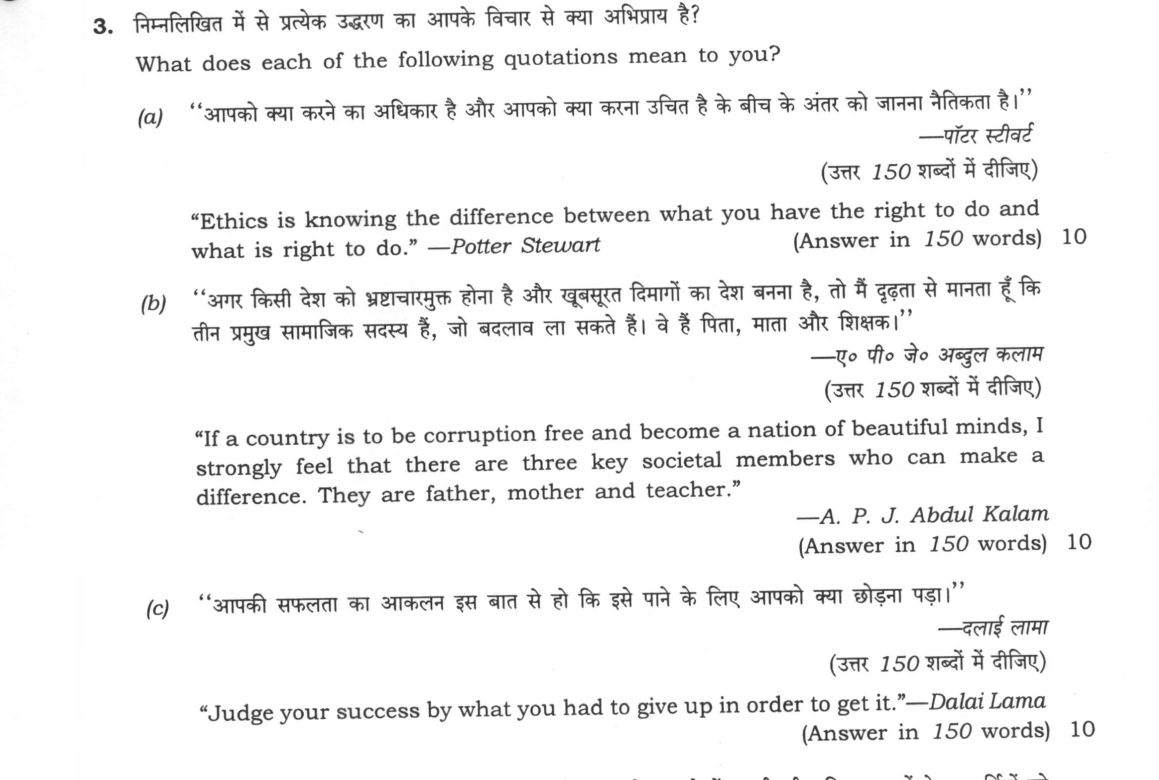
"Ethics is knowing the difference between what you have the right to do and what is right to do." —Potter Stewart (Answer in 150 words) 10 marks
"If a country is to be corruption free and become a nation of beautiful minds, I strongly feel that there are three key societal members who can make a difference. They are father, mother and teacher." —A. P. J. Abdul Kalam (Answer in 150 words) 10 marks
"Judge your success by what you had to give up in order to get it." —Dalai Lama (Answer in 150 words) 10 marks
हिंदी में प्रश्न पढ़ें
निम्नलिखित में से प्रत्येक उद्धरण का आपके विचार से क्या अभिप्राय है?
"आपको क्या करने का अधिकार है और आपको क्या करना उचित है के बीच के अंतर को जानना नैतिकता है।" —पॉटर स्टीवर्ट (उत्तर 150 शब्दों में दीजिए) 10 marks
"अगर किसी देश को भ्रष्टाचारमुक्त होना है और खूबसूरत दिमागों का देश बनना है, तो मैं दृढ़ता से मानता हूं कि तीन प्रमुख सामाजिक सदस्य हैं, जो बदलाव ला सकते हैं। वे हैं पिता, माता और शिक्षक।" —ए. पी. जे. अब्दुल कलाम (उत्तर 150 शब्दों में दीजिए) 10 marks
"आपकी सफलता का आकलन इस बात से हो कि इसे पाने के लिए आपको क्या छोड़ना पड़ा।" —दलाई लामा (उत्तर 150 शब्दों में दीजिए) 10 marks
Model answer
Written by UPSC Answer Check against this question's marking rubric, to the 150-word length. UPSC does not publish answers for Mains — this is one way to score well, not an official key.
Ethical life requires a synergy between internalized values, moral discernment, and the willingness to sacrifice narrow self-interest for the collective good.
(a) Ethics vs. Legal Rights (Potter Stewart) This quotation highlights the fundamental gap between legal permissibility and moral desirability. While the law outlines the minimum permissible standards of human conduct—defining what one can do without state sanction—ethics governs internal conscience, demanding what one ought to do for the greater good. A legally protected entitlement does not inherently confer moral righteousness.
For instance, aggressive corporate tax avoidance, predatory litigation, or commercial lobbying may exploit statutory loopholes legally, but they erode public welfare and social justice. Similarly, in public administration, a bureaucrat possessing wide discretionary authority might have the legal right to enforce rules rigidly or reject welfare claims on technical grounds. However, administrative ethics demands going beyond mere compliance to exercise compassion, procedural fairness, and equity for the vulnerable.
(b) The Triad of Value Inculcation (A. P. J. Abdul Kalam) Dr. Kalam underscores that legal deterrents and anti-corruption institutions like the Lokpal are insufficient unless reinforced by internal moral restraints developed during formative years. The family and the school serve as primary agents of socialization. Mothers nurture empathy and emotional intelligence, fathers model integrity and resilience, and teachers cultivate intellectual curiosity and civic virtue.
This resonates with India’s ancient Gurukul tradition, which prioritized character-building (Vidya) alongside worldly knowledge. Dr. Kalam’s own life reflected the profound influence of his parents and his teacher, Sivasubramania Iyer, who modeled communal harmony and secular values. In contemporary India, integrating ethics into early schooling, as envisaged under the National Education Policy (NEP) 2020, is critical to building corruption-free minds resistant to moral decay.
(c) Success Through Ethical Sacrifice (Dalai Lama) This statement challenges the prevailing materialistic paradigm that equates success with wealth, power, and status. It posits that the true measure of achievement lies in the ethical integrity of the process and the nature of trade-offs made. A success achieved by abandoning one’s principles, exploiting others, or compromising family welfare is fundamentally hollow.
In the Indian civil services, true success is not measured by careerist promotions or corrupt accumulation, but by the sacrifices an officer makes—giving up personal comfort, private leisure, and lucrative opportunities in the private sector to serve the marginalized. Upholding constitutional morality often demands sacrificing popularity and standing firm against extraneous pressures to safeguard the public interest.
Synthesis Together, these maxims construct a comprehensive blueprint for ethical consciousness: Dr. Kalam explains how values are learned through formative guidance, Potter Stewart defines how ethics is discerned beyond legal minimums, and the Dalai Lama provides the ultimate test of ethical living through righteous sacrifice and integrity.
What "Explain" is asking you to do
Make the working of something clear — what sets it off, what follows from what, and what it produces. Explain is the Commission's mechanism word: it dominates the technical papers and the “explain why” stems, where the marks sit in the causal chain and not in the label.
Structure that answers it
State what it is → the initiating condition → the chain of cause, step by step → an instance where it plays out → what the chain produces
Where marks are lost
Describing what something looks like instead of why it works that way. Naming the stages without linking them reads as description too.
How this answer will be evaluated
Approach
Framework: GS4 Ethical Reasoning & Situational Analysis. (a) explain: definition/context > points in order > small example > short close | (b) justify: claim > 3-4 reasons > evidence > conclusion | (c) comment: context > arguments both sides > judgment > close Full marks: Precise definitions, clear distinction between legal/moral, specific examples, and a strong link to public trust.
Key points expected
- Define 'right to do' as legal/constitutional authority
- Define 'right to do' as moral/ethical duty
- Identify the gap between legality and ethics
- Apply to a public official's discretionary power
- Link 'beautiful minds' to ethical character building
- Explain the specific role of the father (values)
- Explain the specific role of the mother (empathy)
- Explain the specific role of the teacher (discipline)
Evaluation rubric
Each sub-part is marked on its own, against the marks and word limit printed on the paper.
- (a) Distinguish legal entitlement from moral obligation in public service. 10 marks · 150 words
explain— definition/context → points in order → small example → short close
Must cover
- Define 'right to do' as legal/constitutional authority
- Define 'right to do' as moral/ethical duty
- Identify the gap between legality and ethics
- Apply to a public official's discretionary power
Loses marks
- Confusing 'right' with 'privilege'
- Preaching without defining the terms
- Ignoring the 'public trust' dimension
Earns more
- Reference to Potter Stewart's judicial context
- Example of legal but unethical administrative action
- Mention of 'higher right' over 'lesser right'
Extra mark
- Cite a specific Supreme Court judgment on ethics
- Reference to a specific Code of Conduct provision
- (b) Justify the role of family and education in curbing corruption. 10 marks · 150 words
justify— claim → 3-4 reasons → evidence → conclusion
Must cover
- Link 'beautiful minds' to ethical character building
- Explain the specific role of the father (values)
- Explain the specific role of the mother (empathy)
- Explain the specific role of the teacher (discipline)
Loses marks
- Treating it as a general essay on corruption
- Ignoring the specific roles of the three members
- Focusing only on legal punishment
Earns more
- Reference to A.P.J. Abdul Kalam's vision
- Mention of 'silent stakeholders' (family)
- Connection to long-term societal change
Extra mark
- Cite a specific educational reform or value-based curriculum
- Reference to a specific anti-corruption campaign
- (c) Comment on the trade-offs required for genuine success. 10 marks · 150 words
comment— context → arguments both sides → judgment → close
Must cover
- Define success in terms of sacrifice/giving up
- Identify what is 'given up' (comfort, ego, shortcuts)
- Contrast 'easy success' with 'earned success'
- Link to the concept of 'opportunity cost'
Loses marks
- Defining success only as material wealth
- Ignoring the 'giving up' aspect
- Preaching without analyzing the trade-off
Earns more
- Reference to Dalai Lama's philosophy
- Example of a leader who sacrificed personal gain
- Mention of 'integrity' as the cost of success
Extra mark
- Cite a specific historical figure's sacrifice
- Reference to a specific ethical dilemma resolved
Practice this exact question
Write your answer and it is marked point by point against the model answer above — what you covered, what you missed, what you got wrong.
Evaluate my answer →More from General Studies 2022 GS Paper IV
- Q1 (a) Wisdom lies in knowing what to reckon with and what to overlook. An officer being eng…
- Q2 (a) The Rules and Regulations provided to all the civil servants are same, yet there is d…
- Q3 What does each of the following quotations mean to you? (a) "Ethics is knowing the differ…
- Q4 (a) What do you understand by the term 'good governance'? How far recent initiatives in t…
- Q5 (a) Russia and Ukraine war has been going on for the last seven months. Different countri…
- Q6 (a) Whistle-blower, who reports corruption and illegal activities, wrongdoing and miscond…