GS Paper IV — Q1
(a) What do you understand by 'moral integrity' and 'professional efficiency' in the context of corporate governance in India?…
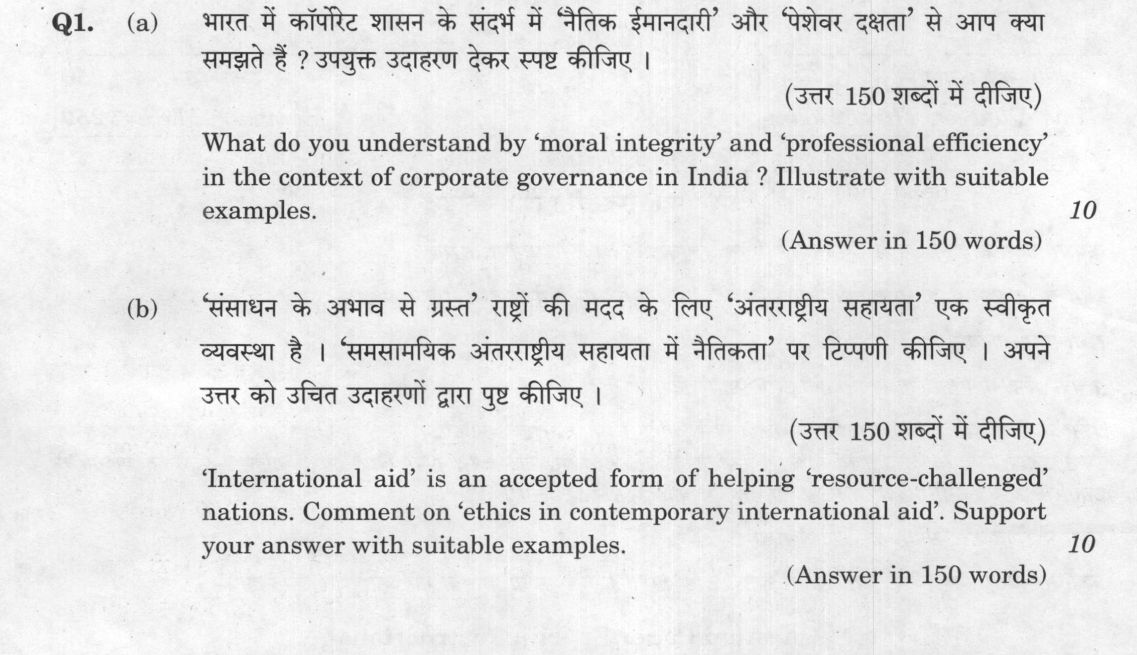
What do you understand by 'moral integrity' and 'professional efficiency' in the context of corporate governance in India? Illustrate with suitable examples. (Answer in 150 words) [10 marks]
'International aid' is an accepted form of helping 'resource-challenged' nations. Comment on 'ethics in contemporary international aid'. Support your answer with suitable examples. (Answer in 150 words) [10 marks]
हिंदी में प्रश्न पढ़ें
भारत में कॉर्पोरेट शासन के संदर्भ में 'नैतिक ईमानदारी' और 'पेशेवर दक्षता' से आप क्या समझते हैं? उपयुक्त उदाहरण देकर स्पष्ट कीजिए। (उत्तर 150 शब्दों में दीजिए) [10 अंक]
'संसाधन के अभाव से ग्रस्त' राष्ट्रों की मदद के लिए 'अंतर्राष्ट्रीय सहायता' एक स्वीकृत व्यवस्था है। 'समसामयिक अंतर्राष्ट्रीय सहायता में नैतिकता' पर टिप्पणी कीजिए। अपने उत्तर को उचित उदाहरणों द्वारा पुष्ट कीजिए। (उत्तर 150 शब्दों में दीजिए) [10 अंक]
Model answer
Written by UPSC Answer Check against this question's marking rubric, to the 150-word length. UPSC does not publish answers for Mains — this is one way to score well, not an official key.
Moral Integrity and Professional Efficiency in Corporate Governance
Moral integrity denotes uncompromising adherence to ethical values, honesty, and transparency in corporate decision-making. Professional efficiency entails technical competence, accountability, and optimal resource allocation to maximize sustainable stakeholder value.
In India, Tata Group exemplifies moral integrity through ethical stewardship and community reinvestment, while Infosys demonstrates professional efficiency through high standards of financial reporting and compliance. Conversely, the Satyam scandal illustrated an integrity deficit where fabricated accounts destroyed shareholder wealth despite apparent operational efficiency. Long-term corporate viability demands that professional competence remains anchored in moral rectitude.
Ethics in Contemporary International Aid
International aid reflects the moral duty of global solidarity, yet its contemporary practice often risks neo-colonialism. Ethical dilemmas manifest when donor conditionality undermines national sovereignty, seen in IMF structural adjustment mandates, or when strategic self-interest creates economic dependency, as in China's debt-leveraged infrastructure financing in developing nations. Similarly, COVID-19 vaccine nationalism exposed severe inequities in global humanitarian assistance.
International aid is ethically justifiable only when it respects sovereign autonomy, avoids geopolitical coercion, and operates as an unconditional, transparent partnership focused on genuine capacity building.
What "Illustrate" is asking you to do
Carry the point with concrete cases rather than assert it, so the examples do the work of proving it. In the technical papers illustrate is often literal — a labelled diagram, a map, a graph — and an answer without the figure has not complied with the instruction.
Structure that answers it
The point stated → example 1 with the feature it demonstrates → example 2 → example 3 or the required diagram → what the set of examples establishes
Where marks are lost
Examples named and then abandoned. A case listed without the sentence showing what it demonstrates is marked as recall of information, not as illustration.
How this answer will be evaluated
Approach
Framework: GS4 Ethics & Governance. (a) explain: definition/context > points in order > small example > short close | (b) comment: context > arguments both sides > judgment > close Full marks: Clear definitions, Indian context, specific examples, balanced judgment
Key points expected
- Define moral integrity in corporate context
- Define professional efficiency in corporate context
- Link both to Indian corporate governance
- Provide suitable examples for both
- Contextualize international aid for resource-challenged nations
- Identify ethical dimensions of contemporary aid
- Provide suitable examples
- Offer balanced judgment on ethical issues
Evaluation rubric
Each sub-part is marked on its own, against the marks and word limit printed on the paper.
- (a) Define moral integrity and professional efficiency in Indian corporate governance with examples. 10 marks · 150 words
explain— definition/context → points in order → small example → short close
Must cover
- Define moral integrity in corporate context
- Define professional efficiency in corporate context
- Link both to Indian corporate governance
- Provide suitable examples for both
Loses marks
- Confusing moral integrity with legal compliance
- Treating efficiency as mere profit maximization
- Generic examples without Indian context
Earns more
- Mention SEBI/Companies Act provisions
- Reference specific Indian corporate cases
- Distinguish between the two concepts
- Link to public trust
Extra mark
- Cite specific SEBI circular or Companies Act section
- Reference Satyam or Kingfisher case
- (b) Comment on ethics in contemporary international aid with examples. 10 marks · 150 words
comment— context → arguments both sides → judgment → close
Must cover
- Contextualize international aid for resource-challenged nations
- Identify ethical dimensions of contemporary aid
- Provide suitable examples
- Offer balanced judgment on ethical issues
Loses marks
- One-sided view without acknowledging complexities
- Ignoring recipient agency in aid ethics
- Vague examples without specific reference
Earns more
- Mention aid conditionality issues
- Reference specific aid programs or cases
- Discuss power dynamics in aid relationships
- Link to recipient nation sovereignty
Extra mark
- Cite specific UN or World Bank framework
- Reference specific country aid case study
Practice this exact question
Write your answer and it is marked point by point against the model answer above — what you covered, what you missed, what you got wrong.
Evaluate my answer →More from General Studies 2023 GS Paper IV
- Q1 (a) What do you understand by 'moral integrity' and 'professional efficiency' in the cont…
- Q2 (a) "Corruption is the manifestation of the failure of core values in the society." In yo…
- Q3 Given below are three quotations of great thinkers. What do each of these quotations conv…
- Q4 (a) "What really matters for success, character, happiness and lifelong achievements is a…