GS Paper IV — Q6
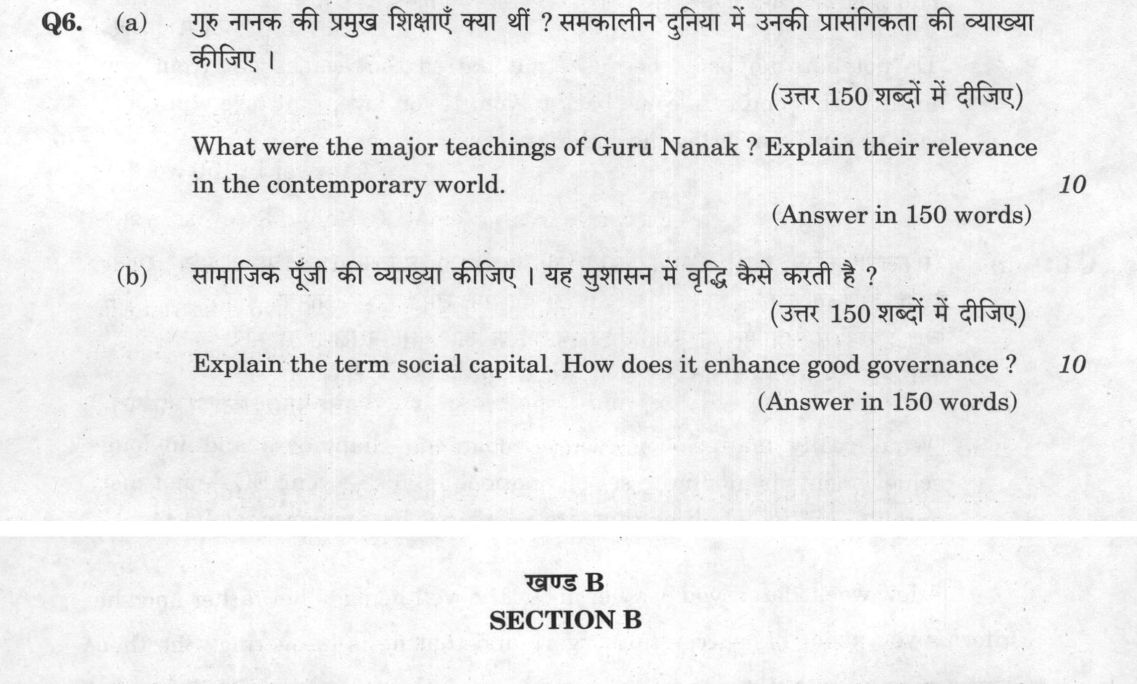
(a) What were the major teachings of Guru Nanak? Explain their relevance in the contemporary world. (Answer in 150 words) 10 (b)…
What were the major teachings of Guru Nanak? Explain their relevance in the contemporary world. (Answer in 150 words) 10 marks
Explain the term social capital. How does it enhance good governance? (Answer in 150 words) 10 marks
हिंदी में प्रश्न पढ़ें
गुरु नानक की प्रमुख शिक्षाएं क्या थीं? समकालीन दुनिया में उनकी प्रासंगिकता की व्याख्या कीजिए। (उत्तर 150 शब्दों में दीजिए) 10 marks
सामाजिक पूंजी की व्याख्या कीजिए। यह सुशासन में वृद्धि कैसे करती है? (उत्तर 150 शब्दों में दीजिए) 10 marks
Model answer
Written by UPSC Answer Check against this question's marking rubric, to the 150-word length. UPSC does not publish answers for Mains — this is one way to score well, not an official key.
Guru Nanak taught Ik Onkar, one God, rejecting idolatry, caste and religious exclusivism; he affirmed gender and religious equality, honest labour (kirat karo), sharing (vand chhako) and community welfare through sangat-pangat. These teachings remain relevant today: they promote secularism and communal harmony, gender justice and women’s leadership, dignity of work under SDG-8, sustainable environmental consciousness, and broader social inclusion.
Social capital is the stock of networks, norms of reciprocity and trust (Putnam, Bourdieu, World Bank) that lowers transaction costs and enables collective action. By binding people to shared civic norms, it makes state action more legitimate and cooperative, especially in local public goods. It enhances good governance because citizens participate more, monitor officials, demand transparency and accountability, and support rule of law; trust reduces corruption and improves service delivery, responsiveness and crisis resilience. Thus, SHGs, gram sabhas, Kerala’s civic engagement and COVID-19 response show how private trust becomes public accountability.
What "Explain" is asking you to do
Make the working of something clear — what sets it off, what follows from what, and what it produces. Explain is the Commission's mechanism word: it dominates the technical papers and the “explain why” stems, where the marks sit in the causal chain and not in the label.
Structure that answers it
State what it is → the initiating condition → the chain of cause, step by step → an instance where it plays out → what the chain produces
Where marks are lost
Describing what something looks like instead of why it works that way. Naming the stages without linking them reads as description too.
How this answer will be evaluated
Approach
Framework: GS4 Ethical & Social Governance Framework. (a) explain: definition/context > points in order > small example > short close | (b) explain: definition/context > points in order > small example > short close Full marks: Precise definitions, clear modern linkages, specific examples, and balanced reasoning.
Key points expected
- Identify core tenets (e.g., equality, Naam Japna, Kirat Karni)
- Link teachings to contemporary issues (e.g., caste, gender, environment)
- Demonstrate relevance in modern social or political context
- Maintain balance between historical context and modern application
- Define social capital (trust, networks, norms)
- Explain the link between social capital and governance
- Identify specific mechanisms (e.g., transparency, accountability)
- Provide a concrete example of social capital in action
Evaluation rubric
Each sub-part is marked on its own, against the marks and word limit printed on the paper.
- (a) Define Guru Nanak's core tenets and map them to modern social challenges. 10 marks · 150 words
explain— definition/context → points in order → small example → short close
Must cover
- Identify core tenets (e.g., equality, Naam Japna, Kirat Karni)
- Link teachings to contemporary issues (e.g., caste, gender, environment)
- Demonstrate relevance in modern social or political context
- Maintain balance between historical context and modern application
Loses marks
- Preaching religious dogma instead of ethical reasoning
- Listing values without explaining their modern relevance
- Ignoring the 'contemporary world' aspect of the question
Earns more
- Mention specific concepts like 'Sarbat da Bhala'
- Reference to 'Chardi Kala' as a mindset for resilience
- Connection to modern secularism or social justice movements
- Mention of 'Seva' as a civic duty
Extra mark
- Citing a specific Japji Sahib verse
- Reference to a specific modern social reform movement
- (b) Define social capital and detail its mechanism in enhancing good governance. 10 marks · 150 words
explain— definition/context → points in order → small example → short close
Must cover
- Define social capital (trust, networks, norms)
- Explain the link between social capital and governance
- Identify specific mechanisms (e.g., transparency, accountability)
- Provide a concrete example of social capital in action
Loses marks
- Confusing social capital with financial capital
- Vague generalities without specific governance mechanisms
- Ignoring the 'how' in the question
Earns more
- Mentioning 'bonding' vs 'bridging' social capital
- Reference to Putnam or Fukuyama
- Linking to citizen participation in policy
- Mentioning reduction in transaction costs
Extra mark
- Citing a specific study or index (e.g., World Bank)
- Reference to a specific governance reform
Practice this exact question
Write your answer and it is marked point by point against the model answer above — what you covered, what you missed, what you got wrong.
Evaluate my answer →More from General Studies 2023 GS Paper IV
- Q3 Given below are three quotations of great thinkers. What do each of these quotations conv…
- Q4 (a) "What really matters for success, character, happiness and lifelong achievements is a…
- Q5 (a) Is conscience a more reliable guide when compared to laws, rules and regulations in t…
- Q6 (a) What were the major teachings of Guru Nanak? Explain their relevance in the contempor…
- Q7 You are working as an executive in a nationalised bank for several years. One day one of…
- Q8 A landslide occurred in the middle of the night on 20th July, 2023 in a remote mountain h…
- Q9 At 9 pm on Saturday evening, Rashika, a Joint Secretary, was still engrossed in her work…