GS Paper IV — Q8
A landslide occurred in the middle of the night on 20th July, 2023 in a remote mountain hamlet, approximately 60 kilometres from…
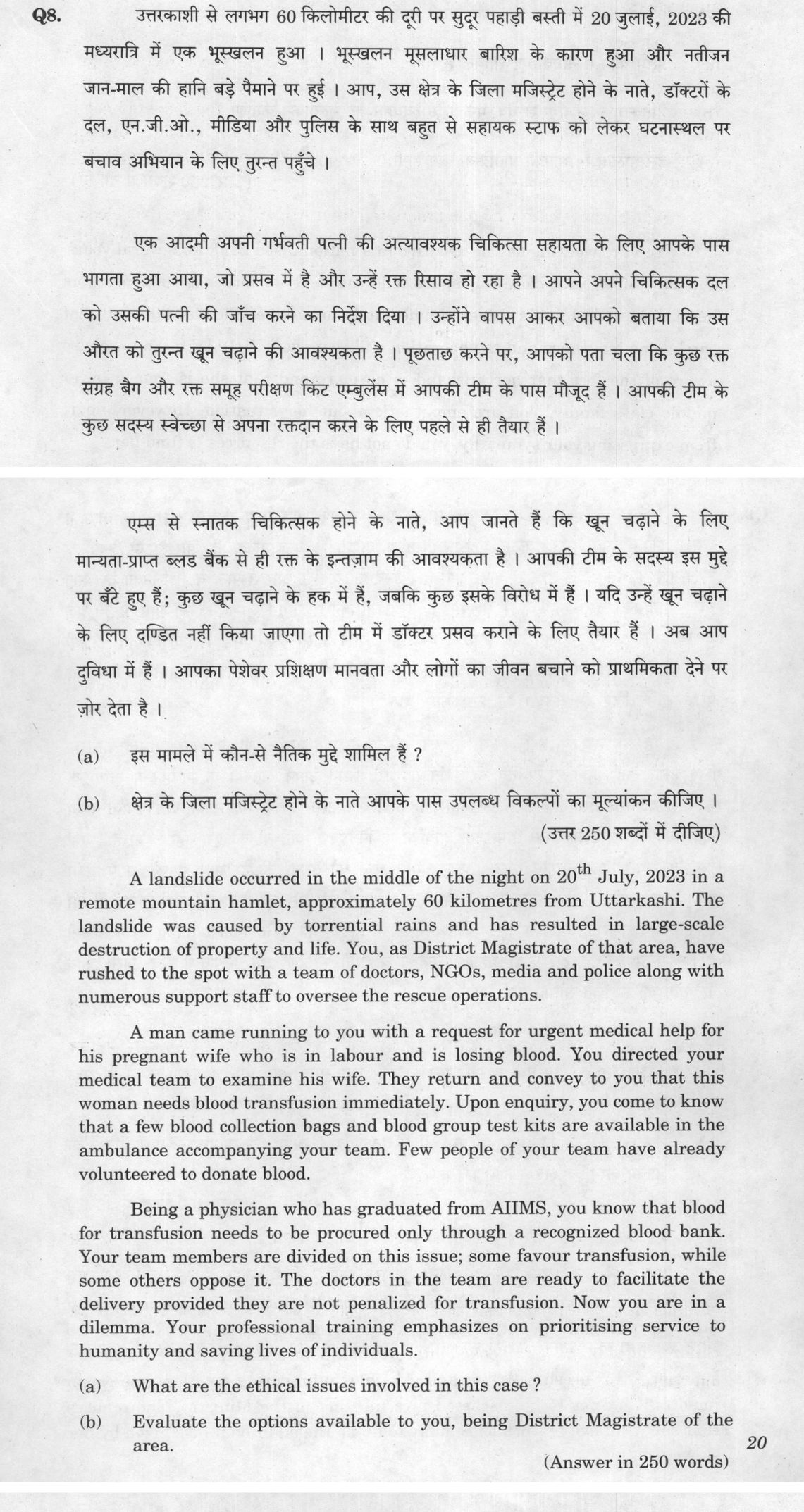
A landslide occurred in the middle of the night on 20th July, 2023 in a remote mountain hamlet, approximately 60 kilometres from Uttarkashi. The landslide was caused by torrential rains and has resulted in large-scale destruction of property and life. You, as District Magistrate of that area, have rushed to the spot with a team of doctors, NGOs, media and police along with numerous support staff to oversee the rescue operations.
A man came running to you with a request for urgent medical help for his pregnant wife who is in labour and is losing blood. You directed your medical team to examine his wife. They return and convey to you that this woman needs blood transfusion immediately. Upon enquiry, you come to know that a few blood collection bags and blood group test kits are available in the ambulance accompanying your team. Few people of your team have already volunteered to donate blood.
Being a physician who has graduated from AIIMS, you know that blood for transfusion needs to be procured only through a recognized blood bank. Your team members are divided on this issue; some favour transfusion, while some others oppose it. The doctors in the team are ready to facilitate the delivery provided they are not penalized for transfusion. Now you are in a dilemma. Your professional training emphasizes on prioritising service to humanity and saving lives of individuals.
What are the ethical issues involved in this case?
Evaluate the options available to you, being District Magistrate of the area.
हिंदी में प्रश्न पढ़ें
उत्तरकाशी से लगभग 60 किलोमीटर की दूरी पर सुदूर पहाड़ी बस्ती में 20 जुलाई, 2023 की मध्यरात्रि में एक भूस्खलन हुआ। भूस्खलन मूसलाधार बारिश के कारण हुआ और नतीजन जान-माल की हानि बड़े पैमाने पर हुई। आप, उस क्षेत्र के जिला मजिस्ट्रेट होने के नाते, डॉक्टरों के दल, एन.जी.ओ., मीडिया और पुलिस के साथ बहुत से सहायक स्टाफ को लेकर घटनास्थल पर बचाव अभियान के लिए तुरंत पहुंचे।
एक आदमी अपनी गर्भवती पत्नी की अत्यावश्यक चिकित्सा सहायता के लिए आपके पास भागता हुआ आया, जो प्रसव में है और उन्हें रक्त रिसाव हो रहा है। आपने अपने चिकित्सक दल को उसकी पत्नी की जांच करने का निर्देश दिया। उन्होंने वापस आकर आपको बताया कि उस औरत को तुरंत खून चढ़ाने की आवश्यकता है। पूछताछ करने पर, आपको पता चला कि कुछ रक्त संग्रह बैग और रक्त समूह परीक्षण किट एम्बुलेंस में आपकी टीम के पास मौजूद है। आपकी टीम के कुछ सदस्य स्वेच्छा से अपना रक्तदान करने के लिए पहले से ही तैयार हैं।
एम्स से स्नातक चिकित्सक होने के नाते, आप जानते हैं कि खून चढ़ाने के लिए मान्यता-प्राप्त ब्लड बैंक से ही रक्त के इंतजाम की आवश्यकता है। आपकी टीम के सदस्य इस मुद्दे पर बंटे हुए हैं; कुछ खून चढ़ाने के हक में हैं, जबकि कुछ इसके विरोध में हैं। यदि उन्हें खून चढ़ाने के लिए दंडित नहीं किया जाएगा तो टीम में डॉक्टर प्रसव कराने के लिए तैयार हैं। अब आप दुविधा में हैं। आपका पेशेवर प्रशिक्षण मानवता और लोगों का जीवन बचाने को प्राथमिकता देने पर जोर देता है।
इस मामले में कौन-से नैतिक मुद्दे शामिल हैं?
क्षेत्र के जिला मजिस्ट्रेट होने के नाते आपके पास उपलब्ध विकल्पों का मूल्यांकन कीजिए।
Model answer
Written by UPSC Answer Check against this question's marking rubric, to the 250-word length. UPSC does not publish answers for Mains — this is one way to score well, not an official key.
The landslide creates an emergency, but the DM’s duty is to save lives without violating blood-safety law.
(a) Ethical issues First, professional medical ethics under the Drugs and Cosmetics Act and NACO blood-safety norms demand that transfusion blood be procured from a recognized blood bank, while humanitarian ethics and beneficence demand immediate action to prevent maternal death. Second, there is a legal-ethical conflict: using untested volunteer blood may breach NACO guidelines and expose doctors to negligence liability under IPC 304A, although emergency doctrines and Good Samaritan protection may mitigate blame if action is reasonable. Third, institutional ethics arise: the DM must balance accountability, protect subordinates from arbitrary blame, and avoid a precedent that disaster authority overrides medical regulation.
(b) Options Immediate transfusion from volunteers may save the mother, but because the kits only test blood group, not HIV/hepatitis, it risks infection and prosecution; it is defensible only as a last resort if death is imminent and no blood can arrive. Evacuation to Uttarkashi’s blood bank is legally safer but 60 km of mountain terrain at night makes delay likely to cause mortality. The better option is a middle path: stabilize the patient, obtain her own documented informed consent if conscious, use the available kits for rapid blood-group compatibility screening, and immediately arrange airlift of blood from a recognized blood bank and patient evacuation if required, using DM powers under the Disaster Management Act, 2005 to coordinate evacuation, not to grant immunity. This balances legal compliance, patient safety, and emergency response.
What "Evaluate" is asking you to do
Judge how well something has performed against the standard it set for itself — its stated aim, mandate or promise — and commit to a verdict. Name the yardstick before you judge; an unanchored judgement reads as opinion.
Structure that answers it
Name the yardstick — stated aim, mandate or benchmark → performance against it → shortfall against it → why the gap exists → verdict
Where marks are lost
Presenting both sides and then declining to decide, or delivering a verdict against a standard you never stated, which makes it look arbitrary.
How this answer will be evaluated
Approach
Framework: GS4 Ethical Dilemma Framework. (a) highlight: name the salient points > one line of substance each > close | (b) evaluate: criteria > evidence > balanced judgment Full marks: Identifies the legal-ethical conflict and chooses life-saving action with clear administrative safeguards.
Key points expected
- Conflict between legal compliance and saving life
- Professional duty of care vs. institutional protocol
- Risk of legal liability for medical team
- Duty to the immediate victim vs. public trust
- Option 1: Adhere to law (risk of death)
- Option 2: Transfuse (risk of legal penalty)
- Option 3: Evacuate (risk of time delay)
- Justification of the chosen course of action
Evaluation rubric
Each sub-part is marked on its own, against the marks and word limit printed on the paper.
- (a) Identify the specific ethical conflicts and competing duties in the scenario.
highlight— name the salient points → one line of substance each → close
Must cover
- Conflict between legal compliance and saving life
- Professional duty of care vs. institutional protocol
- Risk of legal liability for medical team
- Duty to the immediate victim vs. public trust
Loses marks
- Listing generic values without linking to the case
- Ignoring the legal risk to the doctors
- Failing to identify the 'dilemma' nature of the choice
Earns more
- Mention of 'emergency exception' in medical ethics
- Identification of the 'dilemma' as the core issue
- Reference to the 'AIIMS' training as a value anchor
Extra mark
- Citing the specific 'Blood (Transfusion) Act' provision
- Mentioning 'informed consent' in emergency contexts
- (b) Assess the available options and justify the course of action as DM. · 250 words
evaluate— criteria → evidence → balanced judgment
Must cover
- Option 1: Adhere to law (risk of death)
- Option 2: Transfuse (risk of legal penalty)
- Option 3: Evacuate (risk of time delay)
- Justification of the chosen course of action
Loses marks
- Choosing to do nothing (passive option)
- Ignoring the doctors' fear of penalty
- Preaching values without a concrete decision
Earns more
- Prioritizing 'life' over 'procedure' in emergency
- Taking personal responsibility to shield doctors
- Mentioning 'ex-gratia' or legal protection for team
- Balancing 'humanity' with 'administrative accountability'
Extra mark
- Citing a specific Supreme Court judgment on emergency care
- Mentioning 'Section 122 IPC' regarding good faith acts
Practice this exact question
Write your answer and it is marked point by point against the model answer above — what you covered, what you missed, what you got wrong.
Evaluate my answer →More from General Studies 2023 GS Paper IV
- Q5 (a) Is conscience a more reliable guide when compared to laws, rules and regulations in t…
- Q6 (a) What were the major teachings of Guru Nanak? Explain their relevance in the contempor…
- Q7 You are working as an executive in a nationalised bank for several years. One day one of…
- Q8 A landslide occurred in the middle of the night on 20th July, 2023 in a remote mountain h…
- Q9 At 9 pm on Saturday evening, Rashika, a Joint Secretary, was still engrossed in her work…
- Q10 Vinod is an honest and sincere IAS officer. Recently, he has taken over as Managing Direc…
- Q11 You have just been appointed as Additional Director General of Central Public Works Depar…