GS Paper IV — Q5
(a) Is conscience a more reliable guide when compared to laws, rules and regulations in the context of ethical decision-making?…
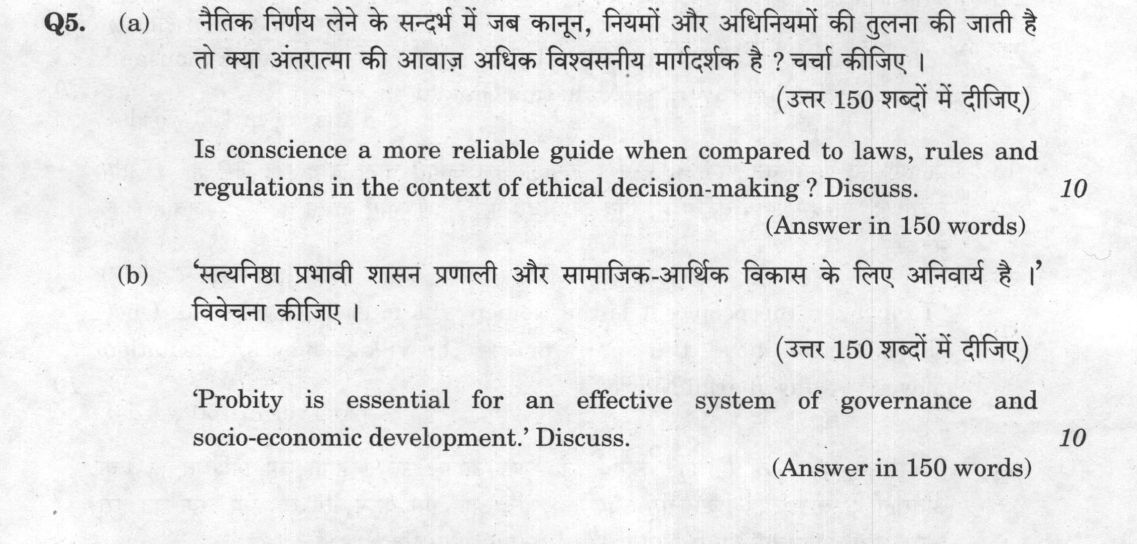
Is conscience a more reliable guide when compared to laws, rules and regulations in the context of ethical decision-making? Discuss. (Answer in 150 words) 10 marks
'Probity is essential for an effective system of governance and socio-economic development.' Discuss. (Answer in 150 words) 10 marks
हिंदी में प्रश्न पढ़ें
नैतिक निर्णय लेने के संदर्भ में जब कानून, नियमों और अधिनियमों की तुलना की जाती है तो क्या अंतरात्मा की आवाज अधिक विश्वसनीय मार्गदर्शक है? चर्चा कीजिए। (उत्तर 150 शब्दों में दीजिए) 10 marks
'सत्यनिष्ठा प्रभावी शासन प्रणाली और सामाजिक-आर्थिक विकास के लिए अनिवार्य है।' विवेचना कीजिए। (उत्तर 150 शब्दों में दीजिए) 10 marks
Model answer
Written by UPSC Answer Check against this question's marking rubric, to the 150-word length. UPSC does not publish answers for Mains — this is one way to score well, not an official key.
(a) Conscience vs. Laws in Ethical Decision-Making
Conscience serves as an internal moral compass, guiding discretion when codified rules are ambiguous or silent. However, conscience is vulnerable to subjectivity, cultural relativism, and personal bias, whereas laws provide objective predictability, uniformity, and universal applicability across society. Hence, conscience cannot entirely replace statutory frameworks; rather, both must complement each other. Ethical governance requires institutionalizing moral conscience within legal systems, as seen in the Whistle Blowers Protection Act, which safeguards individual ethical conviction under the rule of law.
(b) Probity in Governance and Socio-Economic Development
Probity denotes uncompromising honesty, integrity, and transparency in public life, establishing vital trust between the state and citizens. In governance, it curbs administrative corruption and ensures optimal policy implementation through mechanisms like the Right to Information (RTI) Act and Social Audits under MGNREGA. For socio-economic development, probity eliminates leakages in welfare schemes, guarantees equitable resource allocation, and fosters a transparent business climate that attracts investment, driving inclusive national growth.
What "Discuss" is asking you to do
Lay the issue out from more than one side — how it arose, what is claimed for it, what is held against it, and where it now stands. UPSC attaches discuss to broad topics with several live dimensions, so coverage of the dimensions earns more than the strength of your opinion.
Structure that answers it
Set the issue up → the case as it is made → the case against → the dimension both sides leave out → where the balance now lies
Where marks are lost
Listing facts with no thread between them, or arguing one side throughout and calling it a discussion.
How this answer will be evaluated
Approach
Framework: GS4 Ethical Decision-Making & Governance. (a) discuss: intro > 3-4 dimensions > example > balanced close | (b) discuss: intro > 3-4 dimensions > example > balanced close Full marks: Balanced reasoning with specific examples and clear linkage
Key points expected
- Define conscience as internal moral compass
- Acknowledge laws as external, objective baseline
- Identify gap where law is silent or unjust
- Conclude conscience as higher guide for integrity
- Define probity (honesty/integrity in office)
- Link probity to effective governance (trust/efficiency)
- Link probity to socio-economic development (investment)
- Mention consequences of lack of probity (corruption)
Evaluation rubric
Each sub-part is marked on its own, against the marks and word limit printed on the paper.
- (a) Compare conscience vs laws/rules in ethical decision-making 10 marks · 150 words
discuss— intro → 3-4 dimensions → example → balanced close
Must cover
- Define conscience as internal moral compass
- Acknowledge laws as external, objective baseline
- Identify gap where law is silent or unjust
- Conclude conscience as higher guide for integrity
Loses marks
- Preaching values without reasoning
- Ignoring the role of law entirely
- Conclusion repeating the introduction
Earns more
- Mention 'easy-but-wrong' option (legal but unethical)
- Reference silent stakeholders affected by decision
- Distinguish between 'legal' and 'ethical' clearly
- Use specific example of conscience overriding rule
Extra mark
- Cite specific case (e.g., civil disobedience)
- Reference specific ethical framework (e.g., Kantian)
- (b) Link probity to governance and socio-economic development 10 marks · 150 words
discuss— intro → 3-4 dimensions → example → balanced close
Must cover
- Define probity (honesty/integrity in office)
- Link probity to effective governance (trust/efficiency)
- Link probity to socio-economic development (investment)
- Mention consequences of lack of probity (corruption)
Loses marks
- Generic statements without specific linkage
- Focusing only on governance, ignoring development
- Listing values without explaining their impact
Earns more
- Mention 'silent stakeholders' (poor/citizens)
- Reference specific mechanism (e.g., RTI, Lokpal)
- Discuss 'institutional trust' as a dimension
- Mention 'political pressure' as a constraint
Extra mark
- Cite specific index (e.g., CPI ranking)
- Reference specific committee (e.g., 2nd ARC)
Practice this exact question
Write your answer and it is marked point by point against the model answer above — what you covered, what you missed, what you got wrong.
Evaluate my answer →More from General Studies 2023 GS Paper IV
- Q2 (a) "Corruption is the manifestation of the failure of core values in the society." In yo…
- Q3 Given below are three quotations of great thinkers. What do each of these quotations conv…
- Q4 (a) "What really matters for success, character, happiness and lifelong achievements is a…
- Q5 (a) Is conscience a more reliable guide when compared to laws, rules and regulations in t…
- Q6 (a) What were the major teachings of Guru Nanak? Explain their relevance in the contempor…
- Q7 You are working as an executive in a nationalised bank for several years. One day one of…
- Q8 A landslide occurred in the middle of the night on 20th July, 2023 in a remote mountain h…