GS Paper IV — Q9
At 9 pm on Saturday evening, Rashika, a Joint Secretary, was still engrossed in her work in her office. Her husband, Vikram, is…
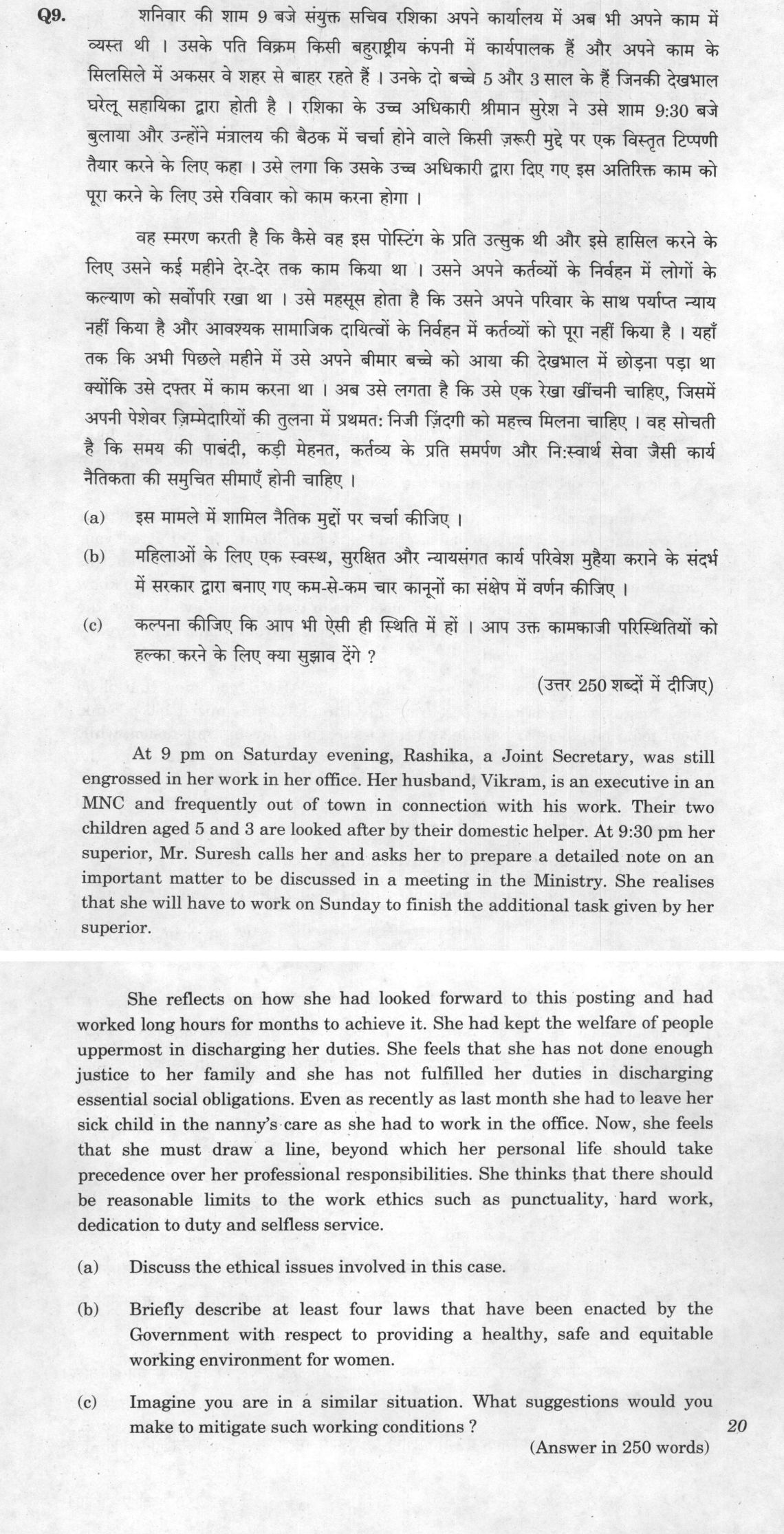
At 9 pm on Saturday evening, Rashika, a Joint Secretary, was still engrossed in her work in her office. Her husband, Vikram, is an executive in an MNC and frequently out of town in connection with his work. Their two children aged 5 and 3 are looked after by their domestic helper. At 9:30 pm her superior, Mr. Suresh calls her and asks her to prepare a detailed note on an important matter to be discussed in a meeting in the Ministry. She realises that she will have to work on Sunday to finish the additional task given by her superior.
She reflects on how she had looked forward to this posting and had worked long hours for months to achieve it. She had kept the welfare of people uppermost in discharging her duties. She feels that she has not done enough justice to her family and she has not fulfilled her duties in discharging essential social obligations. Even as recently as last month she had to leave her sick child in the nanny's care as she had to work in the office. Now, she feels that she must draw a line, beyond which her personal life should take precedence over her professional responsibilities. She thinks that there should be reasonable limits to the work ethics such as punctuality, hard work, dedication to duty and selfless service.
Discuss the ethical issues involved in this case.
Briefly describe at least four laws that have been enacted by the Government with respect to providing a healthy, safe and equitable working environment for women.
Imagine you are in a similar situation. What suggestions would you make to mitigate such working conditions?
हिंदी में प्रश्न पढ़ें
शनिवार की शाम 9 बजे संयुक्त सचिव रशिका अपने कार्यालय में अब भी अपने काम में व्यस्त थी। उसके पति विक्रम किसी बहुराष्ट्रीय कंपनी में कार्यपालक हैं और अपने काम के सिलसिले में अक्सर वे शहर से बाहर रहते हैं। उनके दो बच्चे 5 और 3 साल के हैं जिनकी देखभाल घरेलू सहायिका द्वारा होती है। रशिका के उच्च अधिकारी श्रीमान सुरेश ने उसे शाम 9:30 बजे बुलाया और उन्होंने मंत्रालय की बैठक में चर्चा होने वाले किसी जरूरी मुद्दे पर एक विस्तृत टिप्पणी तैयार करने के लिए कहा। उसे लगा कि उसके उच्च अधिकारी द्वारा दिए गए इस अतिरिक्त काम को पूरा करने के लिए उसे रविवार को काम करना होगा।
वह स्मरण करती है कि कैसे वह इस पोस्टिंग के प्रति उत्सुक थी और इसे हासिल करने के लिए उसने कई महीने देर-देर तक काम किया था। उसने अपने कर्तव्यों के निर्वहन में लोगों के कल्याण को सर्वोच्च रखा था। उसे महसूस होता है कि उसने अपने परिवार के साथ पर्याप्त न्याय नहीं किया है और आवश्यक सामाजिक दायित्वों के निर्वहन में कर्तव्यों को पूरा नहीं किया है। यहाँ तक कि अभी पिछले महीने में उसे अपने बीमार बच्चे को आया की देखभाल में छोड़ना पड़ा था क्योंकि उसे दफ्तर में काम करना था। अब उसे लगता है कि उसे एक रेखा खींचनी चाहिए, जिसमें अपनी पेशेवर जिम्मेदारियों की तुलना में प्रथमतः निजी जिंदगी को महत्व मिलना चाहिए। वह सोचती है कि समय की पाबंदी, कड़ी मेहनत, कर्तव्य के प्रति समर्पण और नि:स्वार्थ सेवा जैसी कार्य नैतिकता की समुचित सीमाएँ होनी चाहिए।
इस मामले में शामिल नैतिक मुद्दों पर चर्चा कीजिए।
महिलाओं के लिए एक स्वस्थ, सुरक्षित और न्यायसंगत कार्य परिवेश मुहैया कराने के संदर्भ में सरकार द्वारा बनाए गए कम-से-कम चार कानूनों का संक्षेप में वर्णन कीजिए।
कल्पना कीजिए कि आप भी ऐसी ही स्थिति में हों। आप उक्त कामकाजी परिस्थितियों को हल्का करने के लिए क्या सुझाव देंगे?
Model answer
Written by UPSC Answer Check against this question's marking rubric, to the 250-word length. UPSC does not publish answers for Mains — this is one way to score well, not an official key.
The scenario highlights the acute friction between administrative dedication and domestic obligations faced by women in leadership.
Ethical Issues Involved First is the conflict between utilitarian public ethics (delivering maximum public welfare) and deontological moral duties toward childcare and family. Second, excessive work demands impose an unequal gendered care burden, violating Rawlsian justice and human dignity. Third, it poses tension between organizational loyalty and personal autonomy. Finally, it tests the reasonable limits of professional dedication: while Article 51A urges striving toward excellence, Article 21 guarantees the right to health, dignity, and a balanced life, demanding that selfless service not translate into institutional exploitation.
Legal Framework for Women's Work Environment Four key enactments provide an equitable workplace:
- Maternity Benefit (Amendment) Act, 2017: Provides 26 weeks paid maternity leave, work-from-home options, and mandatory crèche facilities.
- Sexual Harassment of Women at Workplace (POSH) Act, 2013: Mandates Internal Committees to ensure a secure, safe environment.
- Equal Remuneration Act, 1976: Prohibits gender discrimination in recruitment and ensures equal pay for equal work.
- Factories Act, 1948: Regulates permissible working hours, mandates crèches, and secures safety norms during late hours.
Suggestions to Mitigate Working Conditions At the personal level, establishing transparent boundaries with superiors regarding non-emergency weekend work, effective time management, and spousal negotiation with Vikram for equal co-parenting are vital.
At the institutional level, the civil service should institutionalise flexi-hours, standardized delegation protocols for urgent notes, and ministry-level childcare infrastructure.
Systemically, conducting workload rationalization, gender audits, and respecting the 'right to disconnect' will prevent chronic burnout.
Sustainable public service requires harmonizing administrative efficiency with constitutional protections of personal dignity and well-being.
What "Discuss" is asking you to do
Lay the issue out from more than one side — how it arose, what is claimed for it, what is held against it, and where it now stands. UPSC attaches discuss to broad topics with several live dimensions, so coverage of the dimensions earns more than the strength of your opinion.
Structure that answers it
Set the issue up → the case as it is made → the case against → the dimension both sides leave out → where the balance now lies
Where marks are lost
Listing facts with no thread between them, or arguing one side throughout and calling it a discussion.
How this answer will be evaluated
Approach
Framework: GS4 Ethical Dilemma & Governance Framework. (a) discuss: intro > 3-4 dimensions > example > balanced close | (b) describe: define > structure or process in order > labelled diagram > significance | (c) suggest: the problem in one line > implementable measures > who acts > conclusion Full marks: Identifies the core ethical conflict, cites specific relevant laws (Maternity, POSH), and offers a multi-level (personal/institutional) solution.
Key points expected
- Conflict: Public service vs. family duty
- Ethical dilemma: Selfless service vs. personal well-being
- Stakeholders: Rashika, family, public, superior
- Balanced view: Need for work-life balance
- Maternity Benefit (Amendment) Act, 2017
- POSH Act, 2013 (Prevention of Sexual Harassment)
- Equal Remuneration Act, 1976
- Factories Act, 1948 (provisions for women)
Evaluation rubric
Each sub-part is marked on its own, against the marks and word limit printed on the paper.
- (a) Identify and analyze the conflict between professional duty and personal/family obligations.
discuss— intro → 3-4 dimensions → example → balanced close
Must cover
- Conflict: Public service vs. family duty
- Ethical dilemma: Selfless service vs. personal well-being
- Stakeholders: Rashika, family, public, superior
- Balanced view: Need for work-life balance
Loses marks
- Preaching instead of analyzing the dilemma
- Ignoring the 'superior's' role in the pressure
- Listing values without applying them to the case
Earns more
- Reference to 'duty of care' for children
- Concept of 'burnout' or 'compassion fatigue'
- Distinction between 'dedication' and 'self-neglect'
Extra mark
- Reference to 'utilitarian' vs. 'deontological' ethics
- Specific mention of 'emotional labor'
- (b) List and explain four laws ensuring a safe/equitable working environment for women.
describe— define → structure or process in order → labelled diagram → significance
Must cover
- Maternity Benefit (Amendment) Act, 2017
- POSH Act, 2013 (Prevention of Sexual Harassment)
- Equal Remuneration Act, 1976
- Factories Act, 1948 (provisions for women)
Loses marks
- Listing laws without explaining their relevance to 'working environment'
- Confusing 'Maternity Benefit' with 'Child Care Leave'
- Listing general labor laws not specific to women's safety/equity
Earns more
- Protection of Women from Domestic Violence Act, 2005
- Right to Work (Equal Remuneration) Act
- Specific mention of 'creche facilities' under Maternity Act
Extra mark
- Reference to 'Equal Pay for Equal Work' principle
- Specific section numbers of the Acts
- (c) Provide actionable suggestions to mitigate the working conditions described.
suggest— the problem in one line → implementable measures → who acts → conclusion
Must cover
- Immediate: Delegate or negotiate deadline with superior
- Short-term: Institutionalize work-life balance policies
- Long-term: Cultural shift in organizational hierarchy
- Personal: Set boundaries and prioritize mental health
Loses marks
- Vague suggestions like 'work harder' or 'be patient'
- Ignoring the systemic/institutional level of the problem
- Only focusing on personal coping mechanisms
Earns more
- Suggestion of 'flexible working hours' or 'remote work'
- Proposal for 'mentoring' or 'counseling' support
- Advocacy for 'gender-neutral' parental leave
Extra mark
- Reference to '4-day work week' pilot
- Specific mention of 'empathetic leadership' training
Practice this exact question
Write your answer and it is marked point by point against the model answer above — what you covered, what you missed, what you got wrong.
Evaluate my answer →More from General Studies 2023 GS Paper IV
- Q6 (a) What were the major teachings of Guru Nanak? Explain their relevance in the contempor…
- Q7 You are working as an executive in a nationalised bank for several years. One day one of…
- Q8 A landslide occurred in the middle of the night on 20th July, 2023 in a remote mountain h…
- Q9 At 9 pm on Saturday evening, Rashika, a Joint Secretary, was still engrossed in her work…
- Q10 Vinod is an honest and sincere IAS officer. Recently, he has taken over as Managing Direc…
- Q11 You have just been appointed as Additional Director General of Central Public Works Depar…
- Q12 You hold a responsible position in a ministry in the government. One day in the morning y…