GS Paper IV — Q10
Vinod is an honest and sincere IAS officer. Recently, he has taken over as Managing Director of the State Road Transport…
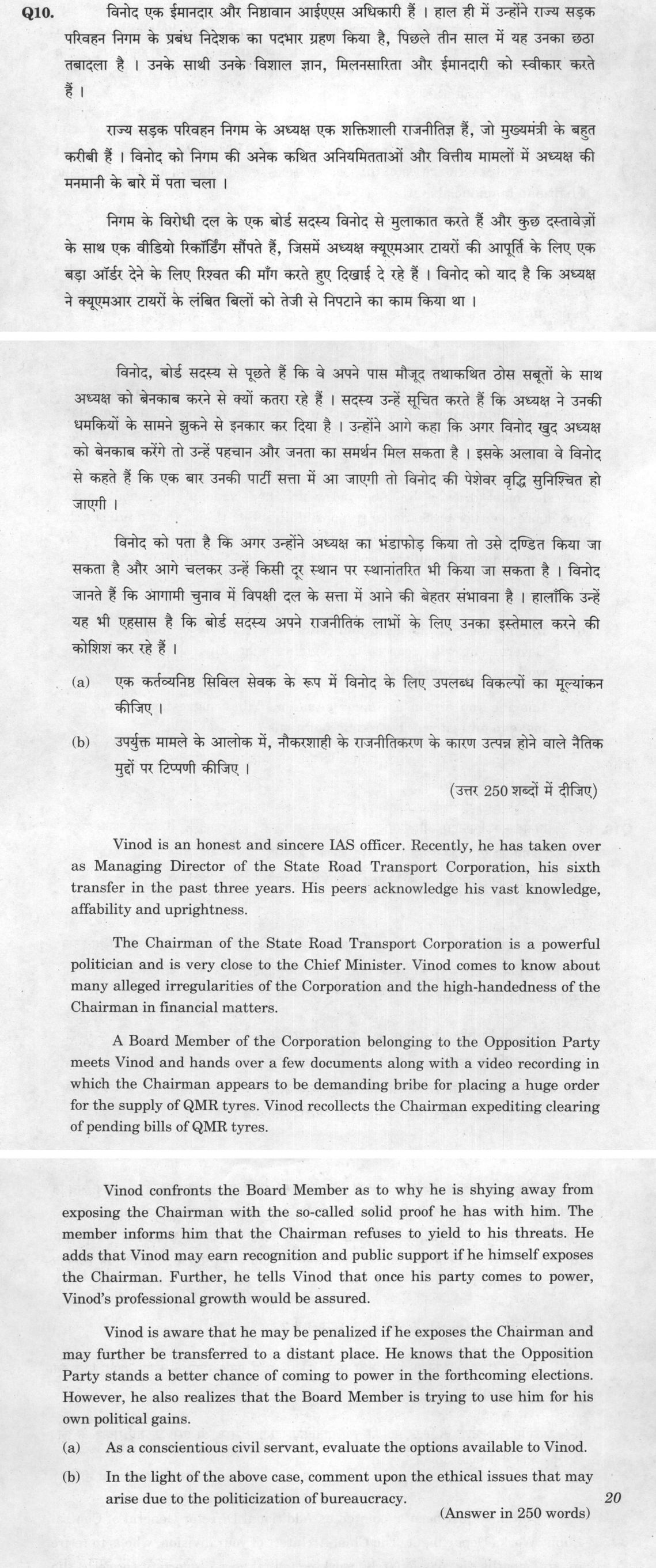
Vinod is an honest and sincere IAS officer. Recently, he has taken over as Managing Director of the State Road Transport Corporation, his sixth transfer in the past three years. His peers acknowledge his vast knowledge, affability and uprightness.
The Chairman of the State Road Transport Corporation is a powerful politician and is very close to the Chief Minister. Vinod comes to know about many alleged irregularities of the Corporation and the high-handedness of the Chairman in financial matters.
A Board Member of the Corporation belonging to the Opposition Party meets Vinod and hands over a few documents along with a video recording in which the Chairman appears to be demanding bribe for placing a huge order for the supply of QMR tyres. Vinod recollects the Chairman expediting clearing of pending bills of QMR tyres.
Vinod confronts the Board Member as to why he is shying away from exposing the Chairman with the so-called solid proof he has with him. The member informs him that the Chairman refuses to yield to his threats. He adds that Vinod may earn recognition and public support if he himself exposes the Chairman. Further, he tells Vinod that once his party comes to power, Vinod's professional growth would be assured.
Vinod is aware that he may be penalized if he exposes the Chairman and may further be transferred to a distant place. He knows that the Opposition Party stands a better chance of coming to power in the forthcoming elections. However, he also realizes that the Board Member is trying to use him for his own political gains.
As a conscientious civil servant, evaluate the options available to Vinod.
In the light of the above case, comment upon the ethical issues that may arise due to the politicization of bureaucracy.
हिंदी में प्रश्न पढ़ें
विनोद एक ईमानदार और निष्ठावान आईएएस अधिकारी हैं। हाल ही में उन्होंने राज्य सड़क परिवहन निगम के प्रबंध निदेशक का पदभार ग्रहण किया है, पिछले तीन साल में यह उनका छठा तबादला है। उनके साथी उनके विशाल ज्ञान, मिलनसारिता और ईमानदारी को स्वीकार करते हैं।
राज्य सड़क परिवहन निगम के अध्यक्ष एक शक्तिशाली राजनीतिज्ञ हैं, जो मुख्यमंत्री के बहुत करीबी हैं। विनोद को निगम की अनेक कथित अनियमितताओं और वित्तीय मामलों में अध्यक्ष की मनमानी के बारे में पता चला।
निगम के विरोधी दल के एक बोर्ड सदस्य विनोद से मुलाकात करते हैं और कुछ दस्तावेजों के साथ एक वीडियो रिकॉर्डिंग सौंपते हैं, जिसमें अध्यक्ष क्यूएमआर टायरों की आपूर्ति के लिए एक बड़ा ऑर्डर देने के लिए रिश्वत की मांग करते हुए दिखाई दे रहे हैं। विनोद को याद है कि अध्यक्ष ने क्यूएमआर टायरों के लंबित बिलों को तेजी से निपटाने का काम किया था।
विनोद, बोर्ड सदस्य से पूछते हैं कि वे अपने पास मौजूद तथाकथित ठोस सबूतों के साथ अध्यक्ष को बेनकाब करने से क्यों कतरा रहे हैं। सदस्य उन्हें सूचित करते हैं कि अध्यक्ष ने उनकी धमकियों के सामने झुकने से इनकार कर दिया है। उन्होंने आगे कहा कि अगर विनोद खुद अध्यक्ष को बेनकाब करेंगे तो उन्हें पहचान और जनता का समर्थन मिल सकता है। इसके अलावा वे विनोद से कहते हैं कि एक बार उनकी पार्टी सत्ता में आ जाएगी तो विनोद की पेशेवर वृद्धि सुनिश्चित हो जाएगी।
विनोद को पता है कि अगर उन्होंने अध्यक्ष का भंडाफोड़ किया तो उसे दंडित किया जा सकता है और आगे चलकर उन्हें किसी दूर स्थान पर स्थानांतरित भी किया जा सकता है। विनोद जानते हैं कि आगामी चुनाव में विपक्षी दल के सत्ता में आने की बेहतर संभावना है। हालांकि उन्हें यह भी एहसास है कि बोर्ड सदस्य अपने राजनीतिक लाभों के लिए उनका इस्तेमाल करने की कोशिश कर रहे हैं।
एक कर्तव्यनिष्ठ सिविल सेवक के रूप में विनोद के लिए उपलब्ध विकल्पों का मूल्यांकन कीजिए।
उपर्युक्त मामले के आलोक में, नौकरशाही के राजनीतीकरण के कारण उत्पन्न होने वाले नैतिक मुद्दों पर टिप्पणी कीजिए।
Model answer
Written by UPSC Answer Check against this question's marking rubric, to the 250-word length. UPSC does not publish answers for Mains — this is one way to score well, not an official key.
The situation tests Vinod’s adherence to constitutional morality, professional integrity, and administrative neutrality against political coercion.
Evaluation of Options Available to Vinod
Option 1: Direct exposure via media or anti-corruption bodies (Lokayukta/State Vigilance/CVC/CBI). While this vigorously confronts graft, premature public leaks violate Service Conduct Rules, risk immediate transfer, and allow the Chairman to tamper with evidence before formal cognizance.
Option 2: Internal institutional remedies (recording formal written dissent on files, moving a Board resolution, halting suspicious tyre procurement bills, and escalating the matter via special audit and official reports to the Chief Secretary/Vigilance). This preserves procedural integrity and builds an unassailable legal paper trail, though it faces severe political blockage from the Chairman.
Option 3: Strategic documentation and deferred action post-election. This ensures career survival and future political patronage, but amounts to moral cowardice, silent complicity in ongoing corruption, and a surrender of administrative neutrality.
Option 4: Principled resignation accompanied by a public statement. This exhibits high personal moral authority, but abandons the possibility of systemic institutional reform from within, leaving public resources unprotected.
Verdict: Vinod must pursue Option 2—utilize institutional channels, record dissent, freeze tainted clearances, and refer the verified material directly to statutory anti-corruption authorities (Lokayukta/Vigilance), completely rejecting the Opposition’s partisan bargain.
Ethical Issues Arising from Politicization of Bureaucracy
Spoils System and Subversion of Tenure: Frequent transfers become tools of punishment and reward, circumventing Civil Services Board norms (T.S.R. Subramanian case) and diluting the constitutional safeguards of Article 311.
Erosion of Neutrality: Civil servants are reduced from neutral constitutional implementers to partisan agents, trading the public trust for career protection.
Institutional Decay: Politicization destroys the anonymity required for fearless, objective advice, triggers loyalty conflicts between political patrons and the public interest, shatters the administrative esprit de corps, and creates a severe democratic accountability deficit.
Vinod must anchor his actions in the rule of law, serving constitutional values rather than shifting political regimes.
What "Evaluate" is asking you to do
Judge how well something has performed against the standard it set for itself — its stated aim, mandate or promise — and commit to a verdict. Name the yardstick before you judge; an unanchored judgement reads as opinion.
Structure that answers it
Name the yardstick — stated aim, mandate or benchmark → performance against it → shortfall against it → why the gap exists → verdict
Where marks are lost
Presenting both sides and then declining to decide, or delivering a verdict against a standard you never stated, which makes it look arbitrary.
How this answer will be evaluated
Approach
Framework: GS4 Ethical Dilemma & Case Study Framework. (a) evaluate: criteria > evidence > balanced judgment | (b) comment: context > arguments both sides > judgment > close Full marks: Comprehensive evaluation of options with strong ethical reasoning and clear link to case; insightful comment on politicization with specific examples.
Key points expected
- Identify the core ethical dilemma (duty vs. self-interest)
- List at least three distinct options (e.g., expose, ignore, report)
- Weigh pros and cons of each option
- Justify the most appropriate course of action
- Define politicization of bureaucracy
- Identify specific ethical issues (e.g., loss of neutrality, corruption)
- Link issues to the case study (Chairman's actions)
- Provide a balanced judgment on the impact
Evaluation rubric
Each sub-part is marked on its own, against the marks and word limit printed on the paper.
- (a) Assess the available courses of action for Vinod based on ethical and administrative criteria.
evaluate— criteria → evidence → balanced judgment
Must cover
- Identify the core ethical dilemma (duty vs. self-interest)
- List at least three distinct options (e.g., expose, ignore, report)
- Weigh pros and cons of each option
- Justify the most appropriate course of action
Loses marks
- Listing options without critical evaluation
- Ignoring the political pressure aspect
- Choosing an option that violates the code of conduct
Earns more
- Mentioning the 'Whistle Blower Protection Act'
- Referencing the '2003 Code of Conduct'
- Discussing the 'Right to Information Act'
- Balancing personal risk against public interest
Extra mark
- Citing a specific Supreme Court judgment on whistleblowing
- Referencing the 'Second Administrative Reforms Commission' report
- (b) Discuss the ethical issues arising from the politicization of bureaucracy in this context.
comment— context → arguments both sides → judgment → close
Must cover
- Define politicization of bureaucracy
- Identify specific ethical issues (e.g., loss of neutrality, corruption)
- Link issues to the case study (Chairman's actions)
- Provide a balanced judgment on the impact
Loses marks
- Generalizing without linking to the case
- Failing to identify specific ethical issues
- Taking a purely political stance without ethical analysis
Earns more
- Discussing the 'Nehruvian ideal' of non-partisan bureaucracy
- Mentioning 'political interference' in transfers
- Referencing the '2G spectrum scam' as a parallel
- Discussing the 'erosion of public trust'
Extra mark
- Citing the '2010 Supreme Court judgment on political interference'
- Referencing the 'Second ARC's recommendations on political interference'
Practice this exact question
Write your answer and it is marked point by point against the model answer above — what you covered, what you missed, what you got wrong.
Evaluate my answer →More from General Studies 2023 GS Paper IV
- Q7 You are working as an executive in a nationalised bank for several years. One day one of…
- Q8 A landslide occurred in the middle of the night on 20th July, 2023 in a remote mountain h…
- Q9 At 9 pm on Saturday evening, Rashika, a Joint Secretary, was still engrossed in her work…
- Q10 Vinod is an honest and sincere IAS officer. Recently, he has taken over as Managing Direc…
- Q11 You have just been appointed as Additional Director General of Central Public Works Depar…
- Q12 You hold a responsible position in a ministry in the government. One day in the morning y…