GS Paper IV — Q11
You have just been appointed as Additional Director General of Central Public Works Department. The Chief Architect of your…
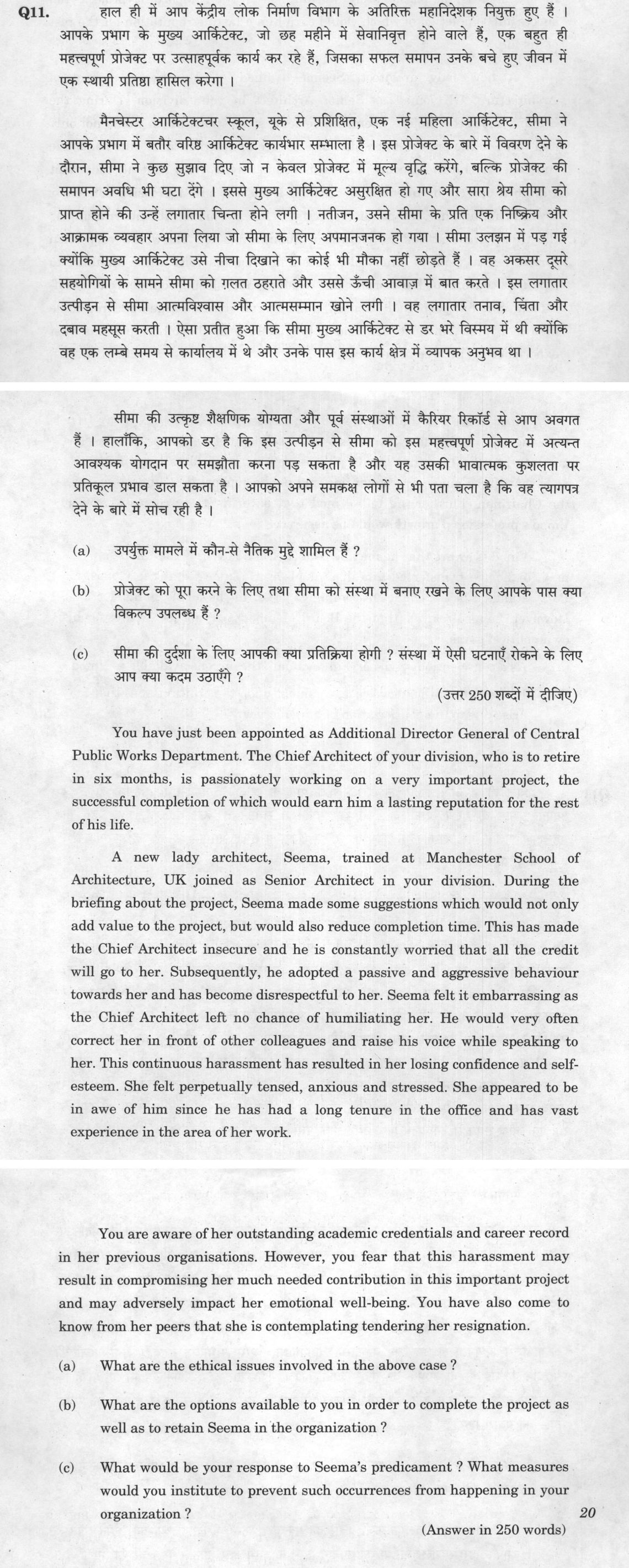
You have just been appointed as Additional Director General of Central Public Works Department. The Chief Architect of your division, who is to retire in six months, is passionately working on a very important project, the successful completion of which would earn him a lasting reputation for the rest of his life.
A new lady architect, Seema, trained at Manchester School of Architecture, UK joined as Senior Architect in your division. During the briefing about the project, Seema made some suggestions which would not only add value to the project, but would also reduce completion time. This has made the Chief Architect insecure and he is constantly worried that all the credit will go to her. Subsequently, he adopted a passive and aggressive behaviour towards her and has become disrespectful to her. Seema felt it embarrassing as the Chief Architect left no chance of humiliating her. He would very often correct her in front of other colleagues and raise his voice while speaking to her. This continuous harassment has resulted in her losing confidence and self-esteem. She felt perpetually tensed, anxious and stressed. She appeared to be in awe of him since he has had a long tenure in the office and has vast experience in the area of her work.
You are aware of her outstanding academic credentials and career record in her previous organisations. However, you fear that this harassment may result in compromising her much needed contribution in this important project and may adversely impact her emotional well-being. You have also come to know from her peers that she is contemplating tendering her resignation.
What are the ethical issues involved in the above case?
What are the options available to you in order to complete the project as well as to retain Seema in the organization?
What would be your response to Seema's predicament? What measures would you institute to prevent such occurrences from happening in your organization?
हिंदी में प्रश्न पढ़ें
हाल ही में आप केंद्रीय लोक निर्माण विभाग के अतिरिक्त महानिदेशक नियुक्त हुए हैं। आपके प्रभाग के मुख्य आर्किटेक्ट, जो छह महीने में सेवानिवृत्त होने वाले हैं, एक बहुत ही महत्वपूर्ण प्रोजेक्ट पर उत्साहपूर्वक कार्य कर रहे हैं, जिसका सफल समापन उनके बचे हुए जीवन में एक स्थायी प्रतिष्ठा हासिल करेगा।
मैनचेस्टर आर्किटेक्चर स्कूल, यूके से प्रशिक्षित, एक नई महिला आर्किटेक्ट, सीमा ने आपके प्रभाग में बतौर वरिष्ठ आर्किटेक्ट कार्यभार संभाला है। इस प्रोजेक्ट के बारे में विवरण देने के दौरान, सीमा ने कुछ सुझाव दिए जो न केवल प्रोजेक्ट में मूल्य वृद्धि करेंगे, बल्कि प्रोजेक्ट की समापन अवधि भी घटा देंगे। इससे मुख्य आर्किटेक्ट असुरक्षित हो गए और सारा श्रेय सीमा को प्राप्त होने की उन्हें लगातार चिंता होने लगी। नतीजन, उसने सीमा के प्रति एक निष्क्रिय और आक्रामक व्यवहार अपना लिया जो सीमा के लिए अपमानजनक हो गया। सीमा उलझन में पड़ गई क्योंकि मुख्य आर्किटेक्ट उसे नीचा दिखाने का कोई भी मौका नहीं छोड़ते हैं। वह अक्सर दूसरे सहयोगियों के सामने सीमा को गलत ठहराते और उससे ऊंची आवाज में बात करते। इस लगातार उत्पीड़न से सीमा आत्मविश्वास और आत्मसम्मान खोने लगी। वह लगातार तनाव, चिंता और दबाव महसूस करती। ऐसा प्रतीत हुआ कि सीमा मुख्य आर्किटेक्ट से डर भरे विस्मय में थी क्योंकि वह एक लंबे समय से कार्यालय में थे और उनके पास इस कार्य क्षेत्र में व्यापक अनुभव था।
सीमा की उत्कृष्ट शैक्षणिक योग्यता और पूर्व संस्थाओं में कैरियर रिकॉर्ड से आप अवगत हैं। हालांकि, आपको डर है कि इस उत्पीड़न से सीमा को इस महत्वपूर्ण प्रोजेक्ट में अत्यंत आवश्यक योगदान पर समझौता करना पड़ सकता है और यह उसकी भावात्मक कुशलता पर प्रतिकूल प्रभाव डाल सकता है। आपको अपने समकक्ष लोगों से भी पता चला है कि वह त्यागपत्र देने के बारे में सोच रही है।
उपर्युक्त मामले में कौन-से नैतिक मुद्दे शामिल हैं?
प्रोजेक्ट को पूरा करने के लिए तथा सीमा को संस्था में बनाए रखने के लिए आपके पास क्या विकल्प उपलब्ध हैं?
सीमा की दुर्दशा के लिए आपकी क्या प्रतिक्रिया होगी? संस्था में ऐसी घटनाएं रोकने के लिए आप क्या कदम उठाएंगे?
Model answer
Written by UPSC Answer Check against this question's marking rubric, to the 250-word length. UPSC does not publish answers for Mains — this is one way to score well, not an official key.
Ethical Issues and Frameworks The situation involves the violation of workplace dignity and psychological safety (Article 21), where professional jealousy overrides meritocracy and organizational efficiency. Under Deontology and the CCS (Conduct) Rules, 1964, leadership possesses a strict duty of care to prevent workplace harassment. Utilitarianism dictates that the senior’s insecurity compromises collective output, while virtue ethics underscores a lack of professional humility and temperance. Applying Rawlsian justice, institutional power asymmetries must not disadvantage vulnerable junior personnel.
Evaluating Strategic Options Direct confrontation or immediate disciplinary action under the POSH Act, 2013 may derail the critical project right before the Chief Architect’s retirement. Conversely, doing nothing risks losing high-caliber talent. The optimal path is structured mediation coupled with a formal credit-sharing framework. Transitioning the workflow into a joint consultative model—where the Chief Architect is credited as Lead Mentor and Seema as Lead Technical Architect—safeguards the senior's legacy, integrates modern technical value, and enables a smooth succession timeline upon his retirement.
Response to Predicament and Institutional Measures My immediate response to Seema would be providing an empathetic hearing, validating her contributions, offering institutional counseling, and reassigning direct project reporting to mitigate hostility while keeping formal grievance routes open. Institutionally, I would enforce strict POSH compliance, mandate annual gender-sensitive workplace audits, introduce 360-degree appraisals, roll out inclusive leadership ethics training, and institute anonymous grievance reporting channels.
Analyzing these interrelated dynamics shows that harmonizing administrative empathy with systemic accountability transforms workplace hostility into institutional collaboration, ensuring both project success and talent retention.
What "Analyse" is asking you to do
Break the subject into its working parts and show how they act on each other. The marks are in the interconnections — which factor drives which, and what the resulting structure explains — not in the inventory of factors.
Structure that answers it
Define the whole → separate it into its parts → show which part drives which → what that interaction produces → what the structure implies
Where marks are lost
A flat list of causes with no account of which drives which. An answer of neatly separated headings, each self-contained, scores as description.
How this answer will be evaluated
Approach
Framework: GS4 Case Study Framework (Crux, Stakeholders, Dilemmas, Options, Course of Action). (a) highlight: name the salient points > one line of substance each > close | (b) suggest: the problem in one line > implementable measures > who acts > conclusion | (c) suggest: the problem in one line > implementable measures > who acts > conclusion Full marks: Identifies the crux (harassment vs project), balances the duties to both staff, and provides a 3-horizon action plan (immediate/short/long).
Key points expected
- Workplace harassment and bullying by senior
- Insecurity-driven conflict of interest
- Gender bias and lack of respect
- Threat to organizational integrity and project
- Immediate intervention to stop harassment
- Reassigning roles to reduce friction
- Counseling the Chief Architect
- Providing support/mentorship to Seema
Evaluation rubric
Each sub-part is marked on its own, against the marks and word limit printed on the paper.
- (a) Identify the specific ethical dilemmas and professional misconducts in the scenario.
highlight— name the salient points → one line of substance each → close
Must cover
- Workplace harassment and bullying by senior
- Insecurity-driven conflict of interest
- Gender bias and lack of respect
- Threat to organizational integrity and project
Loses marks
- Generic listing of values without context
- Ignoring the specific power dynamic
- Focusing only on the project delay
Earns more
- Violation of code of conduct
- Emotional well-being vs professional duty
- Mentorship failure by senior official
Extra mark
- Reference to POSH Act (if applicable)
- Mention of 'Toxic Work Culture'
- (b) Propose actionable options to resolve the conflict and retain talent.
suggest— the problem in one line → implementable measures → who acts → conclusion
Must cover
- Immediate intervention to stop harassment
- Reassigning roles to reduce friction
- Counseling the Chief Architect
- Providing support/mentorship to Seema
Loses marks
- Suggesting immediate dismissal without due process
- Ignoring the Chief Architect's retirement status
- Vague suggestions like 'be nice'
Earns more
- Transparent communication with both parties
- Leveraging Seema's specific expertise
- Setting clear performance metrics
Extra mark
- Mention of '360-degree feedback'
- Reference to 'Conflict Resolution Committee'
- (c) Detail the specific response to Seema and long-term preventive measures.
suggest— the problem in one line → implementable measures → who acts → conclusion
Must cover
- Personal assurance to Seema (immediate)
- Institutionalizing a grievance redressal mechanism
- Mandatory sensitivity/ethics training
- Creating a culture of meritocracy
Loses marks
- Preaching instead of administrative action
- Ignoring the 'preventive' aspect of the question
- Repeating points from part (b)
Earns more
- Regular feedback loops
- Mentorship programs for junior staff
- Strict enforcement of anti-harassment policies
Extra mark
- Reference to 'Internal Complaints Committee (ICC)'
- Mention of 'Whistleblower Protection'
Practice this exact question
Write your answer and it is marked point by point against the model answer above — what you covered, what you missed, what you got wrong.
Evaluate my answer →More from General Studies 2023 GS Paper IV
- Q8 A landslide occurred in the middle of the night on 20th July, 2023 in a remote mountain h…
- Q9 At 9 pm on Saturday evening, Rashika, a Joint Secretary, was still engrossed in her work…
- Q10 Vinod is an honest and sincere IAS officer. Recently, he has taken over as Managing Direc…
- Q11 You have just been appointed as Additional Director General of Central Public Works Depar…
- Q12 You hold a responsible position in a ministry in the government. One day in the morning y…