GS Paper IV — Q3
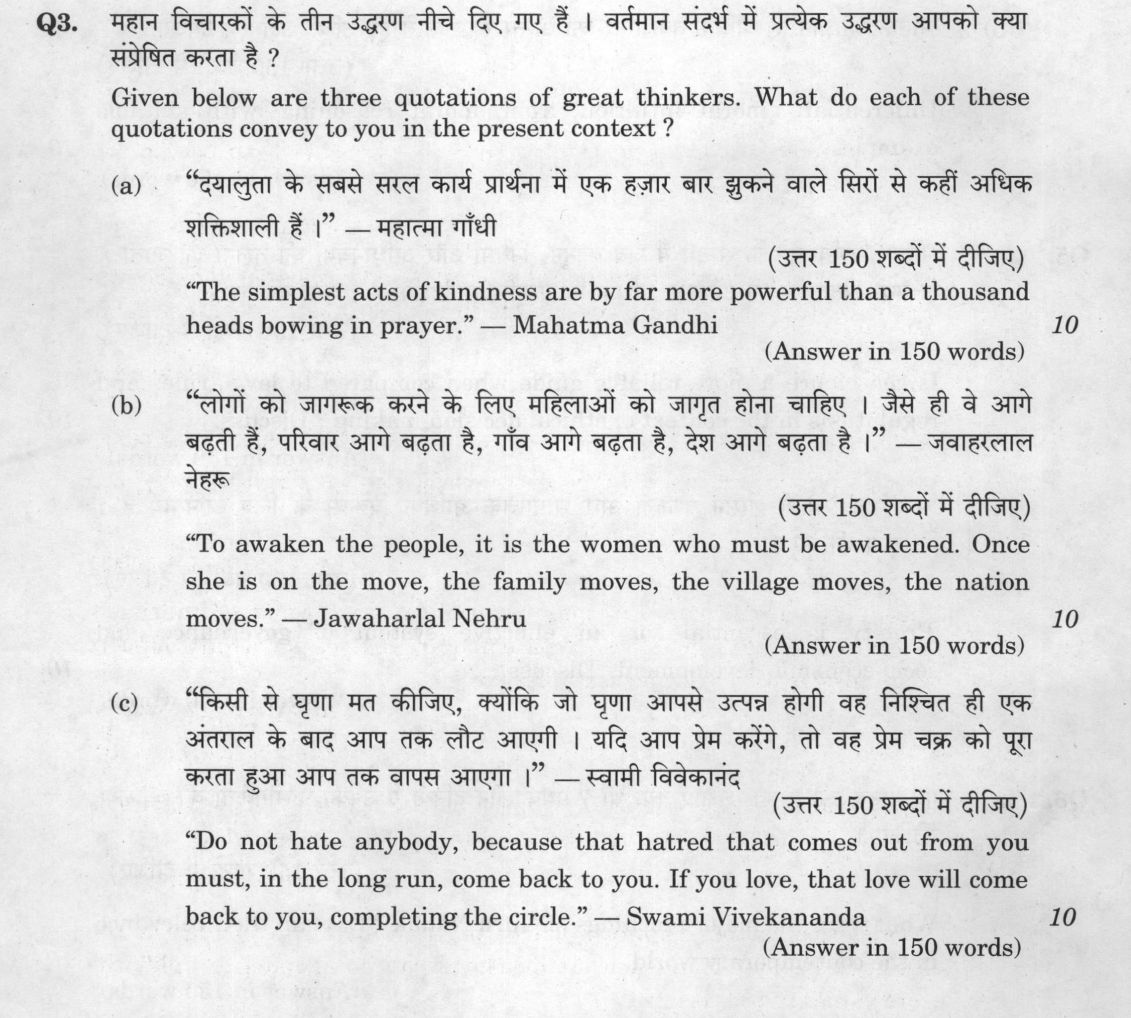
Given below are three quotations of great thinkers. What do each of these quotations convey to you in the present context? (a)…
Given below are three quotations of great thinkers. What do each of these quotations convey to you in the present context? "The simplest acts of kindness are by far more powerful than a thousand heads bowing in prayer." — Mahatma Gandhi
"To awaken the people, it is the women who must be awakened. Once she is on the move, the family moves, the village moves, the nation moves." — Jawaharlal Nehru
"Do not hate anybody, because that hatred that comes out from you must, in the long run, come back to you. If you love, that love will come back to you, completing the circle." — Swami Vivekananda
हिंदी में प्रश्न पढ़ें
महान विचारकों के तीन उद्धरण नीचे दिए गए हैं। वर्तमान संदर्भ में प्रत्येक उद्धरण आपको क्या संप्रेषित करता है? "दयालुता के सबसे सरल कार्य प्रार्थना में एक हजार बार झुकने वाले सिरों से कहीं अधिक शक्तिशाली हैं।" — महात्मा गांधी
"लोगों को जागरूक करने के लिए महिलाओं को जागृत होना चाहिए। जैसे ही वे आगे बढ़ती हैं, परिवार आगे बढ़ता है, गांव आगे बढ़ता है, देश आगे बढ़ता है।" — जवाहरलाल नेहरू
"किसी से घृणा मत कीजिए, क्योंकि जो घृणा आपसे उत्पन्न होगी वह निश्चित ही एक अंतराल के बाद आप तक लौट आएगी। यदि आप प्रेम करेंगे, तो वह प्रेम चक्र को पूरा करता हुआ आप तक वापस आएगा।" — स्वामी विवेकानंद
Model answer
Written by UPSC Answer Check against this question's marking rubric, to the 150-word length. UPSC does not publish answers for Mains — this is one way to score well, not an official key.
These three aphorisms converge on a shared ethical imperative: transformative praxis. They demand moving beyond passive contemplation, tokenism, and negativity toward constructive human action, gendered mobilization, and empathetic social consciousness.
Gandhi: Action-Oriented Ethics over Performative Piety
Mahatma Gandhi prioritizes tangible compassion over formalistic religiosity. The causal mechanism is straightforward: prayer without action remains an internal, unverified sentiment, whereas an act of kindness directly alters material reality by alleviating human suffering. In contemporary society, this distinguishes authentic seva (selfless service) from performative piety. While modern socio-political discourse frequently indulges in grand symbolic rituals, competitive temple building, and corporate "greenwashing," genuine ethical progress requires hands-on intervention. Real-world administrative ethics demands shifting focus from ostentatious CSR declarations to substantive welfare delivery, replicating the spirit of frontline health workers and grassroots civil society organizations who convert empathy into measurable relief.
Nehru: Women as Catalysts of Structural Transformation
Jawaharlal Nehru identifies gender empowerment as the primary lever for socio-economic development. When a woman is educated and economically empowered, the causal chain operates across scales: her increased agency immediately elevates child nutrition, family health, and educational attainment, which in turn enhances village productivity and ultimately accelerates national growth. This multiplier effect is visible in India’s grassroots development through Self-Help Groups (under DAY-NRLM) and initiatives like Beti Bachao, Beti Padhao, which demonstrate that women are structural drivers of change rather than passive welfare recipients. However, a contemporary gap persists: despite high political representation at the panchayat level and rising female educational enrollment, female labor force participation (FLFPR) remains disproportionately low, constrained by persistent safety concerns and the unequal burden of unpaid care work.
Vivekananda: Moral Reciprocity and Emotional Regulation
Swami Vivekananda articulates the psychological and sociological law of moral reciprocity. Hatred released into the public sphere polarizes communities, erodes social trust, and creates an insecure, hostile environment that inevitably harms the instigator. Conversely, proactive compassion establishes positive feedback loops of solidarity and social capital. In the present context of hyper-partisan digital spaces, algorithmic rage, and weaponized hate speech, this insight is critical. When toxicity is normalized on social media and in communal rhetoric, it undermines the constitutional goal of fraternity (Article 51A(e)) and destabilizes internal security. Reclaiming public discourse requires institutional safeguards against hate along with an active cultivation of civic empathy.
Conclusion
Together, these maxims demonstrate that national progress cannot rely on superficial rituals, skewed gender dynamics, or divisive rhetoric. Integrating Gandhi’s lived service, Nehru’s structural gender empowerment, and Vivekananda’s empathetic reciprocity provides the foundational blueprint for ethical governance and an inclusive republic.
What "Explain" is asking you to do
Make the working of something clear — what sets it off, what follows from what, and what it produces. Explain is the Commission's mechanism word: it dominates the technical papers and the “explain why” stems, where the marks sit in the causal chain and not in the label.
Structure that answers it
State what it is → the initiating condition → the chain of cause, step by step → an instance where it plays out → what the chain produces
Where marks are lost
Describing what something looks like instead of why it works that way. Naming the stages without linking them reads as description too.
How this answer will be evaluated
Approach
Framework: GS4 Ethical Reasoning & Situational Analysis. (a) comment: context > arguments both sides > judgment > close | (b) comment: context > arguments both sides > judgment > close | (c) comment: context > arguments both sides > judgment > close Full marks: Clear, context-specific reasoning with concrete examples and balanced judgment.
Key points expected
- Distinguish between ritualistic prayer and active kindness
- Link to present context (e.g., social service, empathy)
- Provide a concrete example of 'simple act of kindness'
- Conclude with a balanced judgment on the quote's power
- Explain the 'multiplier effect' of women's awakening
- Connect family/village/nation progression logically
- Address the 'present context' (e.g., gender gap, workforce)
- Provide a specific example of women-led change
Evaluation rubric
Each sub-part is marked on its own, against the marks and word limit printed on the paper.
- (a) Interpret the quote's relevance to present-day administrative and social context. 10 marks · 150 words
comment— context → arguments both sides → judgment → close
Must cover
- Distinguish between ritualistic prayer and active kindness
- Link to present context (e.g., social service, empathy)
- Provide a concrete example of 'simple act of kindness'
- Conclude with a balanced judgment on the quote's power
Loses marks
- Preaching moral values without administrative reasoning
- Ignoring the 'present context' aspect of the question
Earns more
- Mentioning 'Seva' or 'Sarvodaya' concepts
- Contrasting with bureaucratic apathy
- Referencing a specific social issue (e.g., disaster relief)
Extra mark
- Citing a specific Gandhian principle (e.g., Ahimsa in action)
- (b) Analyze the role of women's empowerment in national development. 10 marks · 150 words
comment— context → arguments both sides → judgment → close
Must cover
- Explain the 'multiplier effect' of women's awakening
- Connect family/village/nation progression logically
- Address the 'present context' (e.g., gender gap, workforce)
- Provide a specific example of women-led change
Loses marks
- Treating women as passive beneficiaries rather than agents
- Failing to link individual awakening to national progress
Earns more
- Referencing schemes like Beti Bachao or MGNREGA
- Discussing economic impact of women's participation
- Mentioning social indicators (health, education)
Extra mark
- Citing a specific statistic on women's workforce participation
- (c) Discuss the ethical principle of non-hatred and its cyclical nature. 10 marks · 150 words
comment— context → arguments both sides → judgment → close
Must cover
- Explain the 'boomerang effect' of hatred vs. love
- Apply to present context (e.g., social media, communalism)
- Provide a concrete example of hate vs. love outcomes
- Conclude with a judgment on the 'completing the circle' concept
Loses marks
- Being overly abstract without practical application
- Ignoring the 'present context' of social polarization
Earns more
- Referencing 'Vasudhaiva Kutumbakam' or universal brotherhood
- Discussing the role of empathy in conflict resolution
- Mentioning the psychological impact of hate
Extra mark
- Citing a specific historical or contemporary example of non-violence
Practice this exact question
Write your answer and it is marked point by point against the model answer above — what you covered, what you missed, what you got wrong.
Evaluate my answer →More from General Studies 2023 GS Paper IV
- Q1 (a) What do you understand by 'moral integrity' and 'professional efficiency' in the cont…
- Q2 (a) "Corruption is the manifestation of the failure of core values in the society." In yo…
- Q3 Given below are three quotations of great thinkers. What do each of these quotations conv…
- Q4 (a) "What really matters for success, character, happiness and lifelong achievements is a…
- Q5 (a) Is conscience a more reliable guide when compared to laws, rules and regulations in t…
- Q6 (a) What were the major teachings of Guru Nanak? Explain their relevance in the contempor…