GS Paper IV — Q4
(a) "What really matters for success, character, happiness and lifelong achievements is a definite set of emotional skills — your…
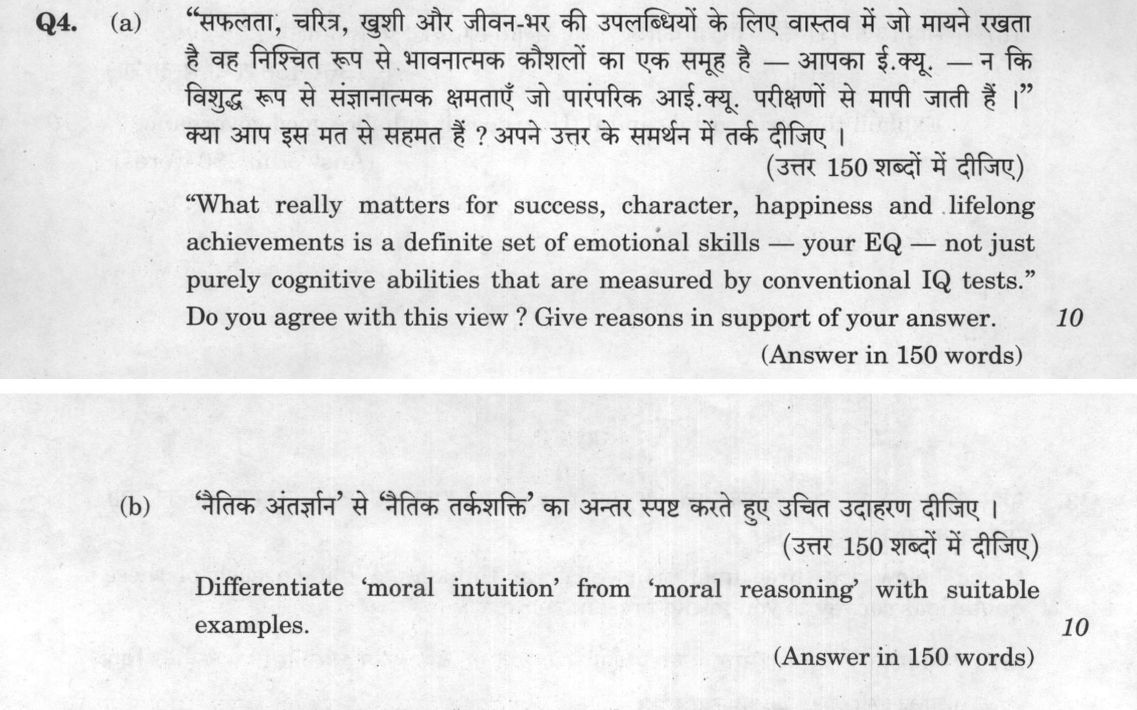
"What really matters for success, character, happiness and lifelong achievements is a definite set of emotional skills — your EQ — not just purely cognitive abilities that are measured by conventional IQ tests." Do you agree with this view? Give reasons in support of your answer.
Differentiate 'moral intuition' from 'moral reasoning' with suitable examples.
हिंदी में प्रश्न पढ़ें
"सफलता, चरित्र, खुशी और जीवन-भर की उपलब्धियों के लिए वास्तव में जो मायने रखता है वह निश्चित रूप से भावनात्मक कौशलों का एक समूह है — आपका ई.क्यू. — न कि विशुद्ध रूप से संज्ञानात्मक क्षमताएं जो पारंपरिक आई.क्यू. परीक्षणों से मापी जाती हैं।" क्या आप इस मत से सहमत हैं? अपने उत्तर के समर्थन में तर्क दीजिए।
'नैतिक अंतर्ज्ञान' से 'नैतिक तर्कशक्ति' का अंतर स्पष्ट करते हुए उचित उदाहरण दीजिए।
Model answer
Written by UPSC Answer Check against this question's marking rubric, to the 150-word length. UPSC does not publish answers for Mains — this is one way to score well, not an official key.
Emotional Intelligence versus Cognitive Ability While high EQ is indispensable for empathetic leadership, resilience, and character (Daniel Goleman), pure EQ determinism is inadequate. Cognitive intelligence (IQ) provides essential analytical and technical competence, vital for ISRO scientists or administrators crafting complex public policies. As Gardner’s theory of multiple intelligences suggests, lifelong achievement requires a synergy: IQ builds domain expertise and problem-solving capacity, while EQ governs ethical execution, self-regulation, and interpersonal success.
Moral Intuition versus Moral Reasoning Moral intuition is an automatic, affect-laden, instantaneous judgment arising without conscious reflection (Jonathan Haidt’s social intuitionist model), such as instinctively leaping to save a drowning child.
Conversely, moral reasoning is a slow, deliberate, principle-driven evaluation of competing duties (Lawrence Kohlberg’s framework), such as resolving vaccine triage or budget allocation through utilitarian and deontological principles.
In ethical governance, both interact dynamically: intuition provides immediate moral alertness, while reasoning critically scrutinises biases to ensure objective, defensible outcomes.
What "Differentiate" is asking you to do
Fix the criteria on which the two differ and apply each criterion to both, so the pair can no longer be mixed up. Differentiate stems usually carry a further task attached — describe the mechanism, set out the principles, discuss the applications — and that task carries its own marks.
Structure that answers it
Criterion 1 applied to both → criterion 2 → criterion 3 → summary line or table → the attached second demand answered in full
Where marks are lost
Two standalone definitions placed side by side, leaving the reader to extract the difference. The second common loss is running out of space before the attached task, which is often worth as much as the differentiation.
How this answer will be evaluated
Approach
Framework: GS4 Ethical Reasoning & Application. (a) comment: context > arguments both sides > judgment > close | (b) compare: paired headings or table > key differences > significance > conclusion Full marks: Nuanced view on EQ/IQ interplay; clear distinction between intuition and reasoning with strong examples.
Key points expected
- Define EQ and IQ briefly
- Arguments supporting the primacy of EQ
- Arguments for the role of cognitive abilities
- Balanced judgment on the interplay of both
- Definition of moral intuition
- Definition of moral reasoning
- Key differences (speed, conscious vs unconscious)
- Suitable examples for both concepts
Evaluation rubric
Each sub-part is marked on its own, against the marks and word limit printed on the paper.
- (a) Contextualize EQ vs IQ, present arguments for both, and offer a balanced judgment. 10 marks · 150 words
comment— context → arguments both sides → judgment → close
Must cover
- Define EQ and IQ briefly
- Arguments supporting the primacy of EQ
- Arguments for the role of cognitive abilities
- Balanced judgment on the interplay of both
Loses marks
- Preaching values without reasoning
- Ignoring the role of IQ entirely
- Conclusion that merely repeats the intro
Earns more
- Reference to Daniel Goleman's work
- Example of a leader with high EQ
- Mention of 'soft skills' in administration
- Distinction between 'knowing' and 'feeling'
Extra mark
- Specific reference to a civil service competency
- Citation of a specific psychological study
- (b) Differentiate moral intuition from moral reasoning using paired headings and examples. 10 marks · 150 words
compare— paired headings or table → key differences → significance → conclusion
Must cover
- Definition of moral intuition
- Definition of moral reasoning
- Key differences (speed, conscious vs unconscious)
- Suitable examples for both concepts
Loses marks
- Treating intuition as always wrong
- Lack of concrete examples
- Confusing intuition with instinct
Earns more
- Reference to Haidt's Social Intuitionist Model
- Reference to Kantian deontological reasoning
- Example of a 'gut feeling' vs 'duty'
- Mention of cognitive load in reasoning
Extra mark
- Reference to the Trolley Problem
- Mention of 'moral dumbfounding'
Practice this exact question
Write your answer and it is marked point by point against the model answer above — what you covered, what you missed, what you got wrong.
Evaluate my answer →More from General Studies 2023 GS Paper IV
- Q1 (a) What do you understand by 'moral integrity' and 'professional efficiency' in the cont…
- Q2 (a) "Corruption is the manifestation of the failure of core values in the society." In yo…
- Q3 Given below are three quotations of great thinkers. What do each of these quotations conv…
- Q4 (a) "What really matters for success, character, happiness and lifelong achievements is a…
- Q5 (a) Is conscience a more reliable guide when compared to laws, rules and regulations in t…
- Q6 (a) What were the major teachings of Guru Nanak? Explain their relevance in the contempor…
- Q7 You are working as an executive in a nationalised bank for several years. One day one of…