GS Paper IV — Q7
You are working as an executive in a nationalised bank for several years. One day one of your close colleagues tells you that her…
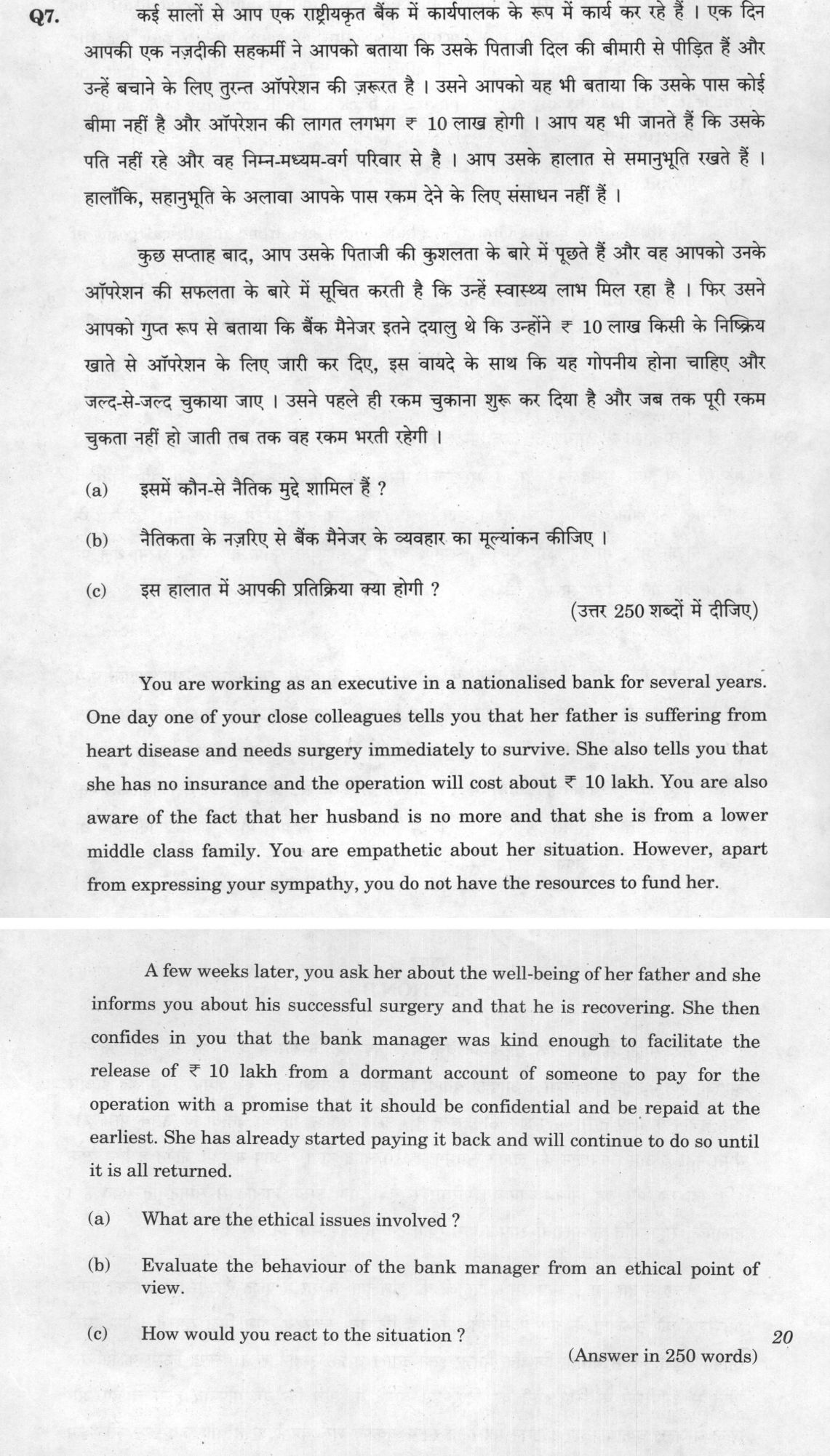
You are working as an executive in a nationalised bank for several years. One day one of your close colleagues tells you that her father is suffering from heart disease and needs surgery immediately to survive. She also tells you that she has no insurance and the operation will cost about ₹ 10 lakh. You are also aware of the fact that her husband is no more and that she is from a lower middle class family. You are empathetic about her situation. However, apart from expressing your sympathy, you do not have the resources to fund her.
A few weeks later, you ask her about the well-being of her father and she informs you about his successful surgery and that he is recovering. She then confides in you that the bank manager was kind enough to facilitate the release of ₹ 10 lakh from a dormant account of someone to pay for the operation with a promise that it should be confidential and be repaid at the earliest. She has already started paying it back and will continue to do so until it is all returned.
What are the ethical issues involved?
Evaluate the behaviour of the bank manager from an ethical point of view.
How would you react to the situation?
हिंदी में प्रश्न पढ़ें
कई सालों से आप एक राष्ट्रीयकृत बैंक में कार्यपालक के रूप में कार्य कर रहे हैं। एक दिन आपकी एक नजदीकी सहकर्मी ने आपको बताया कि उसके पिताजी दिल की बीमारी से पीड़ित हैं और उन्हें बचाने के लिए तुरंत ऑपरेशन की जरूरत है। उसने आपको यह भी बताया कि उसके पास कोई बीमा नहीं है और ऑपरेशन की लागत लगभग ₹ 10 लाख होगी। आप यह भी जानते हैं कि उसके पति नहीं रहे और वह निम्न-मध्यम-वर्ग परिवार से है। आप उसके हालात से सहानुभूति रखते हैं। हालांकि, सहानुभूति के अलावा आपके पास रकम देने के लिए संसाधन नहीं हैं।
कुछ सप्ताह बाद, आप उसके पिताजी की कुशलता के बारे में पूछते हैं और वह आपको उनके ऑपरेशन की सफलता के बारे में सूचित करती है कि उन्हें स्वास्थ्य लाभ मिल रहा है। फिर उसने आपको गुप्त रूप से बताया कि बैंक मैनेजर इतने दयालु थे कि उन्होंने ₹ 10 लाख किसी के निष्क्रिय खाते से ऑपरेशन के लिए जारी कर दिए, इस वायदे के साथ कि यह गोपनीय होना चाहिए और जल्द-से-जल्द चुकाया जाए। उसने पहले ही रकम चुकाना शुरू कर दिया है और जब तक पूरी रकम चुकता नहीं हो जाती तब तक वह रकम भरती रहेगी।
इसमें कौन-से नैतिक मुद्दे शामिल हैं?
नैतिकता के नजरिए से बैंक मैनेजर के व्यवहार का मूल्यांकन कीजिए।
इस हालात में आपकी प्रतिक्रिया क्या होगी?
Model answer
Written by UPSC Answer Check against this question's marking rubric, to the 250-word length. UPSC does not publish answers for Mains — this is one way to score well, not an official key.
Ethical Issues Involved This case presents a fundamental conflict between beneficence (saving a life) and fiduciary duty. The primary ethical issues include: the breach of depositors’ trust and statutory banking ethics (violating RBI’s Master Directions on dormant accounts); the tension between situational ethics and deontological duty; and the creation of a moral hazard through unauthorized fund diversion. The stakeholders directly impacted include the depositor whose property rights were compromised, the colleague placed in moral jeopardy, and the public whose faith in nationalised banks rests on institutional integrity.
Evaluation of the Bank Manager’s Behaviour From a utilitarian perspective, the manager achieved immediate good by saving a human life. However, applying a deontological standard, unauthorized siphoning of third-party funds is categorically wrong, regardless of the noble end. The manager violated the RBI’s Master Direction on Depositor Education and Protection and committed a breach of trust. The action failed the test of proportionality because legitimate alternatives—such as bank staff emergency medical advances, welfare corpus funds, or transparent benevolent approvals—were bypassed. Verdict: Despite benevolent intent, the manager’s conduct constitutes an unjustifiable abuse of authority and professional misconduct.
Course of Action Balancing administrative wisdom with personal empathy, I would: First, advise the colleague and manager to immediately regularize the ₹ 10 lakh transaction by substituting it with a formal staff personal loan or an emergency medical advance to restore the dormant account. Second, uphold statutory integrity obligations under banking conduct rules and the Prevention of Corruption Act by reporting the procedural irregularity to higher authorities, while contextualizing the humanitarian motive to mitigate vindictive penalization. Finally, recommend systemic reforms, including a dedicated Staff Medical Emergency Corpus and automated alerts for dormant accounts, ensuring empathy thrives within institutional legality.
What "Evaluate" is asking you to do
Judge how well something has performed against the standard it set for itself — its stated aim, mandate or promise — and commit to a verdict. Name the yardstick before you judge; an unanchored judgement reads as opinion.
Structure that answers it
Name the yardstick — stated aim, mandate or benchmark → performance against it → shortfall against it → why the gap exists → verdict
Where marks are lost
Presenting both sides and then declining to decide, or delivering a verdict against a standard you never stated, which makes it look arbitrary.
How this answer will be evaluated
Approach
Framework: GS4 Ethical Dilemma Framework (Crux, Stakeholders, Dilemmas, Options, Course of Action). (a) highlight: name the salient points > one line of substance each > close | (b) critically evaluate: positives > negatives/limits > conditions/safeguards > conclusion | (c) suggest: the problem in one line > implementable measures > who acts > conclusion Full marks: Identifies all ethical dimensions, critically evaluates the manager's act with legal context, and provides a structured, actionable response.
Key points expected
- Conflict between duty of care and legal authority
- Violation of banking secrecy and fiduciary duty
- Misuse of public office for private gain
- Silent stakeholder: the owner of the dormant account
- Acknowledge the positive intent (saving a life)
- Highlight the illegality of accessing a dormant account
- Discuss the risk to institutional integrity and public trust
- Conclude that the act is ethically flawed despite good intentions
Evaluation rubric
Each sub-part is marked on its own, against the marks and word limit printed on the paper.
- (a) Identify the core ethical conflicts and stakeholder interests in the scenario.
highlight— name the salient points → one line of substance each → close
Must cover
- Conflict between duty of care and legal authority
- Violation of banking secrecy and fiduciary duty
- Misuse of public office for private gain
- Silent stakeholder: the owner of the dormant account
Loses marks
- Listing generic values without linking to the specific case
- Ignoring the legal implications of the manager's act
Earns more
- Mention of 'duty of confidentiality' vs 'humanitarian aid'
- Reference to 'institutional trust' and 'public interest'
Extra mark
- Citing RBI guidelines on dormant accounts
- Mentioning 'whistleblower' protection laws
- (b) Assess the bank manager's actions by weighing moral intent against legal and professional obligations.
critically evaluate— positives → negatives/limits → conditions/safeguards → conclusion
Must cover
- Acknowledge the positive intent (saving a life)
- Highlight the illegality of accessing a dormant account
- Discuss the risk to institutional integrity and public trust
- Conclude that the act is ethically flawed despite good intentions
Loses marks
- Justifying the act solely on humanitarian grounds
- Failing to mention the legal consequences of the breach
Earns more
- Balancing 'compassion' against 'rule of law'
- Noting the lack of due process or authorization
Extra mark
- Reference to 'RBI Master Directions' on account management
- Mentioning 'fiduciary responsibility' of a bank manager
- (c) Propose a course of action for the executive to handle the situation ethically and legally.
suggest— the problem in one line → implementable measures → who acts → conclusion
Must cover
- Immediate: Report the irregularity to higher authorities
- Short-term: Assist the colleague in finding legal aid
- Long-term: Advocate for institutional welfare schemes
- Ensure the colleague repays the amount legally
Loses marks
- Suggesting to ignore the issue to maintain harmony
- Proposing illegal methods to help the colleague
Earns more
- Suggesting 'internal grievance redressal mechanism'
- Proposing 'corporate social responsibility' (CSR) funds
Extra mark
- Mentioning 'National Health Mission' or 'Ayushman Bharat'
- Referring to 'banking ombudsman' for dispute resolution
Practice this exact question
Write your answer and it is marked point by point against the model answer above — what you covered, what you missed, what you got wrong.
Evaluate my answer →More from General Studies 2023 GS Paper IV
- Q4 (a) "What really matters for success, character, happiness and lifelong achievements is a…
- Q5 (a) Is conscience a more reliable guide when compared to laws, rules and regulations in t…
- Q6 (a) What were the major teachings of Guru Nanak? Explain their relevance in the contempor…
- Q7 You are working as an executive in a nationalised bank for several years. One day one of…
- Q8 A landslide occurred in the middle of the night on 20th July, 2023 in a remote mountain h…
- Q9 At 9 pm on Saturday evening, Rashika, a Joint Secretary, was still engrossed in her work…
- Q10 Vinod is an honest and sincere IAS officer. Recently, he has taken over as Managing Direc…