GS Paper IV — Q2
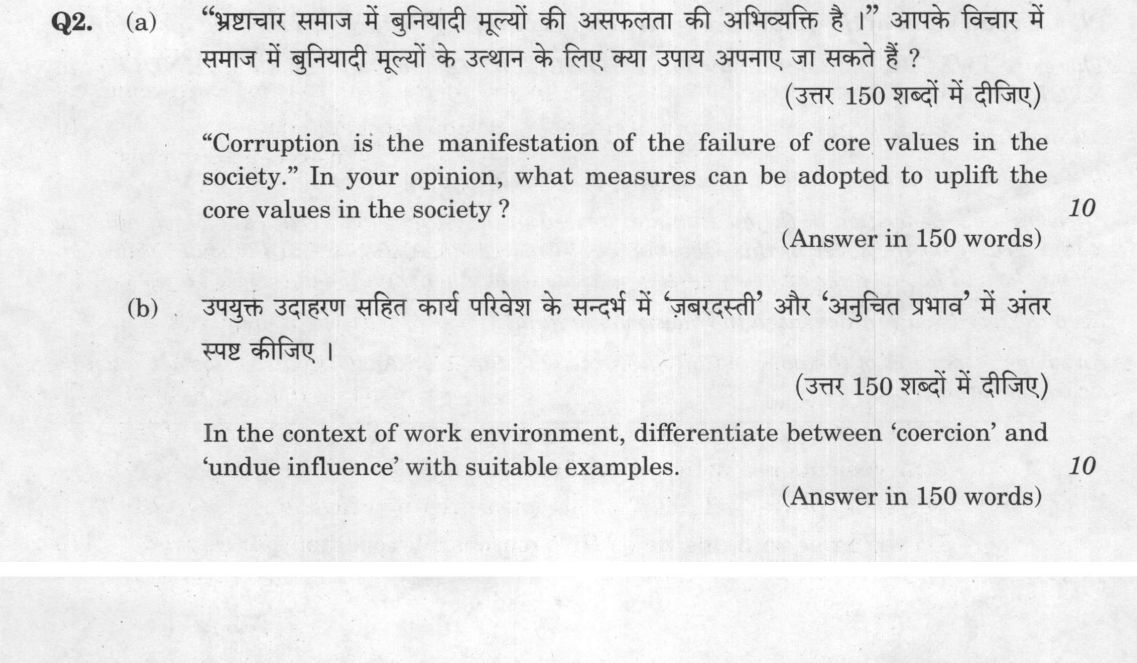
(a) "Corruption is the manifestation of the failure of core values in the society." In your opinion, what measures can be adopted…
"Corruption is the manifestation of the failure of core values in the society." In your opinion, what measures can be adopted to uplift the core values in the society? (Answer in 150 words) [10 marks]
In the context of work environment, differentiate between 'coercion' and 'undue influence' with suitable examples. (Answer in 150 words) [10 marks]
हिंदी में प्रश्न पढ़ें
"भ्रष्टाचार समाज में बुनियादी मूल्यों की असफलता की अभिव्यक्ति है।" आपके विचार में समाज में बुनियादी मूल्यों के उत्थान के लिए क्या उपाय अपनाए जा सकते हैं? (उत्तर 150 शब्दों में दीजिए) [10 अंक]
उपयुक्त उदाहरण सहित कार्य परिवेश के संदर्भ में 'जबरदस्ती' और 'अनुचित प्रभाव' में अंतर स्पष्ट कीजिए। (उत्तर 150 शब्दों में दीजिए) [10 अंक]
Model answer
Written by UPSC Answer Check against this question's marking rubric, to the 150-word length. UPSC does not publish answers for Mains — this is one way to score well, not an official key.
(a) Corruption reflects eroded integrity, honesty and public-service ethics. To uplift values, schools must strengthen value education through NCERT curriculum reform; institutions must ensure Lokpal implementation and RTI strengthening; communities must use Mohalla committees and civil-society vigilance. These make accountability visible and restore trust in public life and public-service ethics.
(b) Coercion, under Section 15 of the Indian Contract Act, 1872, is overt threat or violence that leaves no real choice; a manager threatening termination for refusing unsafe work is an example. Undue influence, under Section 16, is subtle manipulation exploiting fiduciary or domestic trust; a senior pressuring a junior to falsify records for promotion is one. They differ in consent: coercion makes consent not free, while undue influence vitiates consent through relationship; pressure is physical/psychological versus relational; coercion may also attract criminal intimidation, while both render agreements voidable, not automatically void. Workplace power asymmetry is central: coercion is overt, influence hidden.
What "Differentiate" is asking you to do
Fix the criteria on which the two differ and apply each criterion to both, so the pair can no longer be mixed up. Differentiate stems usually carry a further task attached — describe the mechanism, set out the principles, discuss the applications — and that task carries its own marks.
Structure that answers it
Criterion 1 applied to both → criterion 2 → criterion 3 → summary line or table → the attached second demand answered in full
Where marks are lost
Two standalone definitions placed side by side, leaving the reader to extract the difference. The second common loss is running out of space before the attached task, which is often worth as much as the differentiation.
How this answer will be evaluated
Approach
Framework: GS4 Ethical Reasoning & Administrative Ethics. (a) suggest: the problem in one line > implementable measures > who acts > conclusion | (b) compare: paired headings or table > key differences > significance > conclusion Full marks: Clear, structured, actionable, with precise examples and legal/institutional references.
Key points expected
- Link corruption to specific value failures (e.g., integrity, empathy)
- Measures across education, institutional, and social dimensions
- Actionable steps (not just abstract values)
- Close on public trust or societal impact
- Clear definition of both terms in work context
- Key differences (e.g., threat vs. persuasion, overt vs. subtle)
- Suitable example for each term
- Significance of distinction for ethical conduct
Evaluation rubric
Each sub-part is marked on its own, against the marks and word limit printed on the paper.
- (a) Implementable measures to uplift core values in society. 10 marks · 150 words
suggest— the problem in one line → implementable measures → who acts → conclusion
Must cover
- Link corruption to specific value failures (e.g., integrity, empathy)
- Measures across education, institutional, and social dimensions
- Actionable steps (not just abstract values)
- Close on public trust or societal impact
Loses marks
- Preaching values without actionable measures
- Listing 5+ values without explaining how to uplift them
- Conclusion merely repeating the introduction
Earns more
- Mention specific schemes (e.g., RTI, Lokpal) or value-based education
- Address silent stakeholders (e.g., media, civil society)
- Distinguish between individual and systemic measures
- Reference a relevant quote or thinker (e.g., Gandhi, Kautilya)
Extra mark
- Cite a specific value-based initiative (e.g., Swachh Bharat, Integrity Pledge)
- Reference a specific legal or institutional mechanism (e.g., CVC guidelines)
- (b) Differentiate 'coercion' and 'undue influence' in work environment with examples. 10 marks · 150 words
compare— paired headings or table → key differences → significance → conclusion
Must cover
- Clear definition of both terms in work context
- Key differences (e.g., threat vs. persuasion, overt vs. subtle)
- Suitable example for each term
- Significance of distinction for ethical conduct
Loses marks
- Defining terms without work-environment context
- Failing to provide distinct examples for each
- Confusing the two concepts or treating them as identical
Earns more
- Use paired headings or a small table for clarity
- Mention legal or administrative consequences of each
- Highlight the psychological impact on the subordinate
- Reference relevant service rules or ethics code
Extra mark
- Cite a specific case or judgment (e.g., Supreme Court on undue influence)
- Mention a specific institutional mechanism (e.g., Vigilance Cell, Ombudsman)
Practice this exact question
Write your answer and it is marked point by point against the model answer above — what you covered, what you missed, what you got wrong.
Evaluate my answer →More from General Studies 2023 GS Paper IV
- Q1 (a) What do you understand by 'moral integrity' and 'professional efficiency' in the cont…
- Q2 (a) "Corruption is the manifestation of the failure of core values in the society." In yo…
- Q3 Given below are three quotations of great thinkers. What do each of these quotations conv…
- Q4 (a) "What really matters for success, character, happiness and lifelong achievements is a…
- Q5 (a) Is conscience a more reliable guide when compared to laws, rules and regulations in t…