GS Paper III — Q10
Keeping in view India's internal security, analyse the impact of cross-border cyber attacks. Also discuss defensive measures…
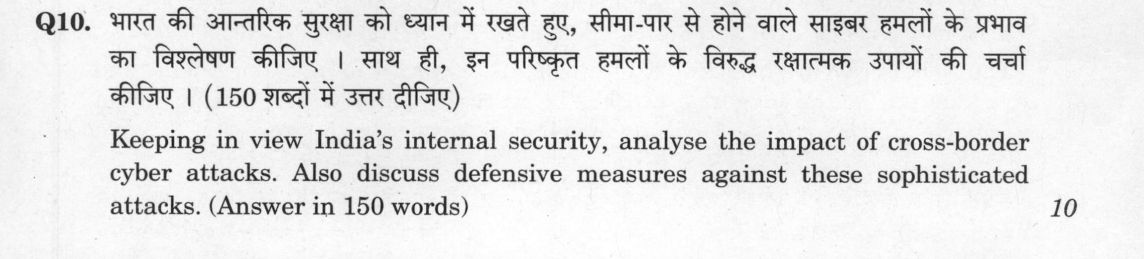
Keeping in view India's internal security, analyse the impact of cross-border cyber attacks. Also discuss defensive measures against these sophisticated attacks. (Answer in 150 words)
हिंदी में प्रश्न पढ़ें
भारत की आंतरिक सुरक्षा को ध्यान में रखते हुए, सीमा-पार से होने वाले साइबर हमलों के प्रभाव का विश्लेषण कीजिए। साथ ही, इन परिष्कृत हमलों के विरुद्ध रक्षात्मक उपायों की चर्चा कीजिए। (150 शब्दों में उत्तर दीजिए)
Model answer
Written by UPSC Answer Check against this question's marking rubric, to the 150-word length. UPSC does not publish answers for Mains — this is one way to score well, not an official key.
Cross-border cyber attacks constitute asymmetric, fifth-generation warfare targeting India’s internal security matrix across multiple interconnected domains.
Multi-Dimensional Impacts First, hostile intrusions into critical infrastructure, such as power grids (evidenced by the 2020 Mumbai blackout), nuclear facilities, and financial systems, threaten essential service delivery. Second, economic and data security are compromised through targeted ransomware attacks on corporations and intellectual property theft, severely denting business confidence. Third, strategic dimensions include state-sponsored cyber espionage, cyber-enabled terrorism, and the potential manipulation of democratic elections, undermining internal political stability.
Defensive Measures To counter these threats, India must enforce technical safeguards like air-gapping critical systems, operationalized through the National Critical Information Infrastructure Protection Centre (NCIIPC) and CERT-In under an updated National Cyber Security Strategy. Legally and doctrinally, amending the Information Technology Act and articulating a definitive cyber deterrence doctrine are vital. Internationally, India must leverage bilateral cyber pacts and the UN Group of Governmental Experts (UN GGE) to establish global norms, building an indigenous, proactive cyber-defense posture.
What "Analyse" is asking you to do
Break the subject into its working parts and show how they act on each other. The marks are in the interconnections — which factor drives which, and what the resulting structure explains — not in the inventory of factors.
Structure that answers it
Define the whole → separate it into its parts → show which part drives which → what that interaction produces → what the structure implies
Where marks are lost
A flat list of causes with no account of which drives which. An answer of neatly separated headings, each self-contained, scores as description.
How this answer will be evaluated
Approach
Framework: Security: classify threat, vulnerability, response; stay calm. analyse: intro > causes > effects > stakeholders/linkages > way forward Full marks: Precise impact analysis and specific, implementable defensive measures.
Key points expected
- Link cyber attacks to internal security threats
- Identify specific impacts (e.g., data, infrastructure)
- Discuss defensive measures (legal, institutional)
- Mention specific Indian initiatives (e.g., CERT-In)
Evaluation rubric
Each sub-part is marked on its own, against the marks and word limit printed on the paper.
- The answer Impact of cross-border cyber attacks on internal security and defensive measures. · 150 words
analyse— intro → causes → effects → stakeholders/linkages → way forward
Must cover
- Link cyber attacks to internal security threats
- Identify specific impacts (e.g., data, infrastructure)
- Discuss defensive measures (legal, institutional)
- Mention specific Indian initiatives (e.g., CERT-In)
Loses marks
- Generic 'cyber security is important' statements
- Ignoring the 'internal security' context
- Listing measures without explaining their function
Earns more
- Reference to IT Act 2000 or 2023 amendment
- Mention of specific agencies (NSG, IB, CERT-In)
- Reference to specific incidents (e.g., 2015 power grid)
- Mention of international cooperation (e.g., UN GGE)
Extra mark
- Mention of specific budget allocation for cyber security
- Reference to specific international treaty or agreement
Practice this exact question
Write your answer and it is marked point by point against the model answer above — what you covered, what you missed, what you got wrong.
Evaluate my answer →More from General Studies 2021 GS Paper III
- Q7 Describe the key points of the revised Global Air Quality Guidelines (AQGs) recently rele…
- Q8 Discuss about the vulnerability of India to earthquake related hazards. Give examples inc…
- Q9 Discuss how emerging technologies and globalisation contribute to money laundering. Elabo…
- Q10 Keeping in view India's internal security, analyse the impact of cross-border cyber attac…
- Q11 Do you agree that the Indian economy has recently experienced V-shaped recovery? Give rea…
- Q12 "Investment in infrastructure is essential for more rapid and inclusive economic growth."…
- Q13 What are the salient features of the National Food Security Act, 2013? How has the Food S…