GS Paper III — Q9
Discuss how emerging technologies and globalisation contribute to money laundering. Elaborate measures to tackle the problem of…
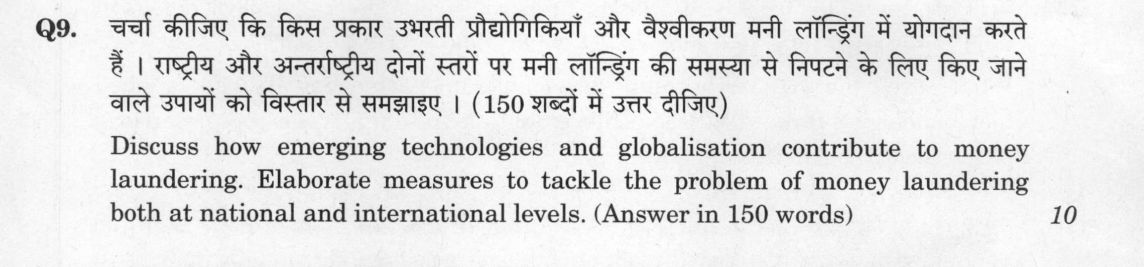
Discuss how emerging technologies and globalisation contribute to money laundering. Elaborate measures to tackle the problem of money laundering both at national and international levels. (Answer in 150 words)
हिंदी में प्रश्न पढ़ें
चर्चा कीजिए कि किस प्रकार उभरती प्रौद्योगिकियां और वैश्वीकरण मनी लॉन्ड्रिंग में योगदान करते हैं। राष्ट्रीय और अंतर्राष्ट्रीय दोनों स्तरों पर मनी लॉन्ड्रिंग की समस्या से निपटने के लिए किए जाने वाले उपायों को विस्तार से समझाइए। (150 शब्दों में उत्तर दीजिए)
Model answer
Written by UPSC Answer Check against this question's marking rubric, to the 150-word length. UPSC does not publish answers for Mains — this is one way to score well, not an official key.
Money laundering transforms illicit gains into legitimate assets. Technological and global drivers have exacerbated this: cryptocurrencies and blockchain anonymity provide opacity, dark web marketplaces enable illicit trade, and AI-driven transaction layering evades detection. Concurrently, globalisation facilitates illicit financial flows through frictionless cross-border capital mobility, offshore tax havens, shell companies, and Trade-Based Money Laundering (TBML), fueling the hawala-crypto nexus seen in high-profile economic offender cases like Nirav Modi and Vijay Mallya.
Countermeasures: National Level: India implements the Prevention of Money Laundering Act (PMLA), 2002, enforced by the Enforcement Directorate (ED), with surveillance by FIU-IND, strict KYC/AML mandates by RBI and SEBI, and proposed Digital India data safeguards. International Level: Frameworks rely on Financial Action Task Force (FATF) recommendations, the UN Convention against Corruption (UNCAC), the Egmont Group for financial intelligence sharing, and Mutual Legal Assistance Treaties (MLATs).
Way Forward: Addressing the regulatory lag against rapid technological innovation requires bridging sovereign jurisdictions through real-time global intelligence coordination and harmonized cross-border virtual asset regulation.
What "Discuss" is asking you to do
Lay the issue out from more than one side — how it arose, what is claimed for it, what is held against it, and where it now stands. UPSC attaches discuss to broad topics with several live dimensions, so coverage of the dimensions earns more than the strength of your opinion.
Structure that answers it
Set the issue up → the case as it is made → the case against → the dimension both sides leave out → where the balance now lies
Where marks are lost
Listing facts with no thread between them, or arguing one side throughout and calling it a discussion.
How this answer will be evaluated
Approach
Framework: Situation > Analysis > Measures: legal, institutional, developmental > Assessment. discuss: intro > 3-4 dimensions > example > balanced close Full marks: Precise tech examples (crypto) and specific legal measures (PMLA/FATF) clearly linked.
Key points expected
- Link crypto, digital payments, or trade-based laundering to globalisation
- Identify specific national legal or institutional measures (e.g., PMLA, FIU)
- Identify specific international measures (e.g., FATF, mutual legal assistance)
- Maintain balanced structure covering both causes and solutions
Evaluation rubric
Each sub-part is marked on its own, against the marks and word limit printed on the paper.
- The answer Explain tech/globalisation role in ML and measures at national/international levels. · 150 words
discuss— intro → 3-4 dimensions → example → balanced close
Must cover
- Link crypto, digital payments, or trade-based laundering to globalisation
- Identify specific national legal or institutional measures (e.g., PMLA, FIU)
- Identify specific international measures (e.g., FATF, mutual legal assistance)
- Maintain balanced structure covering both causes and solutions
Loses marks
- Generic 'technology is bad' statements without specific examples
- Listing laws without explaining their function in tackling ML
- Ignoring the 'globalisation' aspect of the question
Earns more
- Mention specific emerging tech like AI or blockchain
- Reference specific international bodies like Egmont Group
- Distinguish between placement, layering, and integration stages
- Mention specific national enforcement agencies
Extra mark
- Cite a specific recent FATF recommendation or case
- Mention specific national digital payment monitoring systems
Practice this exact question
Write your answer and it is marked point by point against the model answer above — what you covered, what you missed, what you got wrong.
Evaluate my answer →More from General Studies 2021 GS Paper III
- Q6 Explain the purpose of the Green Grid Initiative launched at World Leaders Summit of the…
- Q7 Describe the key points of the revised Global Air Quality Guidelines (AQGs) recently rele…
- Q8 Discuss about the vulnerability of India to earthquake related hazards. Give examples inc…
- Q9 Discuss how emerging technologies and globalisation contribute to money laundering. Elabo…
- Q10 Keeping in view India's internal security, analyse the impact of cross-border cyber attac…
- Q11 Do you agree that the Indian economy has recently experienced V-shaped recovery? Give rea…
- Q12 "Investment in infrastructure is essential for more rapid and inclusive economic growth."…