GS Paper III — Q19
Analyse the multidimensional challenges posed by external state and non-state actors, to the internal security of India. Also…
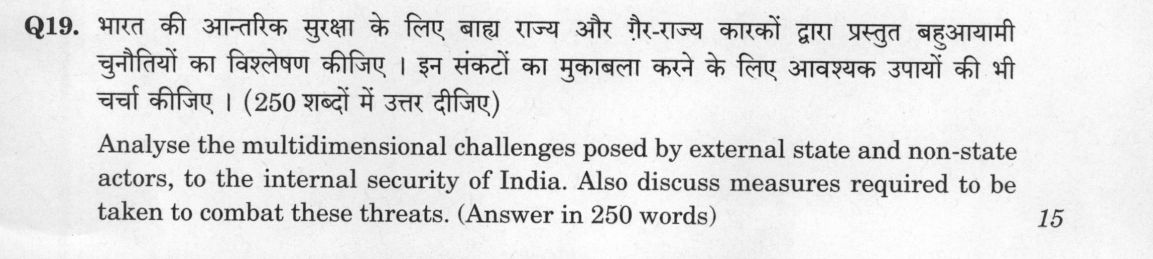
Analyse the multidimensional challenges posed by external state and non-state actors, to the internal security of India. Also discuss measures required to be taken to combat these threats. (Answer in 250 words)
हिंदी में प्रश्न पढ़ें
भारत की आंतरिक सुरक्षा के लिए बाह्य राज्य और गैर-राज्य कारकों द्वारा प्रस्तुत बहुआयामी चुनौतियों का विश्लेषण कीजिए । इन संकटों का मुकाबला करने के लिए आवश्यक उपायों की भी चर्चा कीजिए । (250 शब्दों में उत्तर दीजिए)
Model answer
Written by UPSC Answer Check against this question's marking rubric, to the 250-word length. UPSC does not publish answers for Mains — this is one way to score well, not an official key.
India’s internal security is challenged by an evolving hybrid matrix where external state actors and non-state networks operate in active convergence, blurring traditional distinctions between external defence and domestic stability.
Multidimensional Challenges
State Actors: Pakistan wages asymmetric proxy war by sponsoring cross-border terrorism, exemplified by strikes in Uri and Pulwama. Concurrently, China’s "salami-slicing" tactics and transgressions along the Line of Actual Control in Ladakh and Arunachal Pradesh force strategic dual-front diversion and complicate border management.
Non-State Actors: Outfits such as Lashkar-e-Taiba (LeT) and Jaish-e-Mohammed (JeM) execute targeted attacks, while Northeast insurgent groups exploit cross-border sanctuaries in Myanmar and Bangladesh. External logistics and illegal arms conduits also sustain Left-Wing Extremism (LWE). Emerging dimensions include weapon and drug trafficking via rogue drones and state-sponsored cyber warfare.
The Hybrid Convergence: External adversaries leverage non-state conduits to wage multidimensional warfare. This includes the terror-narcotics nexus via the Golden Crescent, infiltration of Fake Indian Currency Notes (FICN) for economic destabilisation, and weaponised social media for radicalisation and communal polarisation.
Measures Required
Border and Technological Fortification: Deploy the Comprehensive Integrated Border Management System (CIBMS) and smart fencing along sensitive frontiers, alongside strengthening the post-26/11 multi-tier coastal security grid. Critical information infrastructure must be defended through robust cyber architectures under CERT-In and NCIIPC.
Institutional and Kinetic Readiness: Strengthen the National Investigation Agency (NIA) and institutionalise reforms within the National Security Advisory Board (NSAB). Maintain a credible deterrence posture, leveraging targeted cross-border responses such as the Uri surgical strikes and Balakot air strikes when necessary.
Diplomatic and Financial Containment: Utilise multilateral forums, the Financial Action Task Force (FATF), and the UN 1267 Sanctions Committee to curb terror financing and diplomatically isolate state sponsors.
Socio-Developmental Hardening: Complement hard security with soft power through state deradicalisation programmes, intelligence fusion via NATGRID, and socioeconomic development under the Border Area Development Programme (BADP) and Vibrant Villages Programme.
A unified internal security doctrine blending kinetic deterrence, intelligence integration, and diplomatic leverage is vital to secure India's sovereign integrity against asymmetric threats.
What "Analyse" is asking you to do
Break the subject into its working parts and show how they act on each other. The marks are in the interconnections — which factor drives which, and what the resulting structure explains — not in the inventory of factors.
Structure that answers it
Define the whole → separate it into its parts → show which part drives which → what that interaction produces → what the structure implies
Where marks are lost
A flat list of causes with no account of which drives which. An answer of neatly separated headings, each self-contained, scores as description.
How this answer will be evaluated
Approach
Framework: Security: classify threat, vulnerability, response. analyse: intro > causes > effects > stakeholders/linkages > way forward Full marks: Clear distinction of actors with specific, implementable countermeasures.
Key points expected
- Distinguish state vs non-state actor challenges
- Identify specific internal security vulnerabilities
- Link measures to specific threat types
- Include legal/institutional and developmental measures
Evaluation rubric
Each sub-part is marked on its own, against the marks and word limit printed on the paper.
- The answer Categorize state/non-state threats and map specific countermeasures. · 250 words
analyse— intro → causes → effects → stakeholders/linkages → way forward
Must cover
- Distinguish state vs non-state actor challenges
- Identify specific internal security vulnerabilities
- Link measures to specific threat types
- Include legal/institutional and developmental measures
Loses marks
- Generic 'improve security' without specifics
- Ignoring non-state actors (terror/crime)
- Dramatic or emotional security writing
Earns more
- Mention specific border/insurgency examples
- Reference specific laws (e.g., UAPA, NSA)
- Discuss intelligence sharing mechanisms
- Mention soft power/diplomatic measures
Extra mark
- Cite specific committee (e.g., Kargil Review)
- Mention specific scheme (e.g., PM-KISAN for rural security)
Practice this exact question
Write your answer and it is marked point by point against the model answer above — what you covered, what you missed, what you got wrong.
Evaluate my answer →More from General Studies 2021 GS Paper III
- Q16 The Nobel Prize in Physics of 2014 was jointly awarded to Akasaki, Amano and Nakamura for…
- Q17 Describe the major outcomes of the 26th session of the Conference of the Parties (COP) to…
- Q18 Describe the various causes and the effects of landslides. Mention the important componen…
- Q19 Analyse the multidimensional challenges posed by external state and non-state actors, to…
- Q20 Analyse the complexity and intensity of terrorism, its causes, linkages and obnoxious nex…